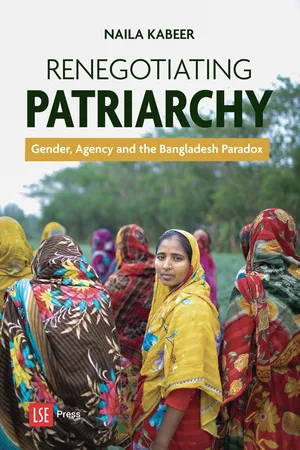
The idea of the 'Bangladesh paradox' describes the unexpected social progress that Bangladesh has made in recent decades that has been both pro-poor and gender equitable. This began at a time when the country was characterised by extreme levels of poverty, poor quality governance, an oppressive patriarchy and rising Islamic orthodoxy.
This 'paradox' has evoked a great deal of interest within the international development community because Bangladesh had been dubbed an 'international basket case' at the time of its independence in 1971, seemingly trapped in a development impasse. Previous attempts to explain this paradox have generally taken a top-down approach, focusing on the role of leading institutional actors - donors, government, NGOs and the private sector. In Renegotiating Patriarchy: Gender, Agency and the Bangladesh Paradox, Naila Kabeer starts with the rationale that policy actions taken at the top are unlikely to materialise into actual changes if they are not acted on by the mass of ordinary women and men. But what led these women and men to act? And why did they act in ways that modified some of the more oppressive aspects of patriarchy in the country? That is what this book sets out to investigate.
It describes the history of the Bengal delta, and the forces that gave rise to the kind of society that Bangladesh was at the time of its independence. It considers the policy and politics that characterised post-independence Bangladesh and how these contributed to the progress captured in the idea of the Bangladesh paradox.
But the key argument of the book is that much of this progress reflected the agency exercised by ordinary, often very poor, women in the course of their everyday lives. Their agency helped to translate institutional actions into concrete changes on the ground. To explore why and how this happened, the book draws on a rich body of ethnographic, qualitative and quantitative research on social change in Bangladesh - including studies by the author herself. The book is therefore about how norms and practices can change in progressive ways despite unpropitious circumstances as a result of the efforts of poor women in Bangladesh to renegotiate what had been described as one of the most non-negotiable patriarchies in the world.