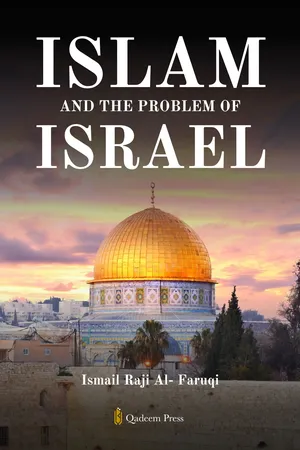
A Comprehensive Examination of the Israel-Palestine Question from Islamic Historical and Theological Perspectives
Islam and the Problem of Israel stands as one of the most thorough scholarly analyses of the Israel-Palestine question from an Islamic viewpoint. Written by Dr. Ismail Raji al-Faruqi (1921–1986), a Palestinian-American philosopher who served as Professor of Islamic Studies and History of Religions at Temple University, this work combines rigorous historical research with sophisticated theological reasoning to examine one of the twentieth century's most contested geopolitical issues.
Historical Foundations
The work begins by establishing the historical context necessary for understanding the contemporary situation. Al-Faruqi traces the fourteen-century relationship between the Muslim World and Western Christendom, from the rise of the Islamic state in Madinah in 622 CE through the Crusades, Ottoman Empire, and modern colonial period. This long historical view demonstrates how the Israel question emerged not as an isolated incident but as the culmination of centuries of complex interactions between civilizations.
Al-Faruqi provides detailed documentation of Jewish experience under Christendom, from medieval persecution through the Enlightenment's promise of emancipation. He examines the legal restrictions, social ostracism, and periodic violence that characterized Jewish life in Christian Europe, while also analyzing moments of relative tolerance and Jewish contributions to European intellectual and economic life. This historical analysis avoids both romanticization and demonization, instead presenting a nuanced picture based on careful examination of primary sources.
The Rise of Political Zionism
A substantial portion of the work examines the emergence of political Zionism in nineteenth-century Europe. Al-Faruqi situates Zionism within the broader context of European Romantic nationalism, showing how Theodor Herzl and other founders adapted European nationalist ideology to Jewish concerns following the Dreyfus Affair and Russian pogroms. The author argues that Zionism represented both a response to genuine persecution and an adoption of the same ethnocentric categories that had motivated that persecution.
This analysis demonstrates how Zionism diverged from traditional Jewish religious thought, substituting nationalist categories for theological ones and redefining Judaism in political rather than spiritual terms. Al-Faruqi distinguishes between what he calls "universalist" and "ethnocentric" strands within Jewish scripture and tradition, arguing that political Zionism elevated ethnocentric interpretations while downplaying universalist ones.
British Colonial Administration in Palestine
The book provides extensive documentation of the British Mandate period in Palestine (1918–1948), examining how British colonial policy deliberately facilitated Zionist settlement while restricting Palestinian development. Al-Faruqi details the mechanisms of land acquisition, immigration policies, administrative structures, and military force used to transform Palestine's demographic and political character. This section draws on both official British documents and Palestinian testimony to present a comprehensive picture of colonial administration.
The author examines the Balfour Declaration, the circumstances of its issuance, and its implementation through British Mandate policies. He analyzes how British commitments to Arab independence, made through correspondence with Sharif Husayn of Makkah, conflicted with simultaneous commitments to Zionism, and how this duplicity shaped the subsequent conflict.
Islamic Legal and Constitutional Principles
Central to al-Faruqi's analysis is his presentation of Islamic constitutional principles regarding religious pluralism and minority rights. He provides detailed examination of the Covenant of Madinah, established by Prophet Muhammad in 622 CE, which guaranteed religious freedom and legal autonomy to Jewish and other non-Muslim communities within the Islamic state. This document, al-Faruqi argues, established principles that governed Muslim-Jewish relations throughout Islamic history.
The work explores the dhimmi system, under which Jewish and Christian communities maintained autonomous religious and legal institutions while participating in the broader Islamic polity. Al-Faruqi documents how this system, while not meeting modern standards of equality, provided Jewish communities with protection, prosperity, and intellectual freedom unprecedented in their history. He examines specific Islamic legal rulings on topics including worship, education, property rights, and interfaith marriage.
The Golden Age of Jewish Scholarship
The book dedicates substantial attention to documenting the flourishing of Jewish learning, philosophy, and Hebrew linguistics under Islamic civilization. Al-Faruqi traces how Jewish scholars in Islamic Spain, North Africa, Egypt, and Iraq produced some of Judaism's most influential works, including Maimonides' philosophical synthesis and the development of Hebrew grammar modeled on Arabic linguistic science.
This section serves multiple purposes in al-Faruqi's argument. First, it demonstrates the historical possibility of Muslim-Jewish coexistence and mutual cultural enrichment. Second, it shows how Islamic civilization's emphasis on learning and rational discourse created conditions favorable to Jewish intellectual development. Third, it establishes a historical precedent for the Islamic solution al-Faruqi proposes.
Critique of Zionism
Al-Faruqi's critique of Zionism operates on multiple levels. Politically, he condemns the injustices involved in establishing and maintaining the Zionist state: displacement of Palestinians, confiscation of property, denial of civil rights, and military aggression. Historically, he argues that Zionism failed to solve the problem it claimed to address, neither providing security to world Jewry nor enabling authentic Jewish religious life to flourish.
Theologically, al-Faruqi argues that Zionism represents a deviation from Jewish tradition by substituting political nationalism for spiritual values and elevating ethnic identity above moral law. He contends that Zionism's adoption of European Romantic nationalism alienated it from the Semitic religious tradition shared by Judaism and Islam. This critique extends to secular Israeli culture, which al-Faruqi sees as thoroughly Western rather than authentically Jewish.
The Islamic Solution
The final chapters present al-Faruqi's proposal for resolving the conflict through application of Islamic constitutional principles. He argues for dismantling the Zionist state while guaranteeing Jewish residents full citizenship rights within a reconstituted Islamic state. This Islamic state, al-Faruqi contends, would provide Jews with security, religious freedom, and legal autonomy superior to anything available in a secular nationalist framework.
Al-Faruqi's vision involves Jewish communities maintaining autonomous religious courts, educational systems, and cultural institutions under the protection of Islamic law. He argues this arrangement would enable authentic Jewish religious life to flourish while eliminating the security threats and moral compromises inherent in Zionism. This proposal reflects traditional Islamic constitutional arrangements that historically governed relations with religious minorities.
Scholarly Methodology
Throughout the work, al-Faruqi demonstrates command of multiple scholarly traditions. He engages with Western historical scholarship, Jewish theological and philosophical writings, Islamic jurisprudence, and political theory. His analysis draws on sources in English, Arabic, and Hebrew, and he demonstrates familiarity with both classical texts and contemporary scholarship.
The author's methodology combines historical analysis, textual interpretation, legal reasoning, and normative theological argument. He moves between descriptive history and prescriptive proposals, between analysis of what occurred and arguments about what should occur. This methodology reflects both his philosophical training (Ph.D. from Indiana University) and his Islamic legal education (Al-Azhar University, Cairo).
Context and Reception
Originally published in 1980 by the Islamic Council of Europe in London, this work appeared during a period when academic discussion of Palestine remained relatively open. The book represents an important moment in Islamic intellectual history, documenting how a leading Muslim scholar engaged with Western thought while maintaining Islamic principles. Al-Faruqi's work influenced subsequent generations of Muslim scholars and activists addressing the Palestine question.
The author's tragic death in 1986, when he and his wife Dr. Lois Lamya al-Faruqi were murdered in their home, cut short a brilliant academic career. His scholarly legacy continues through the institutions he founded, including the International Institute of Islamic Thought and the Association of Muslim Social Scientists, and through works like this that continue to shape Muslim intellectual engagement with contemporary issues.
Contemporary Relevance
While written over four decades ago, this work remains relevant for understanding Muslim perspectives on the Palestine question. The historical analysis provides context often missing from contemporary discussions. The presentation of Islamic legal principles offers insight into how traditional Muslim scholars approach questions of religious pluralism and political sovereignty. The critique of Zionism articulates positions widely held in the Muslim world but rarely encountered in Western academic discourse.
For students, scholars, and general readers seeking to understand Muslim viewpoints on this contested issue, al-Faruqi's work provides an essential resource. It demonstrates how a sophisticated Muslim intellectual, deeply educated in both Islamic and Western traditions, approached a question that continues to define Middle Eastern politics and global Muslim consciousness.
Complete and unabridged. Originally published 1980 by Islamic Council of Europe, London. Republished 2003 by The Other Press, Kuala Lumpur.