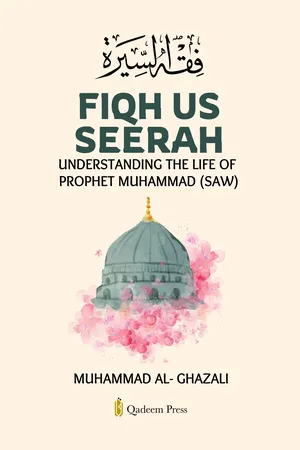
Muhammad Al-Ghazali’s Fiqh Us Seerah represents a distinctive contribution to the genre of prophetic biography, one that transcends conventional chronological narrative to examine the life of Prophet Muhammad ﷺ through the interpretive lens of Islamic jurisprudence. The work’s title—combining “fiqh” (jurisprudential understanding) with “sīrah” (biography)—signals its methodological innovation: rather than presenting the Prophet’s life as mere historical information or devotional literature, Al-Ghazali demonstrates how each phase of the prophetic mission established principles that continue governing Islamic law, ethics, and social organization.
The author begins with a critical examination of prevailing approaches to sīrah literature, which he argues have often reduced the Prophet’s biography to entertainment, sentimentalism, or ritualistic commemoration divorced from practical application. Al-Ghazali contends that Muslims have developed dysfunctional relationships with prophetic history, either treating it as legend lacking contemporary relevance or expressing devotion through empty formalism rather than behavioral transformation. Against these tendencies, he proposes recovering the sīrah as a comprehensive framework for Islamic life, one that addresses not only ritual worship but also social relations, political organization, economic ethics, and personal character development.
Al-Ghazali’s methodological approach synthesizes several scholarly traditions. From classical Arabic historiography, he draws extensive engagement with primary sources—authenticated hadith collections, early biographical works, and Qur’anic commentaries that preserve contextual revelation data. From modern historical scholarship, he adopts analytical techniques that identify patterns, establish causal relationships, and construct coherent narratives from fragmentary evidence. This synthesis allows him to present prophetic history with both scholarly rigor and thematic coherence, avoiding the disconnected anecdotal style characteristic of many traditional sīrah compilations.
The work’s structure follows the chronological unfolding of the prophetic mission while organizing material thematically within each phase.
Early Context and Pre-Prophetic Life
The first chapter establishes the historical and theological context, examining the state of pre-Islamic civilizations and demonstrating humanity’s universal need for divine guidance. Al-Ghazali surveys religious and moral conditions across the ancient world, showing how both polytheistic paganism and corrupted monotheistic traditions had deviated from pure worship of God. This analysis situates the prophetic mission as a global response to humanity’s spiritual crisis.
The second chapter addresses the Prophet’s birth, lineage, childhood, and preparation for prophethood, showing how his character development and early life experiences equipped him for revelation. Al-Ghazali discusses accounts of miraculous signs while maintaining scholarly caution about weak narrations. His treatment balances the Prophet’s human development with acknowledgement of divine providence.
Makkan Period
The third chapter analyzes the Makkan phase, examining the first revelation, recruitment of early believers, the shift from secret to public preaching, and the persecution Muslims endured. Al-Ghazali highlights foundational principles established during this period:
-
belief in tawḥīd
-
accountability in the afterlife
-
moral transformation
-
social solidarity among believers
He identifies several causes of Makkan resistance: tribal pride, economic interests, and hierarchies threatened by Islamic egalitarianism.
Migration and Madinan Community
The fourth chapter explains the Hijrah, analyzing the pledges of ʿAqabah, strategic migration decisions, and the dangers encountered. Migration transformed Islam from a persecuted minority into an established community.
The fifth chapter examines the formation of the Madinan society, including:
-
the Constitution of Madinah
-
brotherhood between Muhājirūn and Anṣār
-
construction of the Prophet’s mosque
-
organization of social, economic, and worship systems
Al-Ghazali shows how the Prophet established a society rooted in consultation (shūrā), mutual responsibility, and justice.
Military Engagements and Ethical Framework
The sixth chapter covers the defensive campaigns—Badr, Uḥud, Khandaq—offering military analysis alongside the ethical-legal framework of warfare:
-
proportionality
-
humane treatment of prisoners
-
protection of non-combatants
-
exhausting peaceful options before conflict
His analysis challenges both the claim that Islam spread by force and pacifist readings that ignore legitimate defense.
Expansion, Governance, and Social Ethics
The seventh chapter explores developments after Hudaybiyah, when Islam spread rapidly through peaceful means. Al-Ghazali discusses:
-
the conquest of Makkah
-
the Prophet’s clemency toward former enemies
-
integration of newcomers
-
precedents for Islamic governance
The eighth chapter examines the Prophet’s marriages, addressing their legal, social, and historical dimensions. Al-Ghazali contextualizes polygamy, clarifies misconceptions, and highlights the role of the Mothers of the Believers in preserving knowledge.
Final Illness, Passing, and Legacy
The final chapter recounts the Prophet’s illness and death, analyzing his final teachings and the community’s response. Al-Ghazali emphasizes the Prophet’s human mortality while showing how his legacy continues through the Qur’an and Sunnah.
Distinct Scholarly Commitments
Throughout the work, Al-Ghazali maintains:
-
rigorous hadith authentication
-
critical evaluation of weak or fabricated reports
-
contextualization of Qur’anic revelation
-
consistent linkage between prophetic history and contemporary Muslim life
He challenges readers to examine how they embody prophetic teachings in personal behavior and communal structures.
Epilogue and Reformist Vision
In the epilogue, Al-Ghazali argues that the Muslim world’s weakness stems from distance from prophetic teachings, and that revival requires returning to the Qur’an and Sunnah with genuine commitment. His conclusion presents prophetic biography as a practical blueprint for addressing modern challenges.
Fiqh Us Seerah thus represents more than a historical narrative; it offers a comprehensive vision of Islamic life rooted in the Prophet’s example, calling Muslims to serious engagement with foundational sources and transformation of individual and collective life according to prophetic principles.