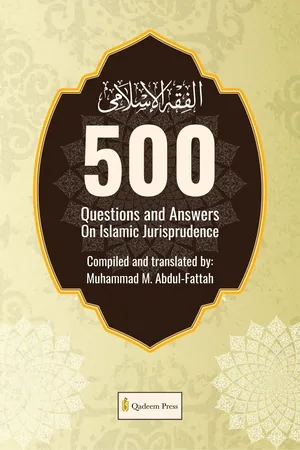
A Comprehensive Guide to Islamic Legal Practice for the English-Speaking Muslim
500 Questions and Answers on Islamic Jurisprudence stands as an essential reference work for English-speaking Muslims seeking authoritative guidance on the practical dimensions of Islamic law. This systematic compilation addresses over 500 authentic questions spanning the complete spectrum of fiqh (Islamic jurisprudence), from foundational rituals of purification to intricate calculations of inheritance. Drawing upon the Qurʾān, authentic Sunnah, and the juristic methodologies of the four major Sunni schools, this work provides reliable guidance for navigating Muslim life in the contemporary world.
Bridging Classical Scholarship and Contemporary Practice
Islamic jurisprudence represents fourteen centuries of sophisticated legal development, yet accessing this rich tradition has remained challenging for English-speaking Muslims. Classical texts, written in Arabic and assuming familiarity with Islamic legal culture, often prove impenetrable to modern readers. Conversely, simplified popular works frequently lack the scholarly rigor necessary for reliable legal guidance. This volume bridges that gap, rendering classical jurisprudence accessible while maintaining scholarly precision and textual authenticity.
The compiler, Muḥammad M. Abdul-Fattah, synthesizes the interpretations of Imām Mālik, Imām Abū Ḥanīfah, Imām Ash-Shāfiʿī, and Imām Aḥmad Ibn Ḥanbal—the foundational scholars whose methodologies have shaped Sunni legal tradition. Rather than advocating a single school, the work presents comparative perspectives, demonstrating how legitimate scholars have reached different conclusions on specific questions. This approach equips readers with understanding of Islamic legal diversity while providing practical guidance for daily life.
Systematic Coverage of Islamic Law
The work progresses systematically through sixteen major domains of Islamic jurisprudence. It begins with Purification (Ṭahārah), addressing questions about ablution, ritual bathing, tayammum (dry ablution), and the removal of physical and ritual impurities. This foundational section establishes principles that undergird subsequent discussions of worship.
Prayer (Ṣalāh) receives extensive treatment, covering obligatory daily prayers, Friday congregational prayer, conditions for validity, invalidators, and permissible variations. Questions address both routine matters (how to perform ablution correctly) and exceptional circumstances (praying during air travel, combining prayers when traveling, abbreviated prayer formats).
The Obligatory Alms (Zakāh) section provides detailed guidance on calculating zakāh for different types of wealth, contemporary applications to stocks and shares, business assets, and modern financial instruments. This addresses critical questions for Muslims navigating 21st-century economies while fulfilling religious obligations rooted in 7th-century revelation.
Fasting (Ṣiyām) clarifies Ramaḍān obligations, exemptions for travelers and the ill, invalidators of fasting, and voluntary fasting practices. The Pilgrimage (Ḥajj and ʿUmrah) sections detail sacred rites, prohibitions during the state of iḥrām, compensations for violations, and differences between the major and minor pilgrimages.
Marriage receives comprehensive treatment, addressing contract requirements, prohibited marriages, rights and obligations of spouses, and contemporary marriage forms. The related Divorce (Ṭalāq) section covers dissolution procedures, waiting periods (ʿiddah), custody questions, and post-divorce financial obligations.
Additional sections address Oaths and Vows (with expiation requirements), Food and Drinks (permitted and prohibited consumption), Clothing and Adornment (Islamic dress codes), Crimes and Legal Punishments (ḥudūd penalties and discretionary punishments), Jurisdiction (judicial procedures), Financial Transactions (contracts, trade, usury, partnership), and Inheritance (estate division according to Islamic law).
Contemporary Relevance and Modern Applications
A distinguishing feature of this work is its attention to contemporary questions rarely addressed in classical texts. Muslims today face situations unknown to previous generations: How should one perform ablution when wearing modern footwear? Does air travel affect prayer obligations? How is zakāh calculated on stocks, mutual funds, and retirement accounts? What are the Islamic ethics of brokerage and commissions? Can one hunt with rifles rather than traditional methods? How should modern business structures like corporations be evaluated under Islamic partnership law?
The compiler addresses these questions by extending classical jurisprudential principles to contemporary circumstances. This demonstrates the living nature of Islamic law—not as a rigid, unchanging system but as a dynamic tradition capable of addressing new realities while remaining rooted in revealed sources and established methodologies.
Pedagogical Features and Learning Resources
The question-and-answer format serves multiple functions. For readers requiring immediate guidance on specific issues, it enables rapid consultation: the table of contents and systematic organization allow quick location of relevant questions. For those pursuing systematic study, the format facilitates progressive learning, with foundational questions establishing principles applied in subsequent, more complex inquiries.
The work includes a comprehensive Glossary defining over 200 Arabic legal terms. Rather than offering minimal translations, each entry provides substantive definitions situating terms within Islamic legal discourse. This enables readers to develop literacy in Islamic legal vocabulary, essential for consulting other scholarly sources.
A Transliteration Table presents the scientific system used throughout the text, ensuring consistent and accurate rendering of Arabic terms. This benefits readers learning Arabic, enables proper pronunciation, and maintains scholarly standards for transliteration.
Source citations reference specific Qurʾānic verses and authenticated ḥadīth, allowing independent verification. This transparency distinguishes scholarly work from popular writing, enabling readers to trace legal rulings back to primary sources.
Audience and Applications
This work serves diverse audiences with varied needs. Students pursuing Islamic studies, Middle Eastern studies, or comparative religious law will find it an invaluable textbook and reference. Mosque imams preparing Friday sermons or responding to community questions will appreciate the systematic organization and source citations. Converts to Islam require systematic understanding of religious practice; this volume provides comprehensive guidance covering all areas of Muslim life.
Practicing Muslims encounter daily questions about ritual purity, prayer timing, financial obligations, and ethical conduct; this work offers authoritative answers rooted in classical scholarship. Islamic school educators developing curriculum will find both content for instruction and a model for presenting Islamic law accessibly. Academic researchers in Islamic law, comparative jurisprudence, or religious studies will value the comparative methodology and source documentation.
A Living Tradition for Contemporary Muslims
500 Questions and Answers on Islamic Jurisprudence demonstrates that Islamic law remains vitally relevant to contemporary Muslim life. Rather than presenting the Sharīʿah as an ancient, foreign legal system, this work shows how Islamic jurisprudence addresses universal human concerns—worship, family, property, crime, inheritance—through principles derived from divine revelation and prophetic guidance.
For English-speaking Muslims worldwide, this volume represents more than a reference work; it is a bridge to fourteen centuries of Islamic legal scholarship, rendered accessible while maintaining authenticity. Whether consulted during moments of uncertainty or studied systematically to deepen understanding of the Sharīʿah, this work serves as an essential companion for Muslims seeking to live faith with knowledge, conviction, and practical guidance.
Published by Qadeem Press, this volume contributes to the critical project of making authoritative Islamic scholarship available to global English-speaking Muslim communities, ensuring that future generations can access their legal heritage in the language of contemporary discourse.