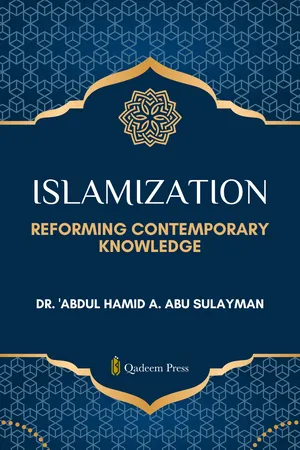
Islamization: Reforming Contemporary Knowledge represents a watershed contribution to contemporary Islamic thought, offering both a penetrating diagnosis of the Muslim world's intellectual malaise and a comprehensive prescription for its remedy. Dr. ʿAbdul Ḥamīd Aḥmad Abū Sulaymān, a pioneering figure in the Islamization of knowledge movement, addresses fundamental questions that have troubled Muslim intellectuals for generations: Why has the Ummah declined from its position of civilizational leadership? Why do Muslims struggle to respond effectively to modernity's challenges? What prevents Islamic thought from producing creative solutions to contemporary problems?
The author's central thesis is both bold and compelling: the root cause of Muslim decline lies not in material deficiency but in a fundamental crisis in the conception and methodology of knowledge itself. While the Ummah possesses abundant natural resources, human potential, historical depth, and divinely revealed values, it suffers from an intellectual paralysis that prevents these assets from being mobilized effectively. This paralysis manifests in multiple symptoms: pervasive backwardness, intellectual stagnation, absence of ijtihād, cultural ossification, and estrangement from the foundational norms that once animated Islamic civilization.
The Historical Roots of Crisis
Abu Sulayman traces this crisis to a critical turning point in early Islamic history—the split between political and intellectual leadership that emerged after the period of al-Khulafāʾ al-Rāshidūn (the Rightly Guided Caliphs). During the Prophet Muhammad's lifetime and the era of his immediate successors, Islamic society achieved a remarkable synthesis: political authority and intellectual leadership were unified in individuals who combined deep knowledge of revelation with practical wisdom, systematic reason, and commitment to justice. This integration enabled the early Muslim community to build an exemplary civilization that balanced spiritual devotion with worldly competence.
However, as tribal elements infiltrated positions of authority and established dynasties based on hereditary succession rather than merit and religious commitment, a destructive bifurcation occurred. Political rulers adopted increasingly oppressive measures to maintain power, while religious scholars—marginalized, imprisoned, and tortured when they resisted injustice—retreated into abstraction. Figures like Imām Abū Ḥanīfah died in prison refusing judicial appointments under unjust rulers. Imām Mālik ibn Anas suffered physical torture for issuing fatwās contrary to political interests. Imām al-Shāfiʿī was forced into exile.
This schism had devastating long-term consequences. Religious scholarship became increasingly theoretical and disconnected from practical realities, while political leadership abandoned accountability to Islamic values. The vigorous ijtihād that characterized early Islam—the creative application of revelation and reason to address emerging challenges—gradually gave way to rigid imitation (taqlīd) and intellectual timidity. Scholars, fearful of deviation and lacking practical engagement with governance, sealed the gates of ijtihād in a misguided attempt to protect Islamic teachings. Meanwhile, abstract philosophical speculation—often imported from non-Islamic sources—flourished in elite circles without genuine commitment to Islam's practical objectives.
The Contemporary Manifestation
The modern crisis represents an intensification of these historical problems, compounded by new challenges. The Muslim world faces not only its inherited intellectual deficiencies but also the overwhelming impact of Western colonialism and the uncritical importation of secular knowledge systems. Two unsuccessful responses have dominated: attempting to revive traditional approaches unchanged, or blindly imitating Western models. Both strategies have failed disastrously, as evidenced by the troubled trajectories of countries like Turkey and Egypt.
Abu Sulayman identifies a debilitating dualism in contemporary Muslim societies: on one hand, a so-called "Islamic knowledge" limited to legalistic studies increasingly irrelevant to modern life; on the other, imported secular knowledge dominating universities and institutions, producing graduates alienated from Islamic values and unable to address the Ummah's authentic needs. This bifurcation perpetuates the leadership split and ensures the continued marginalization of Islam from the main currents of intellectual and practical life.
The Three-Fold Reform Agenda
The author's prescription centers on three interconnected reforms that must occur simultaneously:
First, Muslims must rectify the relationship between divine revelation and reason. The false dichotomy that either elevates reason above revelation (rationalist excess) or suppresses reason in favor of textual literalism (reactionary rigidity) must be transcended. Abu Sulayman articulates a sophisticated position: revelation provides the ultimate objectives and moral framework for human existence, while reason serves as the indispensable instrument for understanding revelation, addressing particular circumstances, and applying eternal principles to changing realities. Neither can function properly without the other.
Second, the scope of knowledge must be redefined. Abu Sulayman challenges the widespread assumption that traditional fuqahāʾ (jurists) alone can provide solutions to contemporary problems through ijtihād. While this was once valid—when a scholar could master law, medicine, mathematics, commerce, and philosophy—modern knowledge has become far too specialized and complex. Contemporary challenges in economics, politics, international relations, technology, and other fields require specialists who combine deep expertise in their disciplines with thorough grounding in Qurʾānic and Prophetic teachings. Islamic intellectual renewal demands interdisciplinary teams of committed Muslim specialists capable of producing Islamic legislative frameworks, policy solutions, and theoretical innovations.
Third, an integrated Islamic educational infrastructure must replace the current dualistic system. Universities should not be divided into “Islamic” institutions teaching only traditional religious sciences and “secular” institutions teaching modern disciplines devoid of Islamic perspective. Instead, every field of study must be taught within a framework incorporating Islamic values and ethical principles. This requires fundamental curriculum reform and the development of Islamic perspectives on all branches of knowledge.
Political Science as Paradigmatic Case
The work's extended treatment of political science demonstrates the Islamization process concretely. Abu Sulayman exposes the deficiencies of existing Islamic political studies: romanticized narratives, apologetic distortions, uncritical adoption of Western terminology, and failure to articulate Islamic alternatives for modern political realities.
His analysis of the khilāfah system is especially instructive. Abu Sulayman highlights the core principles that underpinned its success—unified leadership, meaningful shūrā, justice, accountability, and communal welfare—and argues for their revival in contemporary forms rather than mechanical replication of medieval structures.
Similarly, concepts like democracy and sovereignty reveal how uncritical borrowing creates conceptual confusion. Democracy’s philosophical foundations differ fundamentally from shūrā, while sovereignty imposes foreign dichotomies onto Islamic governance, obscuring its multi-layered legislative structure.
A Blueprint for Intellectual Renewal
Throughout the work, Abu Sulayman writes with scholarly precision and passionate commitment to Islamic revival. He avoids both defensive apologetics and rigid traditionalism. His outlook is confident yet self-critical—rooted in Islam’s strengths while fully acknowledging the Ummah’s present deficiencies.
The conclusion offers a call to action for research centers, Islamic universities, and scholarly organizations: the Islamization of knowledge requires institutional commitment, systematic research, interdisciplinary collaboration, and training new generations of scholars capable of applying Islamic principles to contemporary challenges.
Enduring Relevance
Originally published in the American Journal of Islamic Social Sciences and issued in the International Institute of Islamic Thought’s Occasional Papers series, this landmark work has shaped Islamic intellectual discourse for decades. Its diagnosis remains accurate, its prescriptions remain compelling, and its call for systematic reform remains urgent. For scholars, educators, and all who seek to understand the philosophical foundations of contemporary Islamic reform, this volume is essential reading—a foundational text illuminating the way forward for authentic Islamic intellectual renewal in the modern world.