A Masterwork of Islamic Historical Biography: Three Luminaries Who Transformed Medieval Islam
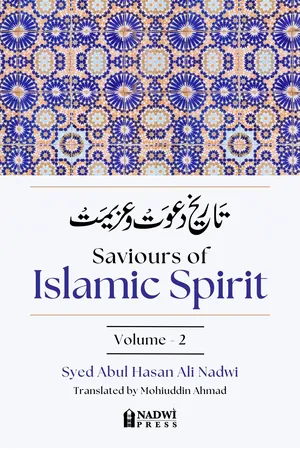
Saviours of Islamic Spirit, Volume II is a monumental contribution to Islamic historical scholarship, presenting the intertwined lives and legacies of three towering figures whose leadership in the eighth century after Hijrah (fourteenth century CE) profoundly shaped Islamic intellectual, spiritual, and social development. Written by Maulana Abul Hasan Ali Nadwi—one of the twentieth century’s most accomplished Islamic historians—and translated with precision by Mohiuddin Ahmad, this volume brings to English readers the rich biographical and intellectual heritage of a pivotal era.
HISTORICAL CONTEXT: ISLAM IN CRISIS
The eighth century Hijrah was marked by unprecedented upheaval. Mongol invasions had devastated the Islamic heartlands, culminating in the destruction of Baghdad and the collapse of the Abbasid Caliphate. Crusader campaigns persisted, political fragmentation eroded centralized authority, and internal stagnation threatened the vitality of Islamic thought: rigid imitation (taqlid) replaced dynamic reasoning (ijtihad), Greek philosophical systems overshadowed Qur’anic epistemology, speculative mysticism drifted into excess, and saint-veneration endangered the purity of monotheism.
Amid this turbulence emerged three extraordinary leaders—each addressing the crisis from a distinct angle, yet united in the mission to restore Islam’s spiritual and intellectual integrity.
SHEIKH-UL-ISLAM IBN TAIMIYAH: THE INTELLECTUAL REVOLUTIONARY
Ahmad ibn Taimiyah (661–728 AH) personified intellectual courage and encyclopedic scholarship. Born during the Mongol onslaught against his homeland, he fled with his family to Damascus, carrying their precious library—symbolic of his enduring devotion to Islamic knowledge.
Nadwi outlines Ibn Taimiyah’s unparalleled mastery of Qur’anic exegesis, Hadith sciences, jurisprudence, theology, and Arabic linguistics. His intellectual fearlessness enabled him to confront the dominant philosophical frameworks of his age. He challenged Aristotelian logic, Greek metaphysics, theological dialectics (kalam), and pantheistic mysticism, arguing that Islamic theology draws its strength from revelation rather than foreign philosophical constructs.
His Ar-Radd ‘ala al-Mantiqiyyin (Refutation of the Logicians) dismantled claims of Aristotelian logic; his Al-Jawab al-Sahih (The Correct Response) offered a sweeping critique of Christian theology. By reopening the gates of ijtihad and grounding scholarship in Qur’anic reasoning, he revived discourse on Tawhid and reshaped Islamic intellectual history.
Despite imprisonment and fierce opposition, Ibn Taimiyah’s influence endures across centuries—his writings continuing to shape theological and legal debates today.
SULTAN-UL-AULIA KHWAJA NIZAM UD-DIN AULIA: SPIRITUAL COMPASSION IN DELHI
Where Ibn Taimiyah battled intellectual decay, Khwaja Nizam ud-din Aulia (634–725 AH) nourished the spiritual heart of Islam. A central figure of the Chishtiyah Order in Delhi, his gentle presence drew scholars, rulers, and common people alike.
Nadwi immerses readers in the Khwaja’s khanqah, where generosity, compassion, and spiritual warmth defined community life. Despite rigorous devotional practices—fasting, night vigils, and constant remembrance—Nizam ud-din remained exceptionally accessible. His legendary hospitality reflected complete trust in Divine provision: whatever arrived in his lodge was distributed the same day.
His weeping during Qur’anic recitation, tender guidance of disciples, and refusal of royal patronage illustrate a spirituality grounded in humility and Divine intimacy. His famous declaration—“The king may have his realm, but I have my God”—captures the essence of Chishtiyah ethos.
Nadwi emphasizes that Nizam ud-din’s mysticism remained firmly rooted in the Shariah, countering the misconception that Sufism inherently conflicts with Islamic law.
MAKHDUM SHARAF UD-DIN YAHYA MANERI: THE MYSTICAL PHILOSOPHER OF BIHAR
The triad concludes with Sheikh Sharaf ud-din Yahya Maneri (709–782 AH), master of the Firdausiyah Order in Bihar and author of profound Persian letters exploring the upper realms of Islamic spirituality.
From his retreat in Maner, Maneri articulated key metaphysical concepts—fana (annihilation), baqa (subsistence), tajalli (Divine manifestation), and ma‘rifah (gnosis). His writings probe human dignity, Divine unity, stages of spiritual ascent, purification of the heart, and the interplay between intellect and mystical insight.
Nadwi highlights translator Mohiuddin Ahmad’s skill in rendering these intricate teachings into lucid English without diminishing their depth. Maneri’s synthesis of Ibn Arabi–influenced metaphysics with practical spiritual guidance enriches Islamic intellectual heritage with a balance between contemplative insight and disciplined scholarship.
SCHOLARLY VALUE AND HISTORIOGRAPHY
Nadwi’s method combines rigorous sourcing with engaging narrative. He evaluates variant accounts, situates personalities within their intellectual climates, and draws extensively on Arabic, Persian, and Urdu primary materials. Footnotes, bibliographies, and cross-references enhance the scholarly value of the volume.
CONTEMPORARY RELEVANCE
This volume addresses enduring questions of religious life:
– How do traditions renew themselves?
– How should reason and revelation interact?
– What separates genuine spirituality from superstition?
– How can intellectual integrity coexist with mystical depth?
By presenting three complementary modes of Islamic leadership—intellectual, devotional, and mystical—Nadwi offers a multidimensional model of religious renewal.
CONCLUSION
Saviours of Islamic Spirit, Volume II is more than biography. It is a sweeping intellectual narrative, a window into medieval Islamic civilization, and a guide for modern readers seeking to understand Islam’s recurring cycles of crisis and renewal. Nadwi’s masterwork—expertly translated by Mohiuddin Ahmad—stands as essential reading for students, scholars, and general readers alike.