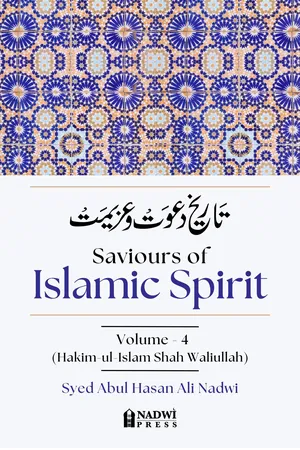
A Comprehensive Study of Islamic Reform in Eighteenth-Century India
Saviours of Islamic Spirit, Volume IV: Shah Waliullah Dehlawi represents one of the most significant contributions to Islamic intellectual history, offering an authoritative and comprehensive study of a reformer whose influence continues shaping Muslim thought across South Asia and beyond. Written by renowned scholar Syed Abul Hasan Ali Nadwi and translated by Syed Mohiuddin, this volume illuminates the life, ideas, and long-term impact of Shah Waliullah Dehlawi (1703–1762)—a scholar, jurist, theologian, mystic, and social reformer whose work revitalized Islamic learning during a time of profound crisis.
Historical Context: An Empire in Turmoil
Shah Waliullah lived during one of the bleakest periods in the history of Indian Muslims. The once-mighty Mughal Empire—whose intellectual and cultural achievements shaped the subcontinent for two centuries—was collapsing. After the death of Aurangzeb in 1707, the monarchy experienced a rapid succession of weak rulers, chronic political instability, and growing regional fragmentation. Intrigues within the court undermined governance, while external threats intensified. Nadir Shah’s catastrophic invasion of Delhi in 1739 inflicted mass destruction, signaling the empire’s complete vulnerability. The economic devastation, moral decline, and administrative disintegration that followed raised existential questions about the future of Muslim society in India.
Simultaneously, intellectual and religious life suffered severe deterioration. Over time, popular religious practices absorbed un-Islamic customs, leading to widespread superstition, shrine-centric rituals, hereditary sainthood, and diminished adherence to orthodox Islamic teachings. The essential monotheistic message of Islam—tawhid—had become obscured in many regions. While classical scholarship persisted, the study of hadith weakened significantly in India. Speculative philosophy overshadowed practical religious scholarship, producing a learned class disconnected from the real needs of the Muslim community.
Into this milieu emerged Shah Waliullah—a scholar uniquely equipped to diagnose the disease and prescribe a comprehensive remedy.
Intellectual Formation and Foundations of Reform
Nadwi traces Shah Waliullah’s formation to the scholarly legacy of his family. His father, Shah Abdur Rahim, founder of the Madrasa Rahimiyya in Delhi, played an instrumental role in shaping his son’s intellectual trajectory. Abdur Rahim’s pedagogical approach emphasized mastery of primary sources—the Qur’an and Sunnah—rather than uncritical reliance on later commentaries. He instilled in Shah Waliullah the importance of understanding the hikmah (wisdom) behind Islamic laws, nurturing a methodological mindset that combined textual fidelity with rational analysis.
Under his father’s guidance, Shah Waliullah absorbed the full spectrum of Islamic sciences: Qur’anic exegesis, hadith, jurisprudence, theology, logic, grammar, rhetoric, and spirituality. He achieved proficiency across the four Sunni legal schools, enabling him to compare methodologies and identify deeper principles that united the juristic tradition. His training also included spiritual discipline and mystical practice, preparing him to articulate a balanced understanding of shari‘ah and tasawwuf.
His pilgrimage to Mecca and Medina in 1730 marked a turning point. Remaining in the Hijaz for fourteen months, he studied under eminent scholars of the Holy Cities, absorbing global Islamic perspectives and reconnecting with the living tradition of hadith transmission. The international scholarly environment revealed both the strengths and weaknesses of South Asian Islamic scholarship, solidifying his conviction that revival must center on re-establishing a direct link to Qur’an and Sunnah.
Major Contributions to Islamic Scholarship
Nadwi’s analysis highlights Shah Waliullah’s profound and far-reaching contributions across multiple domains:
1. Qur’anic Translation and Exegesis
His groundbreaking Persian translation of the Qur’an—Fath-ur-Rahman—was unprecedented. By rendering the Qur’an into the literary language of the educated classes, he dispelled the notion that only Arabic-reading elites could access divine revelation. His treatise on translation principles provides insight into the linguistic, theological, and hermeneutical challenges of conveying Qur’anic meanings across languages. His sons later translated the Qur’an into Urdu, expanding accessibility for the general public.
2. Revival of Hadith Studies
Before his era, India’s engagement with hadith had weakened, with scholars relying largely on later juristic texts. Shah Waliullah reinvigorated hadith studies through curriculum reform, teaching methods, and scholarly works. His masterpiece, Hujjat Allah al-Baligha, remains among the most influential works of Islamic legal theory, explaining the purposes, wisdom, and sociological foundations of Islamic law. He demonstrated how Prophetic guidance cultivates virtue, establishes justice, and promotes social welfare.
3. Juristic Reform and Methodological Synthesis
Shah Waliullah’s juristic thought represented a breakthrough. By harmonizing the four legal schools and identifying their shared principles, he moved beyond rigid partisanship. His advocacy of ijtihad—anchored in sound methodology—revitalized Islamic legal thinking, while his critique of blind taqlid exposed its role in intellectual stagnation. His approach bridged tradition and reform, making him a forerunner of Islamic thinkers seeking reconciliation between classical scholarship and contemporary realities.
4. Political Thought and Islamic Governance
In Izalat al-Khafa, Shah Waliullah explored Islamic political theory with sophistication unmatched in South Asian scholarship. He demonstrated the legitimacy of the Rightly-Guided Caliphs through Qur’anic, historical, and rational arguments. His analysis provided a model for governance rooted in justice, consultation, and moral accountability—principles urgently needed in an era of political breakdown.
5. Mysticism and Spiritual Renewal
A spiritual heir to multiple Sufi orders, he articulated a harmonized vision of law and spirituality. For him, true tasawwuf strengthened adherence to the shari‘ah rather than undermining it. His mystical writings cautioned against innovations infiltrating Sufi practice and established criteria for authentic spiritual discipline.
Legacy and Enduring Influence
One of the great strengths of Nadwi’s work is his mapping of Shah Waliullah’s influence through his sons—Shah Abdul Aziz, Shah Rafi-ud-din, Shah Abdul Qadir, and Shah Abdul Ghani—whose collective contributions shaped Islamic learning for generations. They translated essential works into Urdu, expanded hadith scholarship, maintained the Madrasa Rahimiyya, and guided thousands of students. Their efforts transformed Delhi into one of the world’s most important centers of Islamic scholarship.
Shah Waliullah’s ideas strongly influenced later reform movements, including the activism of Sayyid Ahmad Barelwi, the intellectual traditions of the Deobandi and Ahl-e-Hadith schools, and the broader revival of Islamic education and scholarship across South Asia.
Methodology and Scholarship of the Volume
Drawing on primary sources—autobiographical texts, family records, classical writings, historical chronicles, and over fifty scholarly works—Nadwi constructs a nuanced biography that avoids romantic hagiography while also steering clear of reductive secular narrative. His holistic approach situates Shah Waliullah within political upheaval, spiritual traditions, intellectual debates, and social realities. Syed Mohiuddin’s translation maintains accessibility without compromising scholarly depth, making the work suitable for academic and general readership alike.
Essential Reading for Multiple Audiences
This volume is indispensable for university students, researchers, educators, Muslim readers, and anyone seeking to understand how religious scholarship responds to historical crises. Saviours of Islamic Spirit, Volume IV demonstrates how one thinker—through intellectual brilliance, spiritual depth, and principled moral leadership—can reshape an entire civilization’s religious consciousness.