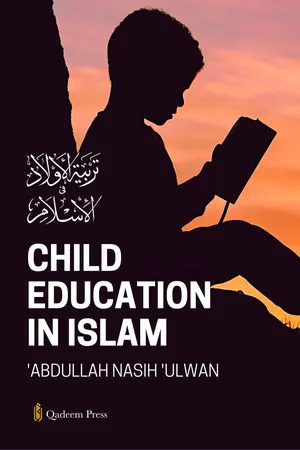
Child Education in Islam by ʿAbdullāh Nāsih ʿUlwān stands as one of the most comprehensive, carefully structured, and influential works on Islamic pedagogy produced in the modern era. Built upon a foundation of Qur’anic revelation, Prophetic guidance, and centuries of classical scholarship, the text offers a sweeping and holistic vision of tarbiyah—a process that encompasses spiritual formation, moral refinement, psychological stability, intellectual cultivation, physical well-being, and social development. Rather than treating childrearing as a set of isolated techniques, ʿUlwān presents it as an integrated and lifelong project that begins even before a child is born and continues through adolescence.
The work unfolds across three extensive parts, each addressing a critical dimension of Islamic education. Part One serves as a foundational overview, illustrating how successful childrearing begins long before the birth of a child. ʿUlwān begins with the ideal Islamic marriage, emphasizing that a stable, righteous household is the starting point for forming upright generations. He explores marriage as a human instinct, a social necessity, and a selective commitment requiring spiritual compatibility and moral integrity. By grounding child development in the character of the parents and the environment they establish from the beginning, the author underscores the Qur’anic principle that a healthy society can only emerge from healthy families.
He then turns to one of the most powerful forces shaping the upbringing of children: the psychological bond between parents and their offspring. Through Qur’anic citations, Prophetic narrations, poetry, and vivid examples, he demonstrates how divine mercy has placed tenderness, affection, and compassion within the hearts of parents. These emotions, when guided by sound Islamic understanding, become the driving force behind protection, discipline, guidance, and moral formation. The author also addresses harmful pre-Islamic attitudes such as preferring boys over girls, highlighting the Prophet’s specific encouragement toward kindness, justice, and spiritual responsibility toward daughters.
Part One then moves into the rites and responsibilities associated with newborns: adhān, iqāmah, tahnik, naming conventions, shaving the hair, ʿaqīqah, and circumcision. Each practice is explained with its evidences, its spiritual wisdom, and its developmental benefit. This section alone functions as a concise manual for Muslim parents preparing to welcome a new child into the world.
Part Two expands into the multifaceted responsibilities of educators—parents, teachers, imams, and mentors—who shape the next generation. ʿUlwān divides these responsibilities into clearly defined realms. Faith education forms the spiritual backbone of the child, nurturing belief in Allah, love of worship, and attachment to the Qur’an. Ethical education addresses manners, moral purity, humility, truthfulness, modesty, and respect. Physical education emphasizes nourishment, hygiene, strength, healthy routines, and the Prophetic ethic of “no harm and no reciprocating harm.” Intellectual education develops curiosity, reason, problem-solving, and the disciplined pursuit of knowledge. Psychological education examines shyness, fear, anger, envy, and inferiority—teaching parents and educators how to build emotional resilience. Social education covers rights, duties, manners of eating, greeting, interacting, and participating in communal life. Sexual education, addressed with clarity and modesty, provides principles of privacy, permission, and protection from inappropriate exposure.
Throughout this section, the author illustrates how Islam treats education not as an academic curriculum but as a complete system of human formation. Every chapter blends spiritual instruction with practical, realistic, and psychologically sound advice—making the entire work both academically rigorous and immediately applicable to everyday life.
Part Three focuses on the practical methods of education: raising children through example, establishing habits, delivering wise counsel, supervising through observation, and applying discipline with measured wisdom. ʿUlwān stresses that a righteous example is the most powerful teaching tool. Children internalize what they see—even more than what they are told—so educators must embody the values they wish to see in the next generation. Habit formation, he argues, builds consistency and character; admonition provides clarity; observation offers insight; and balanced punishment corrects wrongdoing without harming dignity.
The final chapters of the work deliver essential educational principles and practical suggestions that address modern challenges head-on: free time, media exposure, peer pressure, family conflict, social instability, and the erosion of communal bonds. Through each page, ʿUlwān’s message remains constant: Islamic upbringing is not merely instruction—it is the cultivation of a complete human being whose soul, intellect, character, and emotions are aligned with divine guidance.
What sets this text apart is the author’s rare ability to blend theological depth, pedagogical clarity, and lived human experience. His writing demonstrates mastery of scriptural sources and a keen awareness of the realities facing families—poverty, cultural pressures, social disorder, emotional strain, and harmful influences. His approach is firm, compassionate, and deeply optimistic, rooted in the certainty that Muslim families can achieve stability and excellence when guided by revelation.
For parents, this book provides a roadmap for raising children who are spiritually conscious, emotionally balanced, morally upright, and socially responsible. For educators, it offers a structured curriculum in Islamic pedagogy. For scholars and students, it presents a foundational text that bridges classical Islamic knowledge with contemporary family life. And for Muslim communities everywhere, it serves as a reminder that the revival of Islamic civilization begins in the home—with marriages grounded in faith, parents filled with mercy, and children nurtured in righteousness.
In its depth, scope, and enduring relevance, Child Education in Islam remains one of the most essential works on Muslim family development—an authoritative companion for anyone committed to cultivating the next generation upon clarity, strength, and God-conscious purpose.