A Foundational Text on Islamic Faith
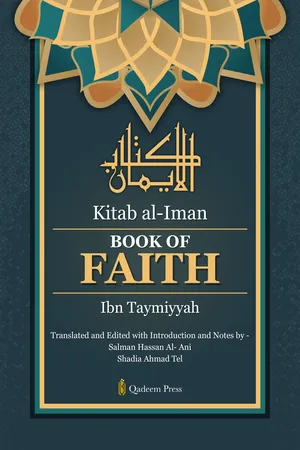
Kitāb al-Īmān (Book of Faith) by Ibn Taymiyyah is widely regarded as one of the most important works on Islamic doctrine and spirituality, and this volume presents the first complete English translation of the text. For over seven centuries, it has served as a reference point in debates about the nature of faith, the boundaries of Muslim identity, and the relationship between belief and practice.
The concept of Īmān (faith) has been central to Islamic theology from the earliest period, yet major schools developed sharply different definitions of what faith entails. Is it purely an inner conviction? Does it necessarily include righteous actions? Can faith increase and decrease? What is the status of Muslims who commit serious sins? Ibn Taymiyyah wrote Kitāb al-Īmān to clarify the authentic Islamic position, grounding his analysis in the Qur’an, Hadith, and the methodology of the Salaf (pious predecessors).
Across twenty-three chapters, Ibn Taymiyyah demonstrates his mastery of Qur’anic interpretation, Hadith analysis, Arabic linguistics, and systematic reasoning. He engages in depth with theological currents such as the Murji’ites, who separated faith from action, the Ashʿarites, who developed complex theological systems, and the Kharijites, who branded sinning Muslims as unbelievers. His method combines extensive scriptural citation, precise linguistic analysis, and a consistent insistence on continuity with early Muslim understanding.
The significance of Kitāb al-Īmān extends well beyond medieval history. Modern Islamic movements, especially those associated with Salafi thought, draw heavily on Ibn Taymiyyah’s theology of faith, making his positions directly relevant to contemporary Muslim debates on orthodoxy, practice, and reform. His call to return to scriptural sources and critique of later innovations continue to shape Islamic discourse globally.
This scholarly translation by Salman Hassan Al-Ani and Dr. Shadia Ahmad Tel preserves the depth, precision, and intensity of the original Arabic, while rendering the work clear and approachable for English readers. The introduction provides essential biographical and historical context, explaining Ibn Taymiyyah’s life, his theological battles, and the enduring influence of Kitāb al-Īmān through students like Ibn Qayyim al-Jawziyyah and Ibn Kathīr.
Kitāb al-Īmān is essential reading for:
• Students and scholars of Islamic theology and intellectual history
• Graduate programs in Islamic Studies and Religious Studies
• Researchers studying medieval theology, sectarian movements, and Salafi thought
• Academic libraries building serious Islamic Studies collections
• Educated readers seeking authentic, primary-source perspectives on Islamic faith
By making this classic available in full, the translation offers indispensable primary material for understanding both medieval Islamic theology and its living legacy in contemporary Muslim thought.