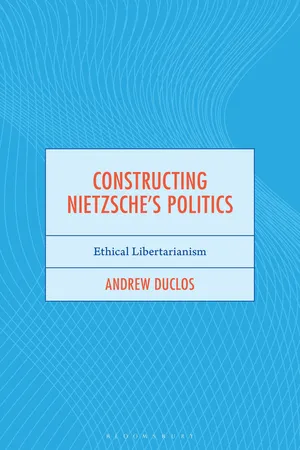
A timely new interpretation of Nietzsche's politics which reconciles the apparent contradictions in Nietzsche's texts by defining his politics as "ethical libertarianism."
Nietzsche's politics has been the subject of much debate, with the existing scholarship largely divided between aristocratic and anti-democratic readings on the one hand, and democratic readings on the other. This book takes its place in the emerging trend of trying to find a "third way" by arguing that Nietzsche's philosophy implies a form of libertarianism. This interpretation emphasizes individual self-transformation and the need to organize society in a way which best facilitates this for its members. While libertarianism is closest to Nietzsche's requirements, it needs to be reformulated to be made fully consistent with his philosophy. This requires a rejection of any grounding of the natural rights of the individual, presumed to be equal for all, in a metaphysical conception of the self. A Nietzschean "ethical libertarianism" would be based on protecting equal access of individuals to conditions which promote self-cultivation. It is thus democratic, but also meritocratic, as rights will be seen to accrue on the basis of individual development.
- 259 pages
- English
- PDF
- Available on iOS & Android
eBook - PDF
About this book
Information
Topic
PhilosophySubtopic
Ethics & Moral PhilosophyTable of contents
- Cover
- Half Title
- Series Page
- Title Page
- Copyright Page
- Dedication
- Contents
- About the Author
- Foreword
- Preface
- Abbreviations
- Introduction
- Part I: Nietzsche’s Ontology
- Chapter 1: Nietzsche’s Concept of the Self
- Chapter 2: One’s Relation to the Self
- Chapter 3: Becoming and Will to Power
- Chapter 4: Reinterpreting the Will to Power, Becoming, and Nietzsche’s Ontology
- Part II: Nietzsche’s Ethics
- Chapter 5: The Self as Perspectival and Interpretive
- Chapter 6: The Role of Opposition and Overcoming in the Self
- Chapter 7: Eternal Recurrence and Amor Fati as Interpretive Mechanisms for Overcoming
- Chapter 8: Self-Cultivation and Life-Affirmation
- Chapter 9: Traits for Self-Cultivation
- Chapter 10: Free Spirits
- Chapter 11: The Übermensch
- Chapter 12: The Social Fabric, Culture, and the Individual
- Chapter 13: A Possibility for Anyone
- Part III: Nietzsche’s Politics
- Chapter 14: Political Aristocratism
- Chapter 15: Nietzsche contra Democracy in General
- Chapter 16: Democratic Liberalism
- Chapter 17: Democratic Conservatism
- Chapter 18: Ethical Libertarianism
- Conclusion: Life-Affirmation
- Bibliography
- Index
Trusted by 375,005 students
Access to over 1.5 million titles for a fair monthly price.
Study more efficiently using our study tools.
Frequently asked questions
Yes, you can cancel anytime from the Subscription tab in your account settings on the Perlego website. Your subscription will stay active until the end of your current billing period. Learn how to cancel your subscription
No, books cannot be downloaded as external files, such as PDFs, for use outside of Perlego. However, you can download books within the Perlego app for offline reading on mobile or tablet. Learn how to download books offline
Perlego offers two plans: Essential and Complete
- Essential is ideal for learners and professionals who enjoy exploring a wide range of subjects. Access the Essential Library with 800,000+ trusted titles and best-sellers across business, personal growth, and the humanities. Includes unlimited reading time and Standard Read Aloud voice.
- Complete: Perfect for advanced learners and researchers needing full, unrestricted access. Unlock 1.5M+ books across hundreds of subjects, including academic and specialized titles. The Complete Plan also includes advanced features like Premium Read Aloud and Research Assistant.
We are an online textbook subscription service, where you can get access to an entire online library for less than the price of a single book per month. With over 1.5 million books across 990+ topics, we’ve got you covered! Learn about our mission
Look out for the read-aloud symbol on your next book to see if you can listen to it. The read-aloud tool reads text aloud for you, highlighting the text as it is being read. You can pause it, speed it up and slow it down. Learn more about Read Aloud
Yes! You can use the Perlego app on both iOS and Android devices to read anytime, anywhere — even offline. Perfect for commutes or when you’re on the go.
Please note we cannot support devices running on iOS 13 and Android 7 or earlier. Learn more about using the app
Please note we cannot support devices running on iOS 13 and Android 7 or earlier. Learn more about using the app
Yes, you can access Constructing Nietzsche's Politics by Andrew Duclos in PDF and/or ePUB format, as well as other popular books in Philosophy & Ethics & Moral Philosophy. We have over 1.5 million books available in our catalogue for you to explore.