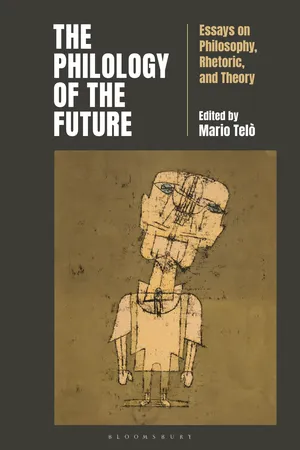
This book gathers a group of scholars whose work has been influenced by the distinctive dialogue between ancient philosophy (and rhetoric) and critical theory promoted by the scholarship of James I. Porter. A classicist who has pushed classics beyond itself – beyond its traditional boundaries – Porter has demonstrated that antiquity cannot be studied without participating in what is sometimes dismissively labeled "reception."
The collection here does not simply celebrate the work of a major figure in the field of classics through a series of writing experiments, but locates the futures of classics in its predisposition to endless transformation, alteration, reconfiguration, and fugitive or exilic deterritorialization. Philology is a practice of philosophy in that contact with the ghosts of antiquity and its diachronic manifestations in modernity confronts the interpreter with opportunities for unlearning as well as learning, unthinking as well as thinking, and for engaging with impossibilities as well as possibilities. The essays gathered here, unified by these themes, include contributions on ancient philosophy and literature (Homer, Sappho, Democritus, the sophists, Aristotle, Lucretius, and Cicero); reflections on the sublime, which Porter has pivotally elucidated; interventions on the theme of philology and exile (in Nietzsche, Marx, Freud, and Derrida); and theoretical musings on the "agony of immanence," the "biomatic," the "atmospheric," and the relationship between immigration and classical reception.
- 297 pages
- English
- PDF
- Available on iOS & Android
eBook - PDF
About this book
Trusted by 375,005 students
Access to over 1.5 million titles for a fair monthly price.
Study more efficiently using our study tools.
Information
Table of contents
- Cover
- Halftitle page
- Series page
- Title page
- Copyright page
- Contents
- For Jim: Toward a Philology of (Im)possible Futures
- “The Utopian Perfectibility of the World in Reverse”: William Kentridge, Jim Porter, and Book Seven of the Iliad
- The Sounds of Sappho and the Sense of Philology
- Thucydides and the Comparativist Gesture
- Can This Be Less Boring?: In Praise of the Dissoi Logoi’s Rhetoric of Conflict and Contradiction
- The Soul in a Sunbeam: Aristotle on Democritus’ Fiery psukhē
- On the Sympathetic Community of the Body and the Soul in Book 3 of Lucretius: Loving Life and Learning to Face Death
- Cicero’s Regret
- The Immigration of Classical Antiquity: Border Trouble in Ovid, Dionne Brand, and Jenny Erpenbeck
- Longinus and the Light
- The Birth of Philology out of the Spirit of Pedagogy
- “Homer’s Contest” as Nietzsche’s Contest over Hellenism
- Marx and the Philology of the Future
- Moses and Monolingualism: Freud, Derrida, and the Philology of Exile
- The Classical Biome
- Bibliography
- Contributors
- Index
Frequently asked questions
Yes, you can cancel anytime from the Subscription tab in your account settings on the Perlego website. Your subscription will stay active until the end of your current billing period. Learn how to cancel your subscription
No, books cannot be downloaded as external files, such as PDFs, for use outside of Perlego. However, you can download books within the Perlego app for offline reading on mobile or tablet. Learn how to download books offline
Perlego offers two plans: Essential and Complete
- Essential is ideal for learners and professionals who enjoy exploring a wide range of subjects. Access the Essential Library with 800,000+ trusted titles and best-sellers across business, personal growth, and the humanities. Includes unlimited reading time and Standard Read Aloud voice.
- Complete: Perfect for advanced learners and researchers needing full, unrestricted access. Unlock 1.5M+ books across hundreds of subjects, including academic and specialized titles. The Complete Plan also includes advanced features like Premium Read Aloud and Research Assistant.
We are an online textbook subscription service, where you can get access to an entire online library for less than the price of a single book per month. With over 1.5 million books across 990+ topics, we’ve got you covered! Learn about our mission
Look out for the read-aloud symbol on your next book to see if you can listen to it. The read-aloud tool reads text aloud for you, highlighting the text as it is being read. You can pause it, speed it up and slow it down. Learn more about Read Aloud
Yes! You can use the Perlego app on both iOS and Android devices to read anytime, anywhere — even offline. Perfect for commutes or when you’re on the go.
Please note we cannot support devices running on iOS 13 and Android 7 or earlier. Learn more about using the app
Please note we cannot support devices running on iOS 13 and Android 7 or earlier. Learn more about using the app
Yes, you can access A Philology of the Future by Mario Telò in PDF and/or ePUB format, as well as other popular books in Literature & Ancient History. We have over 1.5 million books available in our catalogue for you to explore.