eBook - PDF
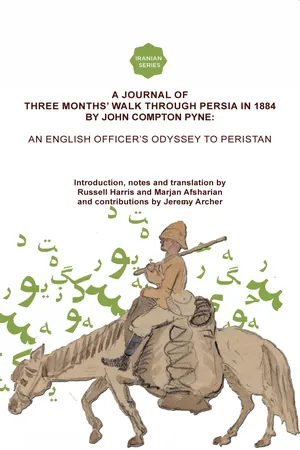
A Journal of Three Months’ Walk in Persia in 1884 by Captain John Compton Pyne
- 321 pages
- English
- PDF
- Available on iOS & Android
eBook - PDF
A Journal of Three Months’ Walk in Persia in 1884 by Captain John Compton Pyne
About this book
In 1884 an obscure British soldier, having finished his tour of duty in India, decided to make a detour on his trip home in order to spend three months crossing Persia unaccompanied except for the local muleteers. Among his accoutrements he packed a small leather-bound sketchbook in which he not only wrote a journal but in which he also added accomplished and charming water-colour illustrations. The authors' introduction contextualises this trip made in 1884 against the background of Persianate influence in British culture, and the general cultural background of late Victorian Britain is presented as the subliminal driver behind a young man's desire to explore, and illustrate, an already discovered country – Persia.
Information
Subtopic
Middle Eastern HistoryIndex
HistoryTable of contents
- _GoBack
- Table of Figures
- John Compton Pyne (1857-1893), 2nd Battalion, The Dorsetshire Regiment, by Jeremy Archer
- Acknowledgements
- Introduction, by Russell Harris and Marjan Afsharian
- Epilogue, by Jeremy Archer
- Bibliography
- Index
- Figure 1: Captain John Compton Pyne.
- Figure 2: Relationship of John Compton Pyne to Earl Kitchener.
- Figure 3: Afghanistan Medal 1878–1880. Designed by the British illustrator Randolph Caldecott (1846–1886), the obverse, seen here, shows Anglo-Indian troops marching through the Khyber Pass with an officer riding in the foreground — a idealised view of a
- Figure 4: Major-General Sir Horatio Herbert Kitchener (1850–1916). Kitchener is seen here in a hand-coloured photograph by the established Cairo studio of Lekegian. At the time of the image, he was Commander-in-Chief of the Khedive’s forces and carrying o
- Figure 5: The Royal Military Academy, Sandhurst, painted by John Compton Pyne, circa 1880.
- Figure 6: Ornamental frontispiece of an 1861 edition of Thomas Moore’s Lalla Rookh: an Oriental Romance. The interpretation of an arabesque bookbinding was executed by Thomas Sulman (circa 1834-1900) and obviously owes much to Owen Jones’s 1856 work The G
- Figure 7: Plate XLIV from Owen Jones’s Grammar of Ornament with Persian pattern details taken from a MS in the British Museum.
- Figure 8: The War in the Sudan. The Battle of el Tel, 29 February 1884. The British illustrated press was replete with vivid a d emotive imagery of the war against the Mahdi in the Sudan in 1883–4.
- Figure 9: Route of the London–Calcutta telegraph line.
- Figure 10: General Kaufman, the “bugbear of British Russophobists”. Image from the Kaufman Album, courtesy of Library of Congress.
- Figure 11: Vambéry in disguise on a camel.
- Figure 12: The Englishman Thomas Stevens (1854–1935) at the start of his journey around the world on a penny-farthing. His luggage, seen tied to the handlebar consisted of socks, a spare shirt, a raincoat that doubled as tent and bedroll, and a pocket rev
- Figure 13: The standard south-north route followed by Pyne and some of the sites he mentions along the ca. 1300 km (circa 800 mi.) journey.
- Figure 14: The mihrab bought apparently piecemeal from Kashan by Preece and removed from Iran. Now in the Museum für Islamische Kunst Berlin (Pergamonmuseum), Inv.-Nr. I. 5366. Source: Glover, 1913.
- Figure 15: Here a local in Khiva is photographed removing tiles from a mosque to fulfil an order for a collector. Source: d’Allemagne, 1911.
- Figure 16: Sir Robert Murdoch Smith (1835–1900) “has bestowed some of his leisure hours in collecting specimens of the ancien artwork of Persia”. Photograph by R. L. Webster, Edinburgh.
- Figure 17: Stevens is met by Mr. McIntyre (on horseback).
- Figure 18: Holy Trinity Church, Karachi. Completed in 1855, Holy Trinity was the first major church to be built in Karachi. The tower had five storeys above the buttressed entranceway of the tower and the roof is pitched. Two storeys of the tower were rem
- Figure 19: ‘Bundar Abbas’ from MacGregor’s Narrative of a journey through the province of Khorassan and on the N.W. frontier o Afghanistan in 1875 (1879).
- Figure 20: The port of Bushire, published by J. Thomson (1891).
- Figure 21: Bushire by Coste (1851).
- Figure 22: Merchant caravanserai in Bushehr, published by J. Thomson (1891).
- Figure 23: Bushehr. The British Residency, published by J. Thomson (1891).
- Figure 24: The interior of an unnamed caravanserai, Vilmorin (1895).
- Figure 25: “Borazjun: The Caravanserai”, published by J. Thomson (1891).
- Figure 26: “Caravanséraï de Borasgoun”. Vilmorin (1895).
- Figure 27: Borazjun, London Illustrated News 1857.
- Figure 28: Advertisement for Liebig’s Beef Tea.
- Figure 29: The bridge at Dalaki. Vilmorin (1895).
- Figure 30: “Daliki: The Petroleum Camp” [detail], published by J. Thomson (1891).
- Figure 31: A group of muleteers. Unknown photographer (Lefèvre-Pontasis, p. 69).
- Figure 32: Mules on the road to Kotal-Dokhtar published by J. Thomson (1891).
- Figure 33: Pir-e-Zan, Fars. Flandin, Eugène and Pascal Coste.
- Figure 34: The perilous mule trail to Kotal-Dokhtar photographed from above, early 1940s.
- Figure 35: Pir Zan showing the line to the telegraph post. Line drawing by Goldsmid, 1874.
- Figure 36: A drawing of Mian Kotal Serai, Lemessurier (1889).
- Figure 37: Coste, the Caravansarai at Miyan between Isfahan and Shiraz.
- Figure 38: The village of Kazirun as drawn by Coste (1851).
- Figure 39: MacGregor’s view of Kazirun.
- Figure 40: Advertisement for the “famous collection of Persian Faïence & Antiquities” collection by J.R. Preece. Illustrated London News, 10 May 1913.
- Figure 41: Tomb of Hafez by Madame Dieulafoy.
- Figure 42: Bagh-e Takht by Madame Dieulafoy.
- Figure 43: Bagh-e Takht palace and gardens by Thomson (1891).
- Figure 44: Shiraz. The Sadiah. Tomb of Sheikh Sadi the poet, published by J. Thomson (1891).
- Figure 45: Tombeau du poète Saadi à Chiraz, from a photograph by Madame Dieulafoy.
- Figure 46: Tombeau de Cheik-Saadi. Coste.
- Figure 47: Binning’s Journal of Two Years’ Travel in Persia.
- Figure 48: Porter’s Travels in Georgia, Persia, Armenian, Ancient Babylonia.
- Figure 49: Naksh-e Rustum from Ussher’s Travels.
- Figure 50: Naksh-e Rustum by Coste.
- Figure 51: Naksh-e Rustum by Madame Dieulafoy.
- Figure 52: Persepolis published by J. Thomson (1891).
- Figure 53: View of Persepolis as depicted by Coste.
- Figure 54: Map of Persepolis by Coste.
- Figure 55: A bridge over “Bendemeer’s Stream”, Lemessurier (1889).
- Figure 56: Bridge over the Bendemeer Stream by Coste.
- Figure 57: A watercolour by John Compton Pyne of a hill station at Jalapahar, Darjeeling, in British India, painted in January 1879.
- Figure 58: The illustration published by Ussher, p. 621, showing that Pyne changed a little the disposition of the figures.
- Figure 59: Coste, the tomb of Cyrus.
- Figure 60: Detail: “Tomb of Cyrus”, published by J. Thomson (1891).
- Figure 61: “Grave of Cyrus”, by Sarre (1910).
- Figure 62: Yazd-i Khast by Madame Dieulafoy.
- Figure 63: Yazd-i Khast by Coste.
- Figure 64: Yazd-i Khast by Coste.
- Figure 65: Yazd-i Khast published by J. Thomson (1891), published by J. Thomson (1891..
- Figure 66: Imam-Zadeh at Komishah by Coste.
- Figure 67: Julfa church, Isfahan, by Coste.
- Figure 68: House of a European resident near Julfa, possibly that of Mr. Collignon.
- Figure 69: Armenian bishop of Julfa, photographed by Madame Dieulafoy 1881-2 and engraved by E. Ronjat.
- Figure 70: Armenian woman from Isfahan, photographed by Madame Dieulafoy 1881-2 and engraved by Osvaldo Tofani.
- Figure 71: Madame Jane Dieulafoy in her typical male attire.
- Figure 72: Miss Isabella Read and Armenian girls at the school in Julfa, circa 1890.
- Figure 73: The Armenian family copied by Pyne… again he must have seen a copy of this in Julfa, as he copied it before it was published.
- Figure 74: Chihil Sutun interior by Coste.
- Figure 75: The Chahr Bagh by Madame Dieulafoy showing the trees which Pyne complains are being “rapidly cut down”.
- Figure 76: The Chahr Bagh by Madame Dieulafoy showing the entrance to the madrasa mader-yi shah.
- Figure 77: Panoramic view of the Armenian church at Julfa by Madame Dieulafoy.
- Figure 78: The shaking minarets (Menar-e-jomban), photograph by Luigi Pesce, circa 1855. Source: Bibliothèque nationale de France.
- Figure 79: The shaking minarets illustrated by d’Allemagne (1911).
- Figure 80: House of a leading Shiraz merchant, published by J. Thomson (1891).
- Figure 81: Caravansarai at Pasangoon by Coste.
- Figure 82: Tombeau de Fatma à Koum. - Dessin de Taylor, d’après une photographie.
- Figure 83: The original of the caravan of corpses by Ussher.
- Figure 84: The caravan of corpses by de Windt.
- Figure 85: Madame Dieulafoy’s view of the same scene engraved by Osvaldo Tofani.
- Figure 86: Tajrish by Thomson (1891).
- Figure 87: Gulabek Valley showing the British-owned properties (1911).
- Figure 88: Persian for Travellers by Alexander Finn, F.R.G.S., F.R.A.S., H.M. Consul at Resht (London, 1884).
- Figure 89: “From the Fort. A Corner of the City, Peshawar, 14 November 1888,” a watercolour by John Compton Pyne, showing the Taxila Gate and a portion of the city.
- Figure 90: Mount Demavend, drawing by J. Laurens, published in Mme. Dieulafoy’s book La Perse, la Chaldée et la Susiane.
- Figure 91: The “bas-relief of the present Shah on horseback”. The bearded man is the then minister of finance, Mirza Yusuf Ash iyani.
- Figure 92: Pyne’s route northward from Tehran, plotted on a contemporary map.
- Figure 93: A depiction of Baku on the cover of Charles Marvin’s history of the petroleum industry on the Caspian Sea in 1883.
- Figure 94: Oil towers at the Balakhani-Sabunchu field c. 1890s.
- Figure 95: The Oil Wells of Baku. Illustration by the Scottish artist William Simpson (1823-1899) published in the Illustrated London News, 5 June 1886.
- Figure 96: An oil fountain, Baku, circa 1897. Source: Perowne, 1898.
- Figure 97: Tatar women of the Caucasus, detail of Russian postcard, circa 1905.
- Figure 98: Tsaritsin railway station.
- Figure 99: The Kremlin in Moscow, circa 1890. Image by the Detroit Publishing Co., print no. 8849.
- Figure 100: Slavyansky Bazaar building circa 1909.
- Figure 101: Hotel de France, St. Petersburg.
- Figure 102: The Cathedral of St. Isaac, St. Petersburg, circa 1900.
- Figure 103: St. Paul’s Cathedral, London, circa 1890.
- Figure 104: Illustrated cover page of Pyne’s Notes on the Egyptian Army.
- Figure 105: Pyne’s illustration of a Sudanese soldier in Zouave uniform.
- Figure 106: General Sir Francis Reginald Wingate (1861–1955) who succeeded Lord Kitchener as Governor-General of the Sudan.
- Figure 107: The ‘Action of Ambigole’ – map showing where Captain Pyne fell.
- Figure 108: The memorial plaque in Sherborne Abbey.
Trusted by 375,005 students
Access to over 1.5 million titles for a fair monthly price.
Study more efficiently using our study tools.
Frequently asked questions
Yes, you can cancel anytime from the Subscription tab in your account settings on the Perlego website. Your subscription will stay active until the end of your current billing period. Learn how to cancel your subscription
No, books cannot be downloaded as external files, such as PDFs, for use outside of Perlego. However, you can download books within the Perlego app for offline reading on mobile or tablet. Learn how to download books offline
Perlego offers two plans: Essential and Complete
- Essential is ideal for learners and professionals who enjoy exploring a wide range of subjects. Access the Essential Library with 800,000+ trusted titles and best-sellers across business, personal growth, and the humanities. Includes unlimited reading time and Standard Read Aloud voice.
- Complete: Perfect for advanced learners and researchers needing full, unrestricted access. Unlock 1.5M+ books across hundreds of subjects, including academic and specialized titles. The Complete Plan also includes advanced features like Premium Read Aloud and Research Assistant.
We are an online textbook subscription service, where you can get access to an entire online library for less than the price of a single book per month. With over 1.5 million books across 990+ topics, we’ve got you covered! Learn about our mission
Look out for the read-aloud symbol on your next book to see if you can listen to it. The read-aloud tool reads text aloud for you, highlighting the text as it is being read. You can pause it, speed it up and slow it down. Learn more about Read Aloud
Yes! You can use the Perlego app on both iOS and Android devices to read anytime, anywhere — even offline. Perfect for commutes or when you’re on the go.
Please note we cannot support devices running on iOS 13 and Android 7 or earlier. Learn more about using the app
Please note we cannot support devices running on iOS 13 and Android 7 or earlier. Learn more about using the app
Yes, you can access A Journal of Three Months’ Walk in Persia in 1884 by Captain John Compton Pyne by Marjan Afsharian,Russell Harris in PDF and/or ePUB format, as well as other popular books in History & Middle Eastern History. We have over 1.5 million books available in our catalogue for you to explore.