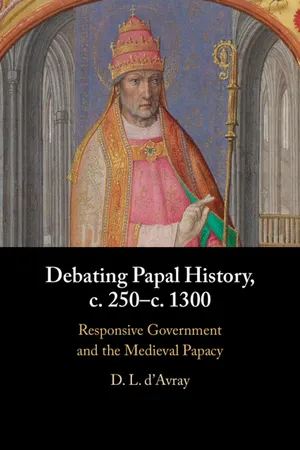
eBook - PDF
Debating Papal History, c. 250–c. 1300
Responsive Government and the Medieval Papacy
- 344 pages
- English
- PDF
- Available on iOS & Android
eBook - PDF
About this book
The papacy is the oldest surviving government in human history, yet the forms and roles of papal authority remain contested in scholarship. Debating Papal History offers a reinterpretation of papal history from the third to the thirteenth century, through an extensive series of case studies with translations of supporting documents. D.L. d'Avray argues against interpretations of the papacy which focus on a top-down imposition of power, suggesting instead that papal authority was primarily responsive, invoked to resolve uncertainty arising from different ecclesiastical subsystems, and interlinked with the roles of other non-ecclesiastical powers. The study brings together late Antique and Medieval history while also transmitting the findings of non-English scholarship in the field. Debating Papal History aims to inspire fresh thinking and discussion, rendering original documents newly accessible and presenting a vivid corrective to conventional understandings of the papacy.
Trusted by 375,005 students
Access to over 1.5 million titles for a fair monthly price.
Study more efficiently using our study tools.
Information
Subtopic
European HistoryIndex
HistoryTable of contents
- Cover
- Half-title
- Title page
- Imprints page
- Dedication
- Table of Contents
- Acknowledgements
- List of Abbreviations and Conventions
- Introduction
- Case 1: Constantine and the Papacy
- Case 2: The Canon of the Bible
- Case 3: A Late Antique Decretal and the Carolingian Church (416)
- Case 4: Gelasius I and the Idea of Hierarchy (494)
- Case 5: The Episcopal and Monastic Systems (c. 600 to c. 800)
- Case 6: Marriage of Priests in the Mid-Eighth Century (1 April 743)
- Case 7: An Eighth-Century Questionnaire Sent to the Apostolic See
- Case 8: The Donation of Constantine and Its Afterlife (750–800 and 1236)
- Case 9: Privilege for Offa of Mercia and His Queen (772–795)
- Case 10: Nicholas I Reports on His Deposition of Two Archbishops (863)
- Case 11: Spiritual Kinship, Marriage, and Baptism in the Late Carolingian Era
- Case 12: Bad Latin in the Tenth-Century Papal Entourage
- Case 13: John XIII Raises Magdeburg to Metropolitan Status, as Asked by the Emperor Otto I (967)
- Case 14: An Early Eleventh-Century Attempt to Launch a Crusade (1010)
- Case 15: The Pope, the Archbishop of Canterbury, and a Man Who Had Killed His Son
- Case 16: Encyclical on the Papal Reform Council of 1059
- Case 17: The Dictatus papae of Gregory VII (1075)
- Case 18: The Concordat of Worms (1122)
- Case 19: Bastard Sons of Priests and Routinization of Dispensation (1161–1181 and 1234)
- Case 20: Reform Legislation and the Complexity of the Social World
- Case 21: Baptism in the Second Decretal Age
- Case 22: Early Papal Indulgences
- Case 23: Vernacular Bible Reading (9 December 1199)
- Case 24: Templars as Victims (8 March 1200)
- Case 25: Monastic Exemption in the Thirteenth Century
- Case 26: Lay Patronage as an Ecclesiastical System
- Case 27: Rival Metropolitans
- Case 28: Papal Provisions
- Case 29: Papacy and Lepers
- Case 30: The French Monarchy and the Papacy in the Late Thirteenth Century
- Case 31: Boniface VIII as ‘Symphoniste’
- Epilogue
- Glossary
- Bibliography
- Index
Frequently asked questions
Yes, you can cancel anytime from the Subscription tab in your account settings on the Perlego website. Your subscription will stay active until the end of your current billing period. Learn how to cancel your subscription
No, books cannot be downloaded as external files, such as PDFs, for use outside of Perlego. However, you can download books within the Perlego app for offline reading on mobile or tablet. Learn how to download books offline
Perlego offers two plans: Essential and Complete
- Essential is ideal for learners and professionals who enjoy exploring a wide range of subjects. Access the Essential Library with 800,000+ trusted titles and best-sellers across business, personal growth, and the humanities. Includes unlimited reading time and Standard Read Aloud voice.
- Complete: Perfect for advanced learners and researchers needing full, unrestricted access. Unlock 1.5M+ books across hundreds of subjects, including academic and specialized titles. The Complete Plan also includes advanced features like Premium Read Aloud and Research Assistant.
We are an online textbook subscription service, where you can get access to an entire online library for less than the price of a single book per month. With over 1.5 million books across 990+ topics, we’ve got you covered! Learn about our mission
Look out for the read-aloud symbol on your next book to see if you can listen to it. The read-aloud tool reads text aloud for you, highlighting the text as it is being read. You can pause it, speed it up and slow it down. Learn more about Read Aloud
Yes! You can use the Perlego app on both iOS and Android devices to read anytime, anywhere — even offline. Perfect for commutes or when you’re on the go.
Please note we cannot support devices running on iOS 13 and Android 7 or earlier. Learn more about using the app
Please note we cannot support devices running on iOS 13 and Android 7 or earlier. Learn more about using the app
Yes, you can access Debating Papal History, c. 250–c. 1300 by D. L. d'Avray in PDF and/or ePUB format, as well as other popular books in History & European History. We have over 1.5 million books available in our catalogue for you to explore.