Given Wharton's broad education in European languages and cultures, the absence of a full-length study of the influence of German thinking and aesthetics on her creative work has long been a considerable gap in the field of Wharton studies.
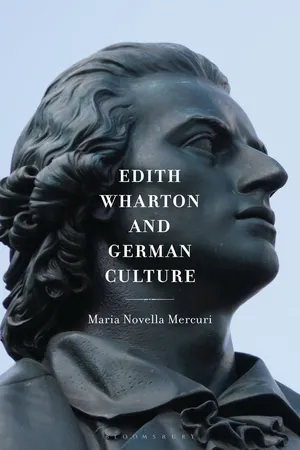
Maria Novella Mercuri offers a close analysis of Wharton's engagement with German literature and philosophy. Each chapter centers on one main novel or theme recurring in a group of works including poetry, plays and short fiction, as well as posthumously published autobiographical work. Wharton's body of work is analyzed in relation to German authors such as Wolfgang Goethe, Friedrich Schiller, Johann Gottfried Herder, Friedrich de La Motte Fouqué, Theodor Fontane, Clara Viebig, Thomas Mann, Heinrich Sudermann, and Gottfried Keller. Mercuri also draws attention to the impact on Wharton of the philosophy of Arthur Schopenhauer and Friedrich Nietzsche and to the pervasive influence of Goethe's thought about history, ethics and aesthetics that is evident in her work.
- 257 pages
- English
- PDF
- Available on iOS & Android
eBook - PDF
Edith Wharton and German Culture
About this book
Information
Table of contents
- Cover
- Half Title
- Title Page
- Copyright Page
- Dedication
- Contents
- Acknowledgments
- Introduction
- Chapter 1: Wharton’s Creative Affinity with German Culture
- Chapter 2: A Philosophical Romance: The Valley of Decision (1902)
- Chapter 3: Naturalism Tempered: The House of Mirth (1905)
- Chapter 4: Solitude and Society in The Fruit of the Tree (1907)
- Chapter 5: Nietzschean Influence in Wharton’s Works
- Chapter 6: “Blond Beasts” in The Custom of the Country (1913)
- Chapter 7: A Bildungsroman of Old New York: The Age of Innocence (1920)
- Chapter 8: Renunciation and Elective Affinities in the Novels of “New” New York
- Chapter 9: Genius and Artistic Inspiration in A Son at the Front (1923), Hudson River Bracketed (1929), and The Gods Arrive (1933)
- Chapter 10: Before the War, and After
- Bibliography
- Index
Trusted by 375,005 students
Access to over 1.5 million titles for a fair monthly price.
Study more efficiently using our study tools.
Frequently asked questions
Yes, you can cancel anytime from the Subscription tab in your account settings on the Perlego website. Your subscription will stay active until the end of your current billing period. Learn how to cancel your subscription
No, books cannot be downloaded as external files, such as PDFs, for use outside of Perlego. However, you can download books within the Perlego app for offline reading on mobile or tablet. Learn how to download books offline
We are an online textbook subscription service, where you can get access to an entire online library for less than the price of a single book per month. With over 1.5 million books across 990+ topics, we’ve got you covered! Learn about our mission
Look out for the read-aloud symbol on your next book to see if you can listen to it. The read-aloud tool reads text aloud for you, highlighting the text as it is being read. You can pause it, speed it up and slow it down. Learn more about Read Aloud
Yes! You can use the Perlego app on both iOS and Android devices to read anytime, anywhere — even offline. Perfect for commutes or when you’re on the go.
Please note we cannot support devices running on iOS 13 and Android 7 or earlier. Learn more about using the app
Please note we cannot support devices running on iOS 13 and Android 7 or earlier. Learn more about using the app
Yes, you can access Edith Wharton and German Culture by Maria Novella Mercuri in PDF and/or ePUB format, as well as other popular books in Literature & German Literary Criticism. We have over 1.5 million books available in our catalogue for you to explore.