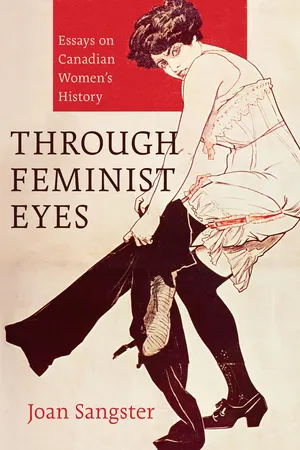
Through Feminist Eyes gathers in one volume the most incisive and insightful essays written to date by the distinguished Canadian historian Joan Sangster. To the original essays, Sangster has added reflective introductory discussions that situate her earlier work in the context of developing theory and debate. Sangster has also supplied an introduction to the collection in which she reflects on the themes and theoretical orientations that have shaped the writing of women's history over the past thirty years.Approaching her subject matter from an array of interpretive frameworks that engage questions of gender, class, colonialism, politics, and labour, Sangster explores the lived experience of women in a variety of specific historical settings. In so doing, she sheds new light on issues that have sparked much debate among feminist historians and offers a thoughtful overview of the evolution of women's history in Canada.
- 440 pages
- English
- ePUB (mobile friendly)
- Available on iOS & Android
eBook - ePub
Through Feminist Eyes
About this book
Information
Subtopic
North American HistoryIndex
Social SciencesINTRODUCTION: REFLECTIONS ON THIRY YEARS OF WOMEN’S HISTORY
I did not grow up wanting to be a historian. As a well-socialized child of the 1950s, my early fantasies centred more on the frilliest wedding dress possible. Luckily for me, I abandoned the ‘say yes to the dress’ dream for a life in history. After an undergraduate career in which I managed to avoid Canadian history almost completely and focused instead on African subjects, I worked, travelled to Africa, and came back thinking about the radical possibilities of history on the home front. From the time I returned to school, first part-time at Glendon College, then to do graduate work at McMaster University, I had a dual devotion to labour and women’s history, though there were inevitably tensions and challenges in that pairing. Yet as I was a relatively new feminist at that time, women’s history often felt like ‘home,’ and I have never lost the sense of discovery, excitement, involvement, and pleasure that reading women’s history entails. Trying to pass a fraction of that excitement along to students has taken up almost thirty years of my life, and I have thoroughly enjoyed the ‘wow’ factor in students’ responses to previously unimagined views of the past, whether it was Sylvia Van Kirk’s wonderful reinterpretation of women in the fur trade, Constance Backhouse’s disturbing account of the Ku Klux Klan and intermarriage, or Rusty Bitterman’s tale of Isabella MacDonald, a stick-wielding rural woman defending her family and property against Prince Edward Island landlords.1
This collection grew out of a desire to reflect critically on the evolution of women’s history over the past thirty-some years. My original intent was to pen a historiographic text, but other research passions always intervened. Another feminist historian suggested using my own writing as a basis around which to discuss women’s history in Canada, and Athabasca University Press responded to her suggestion with enthusiasm. This is not, however, an autobiographical text detailing my personal experiences as a historian. Nor do I claim that the essays gathered here are a perfect reflection of the evolution of Canadian women’s history, since the interpretive paths of gender historians have sometimes approximated each other but have at other times diverged. I chose a number of pieces that explore some of the changing concerns and debates in women’s history, though ultimately they illustrate how I wrestled with concepts, theories, and the peculiarities of Canadian gender history. One advantage of taking a retrospective view of writing about women’s history is that it helps to contextualize our own writing, reminding us how significantly women’s and gender histories were shaped by the social milieu, political background, and theoretical debates of the time. I do not pretend to hide my own research interests (how could I?), which have centred on themes such as class, work, legal regulation, and colonialism, or my theoretical predilections for a feminist historical materialism, if influenced also by some of the ‘post’ writing. While my ideas have shifted over time, productively challenged especially by critical race theory and anticolonial writing, I also believe that not everything new is automatically better. Some ‘old’ ideas and positions may be, and should be, defended.
It is not my aim to offer a detailed ‘from then to now’ description of the writing of women’s history in this introduction, though a few very general observations do come to mind. First, Canadian women’s history has always existed at the crossroads of, and in dialogue with, international writing, particularly that emanating from the United States, Britain, and France (the last more so in Quebec). As colonialism has taken on greater significance in women’s history, scholarship on empire, and comparative research on British white settler societies have also become more important. Second, writing on women and gender has been intimately connected to, and stimulated by, movements for social change, most notably, (but not only) the women’s movement. Whether it was challenges to the gendered division of labour, patriarchal legal structures, or the regulation of women’s bodies, feminist critiques of existing power structures have had an inestimable impact on women’s history. In turn, feminist efforts to construct our own ‘herstory’ offered insights into, and also lent weight to, specific political struggles. As racism increasingly became a political issue for the women’s movement, for instance, new questions about ‘race’ and whiteness emerged in women’s history, though political concerns always take some time to register in published scholarship.
Third, it also goes without saying that our project has been intertwined with that of women’s studies and with feminist theorizing. Women’s studies has both sustained and been sustained by women’s history and has created a vibrant space for interdisciplinary dialogue. Feminist theory may appear less important in historical writing than in other disciplines in which theory is the sole topic of conversation, but this is in part because historians often interweave theory with their historical narrative. We might even argue that historical knowledge is vital to the development of feminist theory, though this imperative would not be universally embraced.
Fourth, the subject area of women’s history, while marginalized in its infancy, increasingly gained acceptance and moved closer to the centre of the historical profession: this was registered in many ways, including the awarding of prizes, articles in journals, the hiring of professors, and our participation in professional organizations. Gender has been integrated into some general history texts and courses, and far more departments now have at least one gender specialist. The danger, of course, may be a perception that one is just enough. Finally, Canadian women’s history does have its own peculiarities, shaped by distinct patterns of economic and social development, by Canada’s own version of colonialism, and by in- and out-migration, not to mention historians’ past preoccupation with the nation-state and nationalisms. The receptiveness of Canadian women’s history to international scholarship and theoretical currents has been by and large very positive and productive. One problem, however, is that Anglo-American historiography is so dominant, even hegemonic, and almost always so unaware of Canadian scholarship that we have to be careful to question the conclusions and historiographical certainties enshrined in this writing, as there may well be Canadian exceptions to these ‘rules.’ Raising these would-be distinctions in international audiences can make one sound like an irritating Canadian nationalist demanding attention, but there is no way around this problem of scholarly marginalization.2
In the following discussion, I have assumed, as Judith Bennett has suggested, that we can use the term ‘women’s history’ with the understanding that it encompasses gender history, for the longer ‘women’s and gender history,’ or WGH, is a larger mouthful (or an awkward acronym). Some historians have seen these projects as distinct, and where that is the case, I try to note their standpoint on this issue. A few still see a pecking order of sophistication, with women’s history superseded by gender history.3 My own view is that hierarchies in this regard are not particularly useful. More historians would probably now concede, I hope, an overlap and interplay between these two approaches, in which other distinctions—theory, theme, method, evidence—are at least as important as the woman/gender distinction. Perhaps of greater value than setting up this hierarchy of methodological sophistication is a different, more general question: does our writing effectively uncover and understand power relations in the past, and, if so, how and why does it do this? In this regard, both gender and women’s history can be considered ‘feminist’ history (or not), depending on their commitment to feminist politics and perspectives. This might mean approaching a past without sexist or racist preconceptions, understanding the ‘why’ of women’s agency, analyzing women’s inequality where it existed, or probing the multiple power relations that have created and sustained social inequalities.
Historians like Cecilia Morgan and Beverly Boutilier have explored the history of Canadian women’s history, offering intriguing examples of women—often amateurs shut out of the corridors of academe—who valued, rescued, and recounted Canadian women’s history, long before our time. Many were animated by their own political and cultural beliefs, including feminism for some, or more often a particular vision of progress, ‘Canadianness,’ nationalism, or imperialism. Taking a different view, Aboriginal historians like Ethel Brant Monture were keenly aware of the ways in which the dominant Canadian histories had discounted and marginalized Indigenous peoples, and folklorists like Edith Fowke attempted to rescue the disappearing history of the ‘common people’ by preserving their stories and songs.4
While recognizing the importance of these pre-1960s historians, we usually associate the rise of women’s history with the late 1960s and the 1970s, and the explosion of curiosity, creativeness, and political energy that shaped the emergence of this new women’s history is undeniable. Inspired by the ferment of the ‘long sixties’ political movements of feminism, the New Left, and civil rights organizing, and shaped by new currents in social history that validated a focus on ordinary people rather than high politics, women’s history burst onto the academic scene with considerable optimism and political vitality. In Canada, it announced its presence with books like Women at Work: Ontario, 1880–1930, with new journals like Atlantis, and with the founding of the Canadian Committee on Women’s History (CCWH) in 1975.5 The foundation story of the CCWH, already told effectively by Veronica Strong-Boag,6 was intricately tied up with overt challenges to the barriers women faced in a profession that was not only male-dominated but also shaped by class and ethnocentric biases. However, we were not entirely alone: our attempts to question what was of scholarly significance, as well as existing professional power structures, were shared by other insurgent groups, including labour historians. Both challenged a hierarchy in which workers and women appeared to be nonentities on the historical stage, and both redirected attention to groups, themes, and power relations previously ignored in historical writing: the patriarchal relations of family life, the class relations of the workplace, or the intermingling of the two.7 As our historical gaze shifted to the streets, the home, and the workplace, older nationalist versions of history, so closely tied to the narrative of nation-state building, came under critical scrutiny, though Quebec social and women’s history moved in parallel and different directions, shaped by a distinct cultural history and a concern with Quebec’s own national subordination.
This “moment of discovery” was very much a project of the women’s movement, for feminists recognized that women needed an understanding of the past in order to reshape our present and imagine a better future. Popular women’s publications were hungry for any tidbit of women’s history. In Kinesis, a feminist newspaper produced in Vancouver, for example, a feature article on women’s history in 1976 insisted that revising our understanding of history was essential to the feminist project. History books reflected the ideas of those in power, thus “excluding women, the non-white and the poor.” A history of “working women, Native peoples, and the poor,” the author argued, would reveal a completely different story, including their struggles for “equality and justice.” This popular article relied on the limited research to date, including material on the vote, social reform, and British Columbia women elected to office from all political parties, but it was also deeply critical of the conservative agenda of early suffragists, detailed actions of working-class women, and was critical of “racism” against Aboriginal peoples. Its politics, in other words, were more radical than the historical writing it was able to cite, an interesting comment on this time period.8 Some of the earliest p...
Table of contents
- Cover Page
- Title Page
- Copyright Page
- Contents
- Acknowledgements
- Introduction
- Discovering Women’s History
- The 1907 Bell Telephone Strike: Organizing Women Workers
- Looking Backwards: Re-assessing Women on the Canadian Left
- The Communist Party and the Woman Question, 1922–1929
- Manufacturing Consent in Peterborough
- The Softball Solution: Female Workers, Male Managers, and the Operation of Paternalism at Westclox, 1923–1960
- ‘Pardon Tales ’ from Magistrate’s Court: Women, Crime, and the Court in Peterborough County, 1920–1950
- Telling our Stories: Feminist Debates and the Use of Oral History
- Foucault, Feminism, and Postcolonialism
- Girls in Conflict with the Law: Exploring the Construction of Female ‘Delinquency’ in Ontario, 1940–1960
- Criminalizing the Colonized: Ontario Native Women Confront the Criminal Justice System, 1920–1960
- Constructing the ‘Eskimo’ Wife: White Women’s Travel Writing, Colonialism, and the Canadian North, 1940–1960
- Embodied Experience
- Words of Experience/Experiencing Words: Reading Working Women’s Letters to Canada’s Royal Commission on the Status of Women
- Making a fur Coat: Women, the Labouring Body, and Working-class History
- Publications by Joan Sangster
- Publication Credits
Trusted by 375,005 students
Access to over 1.5 million titles for a fair monthly price.
Study more efficiently using our study tools.
Frequently asked questions
Yes, you can cancel anytime from the Subscription tab in your account settings on the Perlego website. Your subscription will stay active until the end of your current billing period. Learn how to cancel your subscription
No, books cannot be downloaded as external files, such as PDFs, for use outside of Perlego. However, you can download books within the Perlego app for offline reading on mobile or tablet. Learn how to download books offline
Perlego offers two plans: Essential and Complete
- Essential is ideal for learners and professionals who enjoy exploring a wide range of subjects. Access the Essential Library with 800,000+ trusted titles and best-sellers across business, personal growth, and the humanities. Includes unlimited reading time and Standard Read Aloud voice.
- Complete: Perfect for advanced learners and researchers needing full, unrestricted access. Unlock 1.5M+ books across hundreds of subjects, including academic and specialized titles. The Complete Plan also includes advanced features like Premium Read Aloud and Research Assistant.
We are an online textbook subscription service, where you can get access to an entire online library for less than the price of a single book per month. With over 1.5 million books across 990+ topics, we’ve got you covered! Learn about our mission
Look out for the read-aloud symbol on your next book to see if you can listen to it. The read-aloud tool reads text aloud for you, highlighting the text as it is being read. You can pause it, speed it up and slow it down. Learn more about Read Aloud
Yes! You can use the Perlego app on both iOS and Android devices to read anytime, anywhere — even offline. Perfect for commutes or when you’re on the go.
Please note we cannot support devices running on iOS 13 and Android 7 or earlier. Learn more about using the app
Please note we cannot support devices running on iOS 13 and Android 7 or earlier. Learn more about using the app
Yes, you can access Through Feminist Eyes by Joan Sangster in PDF and/or ePUB format, as well as other popular books in Social Sciences & North American History. We have over 1.5 million books available in our catalogue for you to explore.