The ABCs of Human Survival examines the effect of militant nationalism and the lawlessness of powerful states on the well-being of individuals and local communities?and the essential role of global citizenship within that dynamic. Based on the analysis of world events, Dr. Arthur Clark presents militant nationalism as a pathological pattern of thinking that threatens our security, while emphasizing effective democracy and international law as indispensable frameworks for human protection.Within the contexts of history, sociology, philosophy, and spirituality, The ABCs of Human Survival calls into question the assumptions of consumer culture and offers, as an alternative, strategies to improve overall well-being through the important choices we make as individuals.
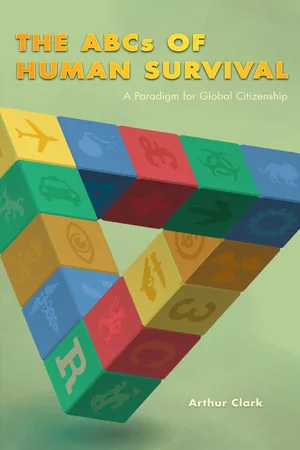
- 281 pages
- English
- ePUB (mobile friendly)
- Available on iOS & Android
eBook - ePub
ABC's of Human Survival
About this book
Information
Topic
PhilosophySubtopic
Political PhilosophyCHAPTER ONE
Choosing the Future
People do the darnedest things. They discover preventions and cures for disease; commit mass murder and rape; create masterpieces of literature; perform levitating acts of kindness and devastating acts of blindness; and invent weapons that can bring their own species to an end.
Because of this astonishing range of human options and abilities, we constantly change the world. The world of 1800 was very different from the world of 1900. No one in 1900 could have imagined what the world would be like today, and no one today can predict what the world will be like in a hundred years. The changes take place incrementally or suddenly. Absolutely essential advances may go completely unheralded; catastrophic changes are usually unforeseen. The work of years can be destroyed in minutes; the work of an afternoon can exert a powerful influence for decades. We cannot predict what the world will be like even ten years from now, yet we influence what that world will be like each day of our lives.
It was not quite a century ago that World War I was called “the war to end all wars.” That cataclysm did hideous things to countless human beings, yet even former peace activists were recruited into it, perhaps thinking this would be the last time. It was followed by an attempt to outlaw war, yet by 1940 we were at it again, descending into World War II. During that particular chapter of our history, we invented nuclear weapons, which are widely recognized as a threat to our very existence as a species.
Sobered by the consequences of our behavior, we humans then conceived the United Nations. The UN Charter, signed on June 26, 1945, opens with these words:
We, the people of the United Nations, determined to save succeeding generations from the scourge of war, which twice in our lifetime has brought untold sorrow to mankind, and to regain faith in fundamental human rights, in the dignity and worth of the human person, in the equal rights of men and women and of nations large and small … and for these ends … to ensure, by the acceptance of principles and the institution of methods, that armed force shall not be used, save in the common interest, and to employ international machinery for the promotion of the economic and social advancement of all peoples, have resolved to combine our efforts to accomplish these aims.
Where are we going?
Recurrent cycles of self-destructive behavior, followed by repeated resolutions to bring the behavior under control, characterize alcoholics as individuals and human beings as a species. There have been signs of progress toward breaking our addiction but also emerging challenges that can undermine the progress. There is the ever-present danger that such challenges might even lead to human extinction.
For the first time in history, it is possible to contemplate a non-biblical “end of the world” scenario — not an act of God but a deliberate unleashing of a manmade, global, cataclysmic chain reaction. (Brzezinski 2004, 12)
As every well-educated person knows, the dangers are not only from warfare and nuclear weapons but also from environmental conditions. Jared Diamond emphasizes a series of environmental challenges that include climate change:
Our world society is presently on a non-sustainable course, and any of our 12 problems of non-sustainability that we have just summarized would suffice to limit our lifestyle within the next several decades. They are like time bombs with fuses of less than 50 years. (2005, 498)
The major challenges we face do not occur in isolation. On the page preceding the statement quoted above, Jared Diamond provides two maps. One illustrates “political trouble spots of the modern world”; the other, “environmental trouble spots of the modern world.” The two maps are identical except for the titles.
A person weakened by hopelessness or malnutrition or an immune deficiency is more likely to succumb to an infectious disease than a person who has the same disease but is otherwise in good health. Environmental problems are made worse by militarism. Warfare undermines the basis for all human rights. Public health systems and infrastructure deteriorate when public resources are diverted into weapons acquisition and development.
Our patterns of behavior in North America indicate that we are grossly irresponsible with respect to conditions essential for human survival. This irresponsibility is apparent in our conspicuous waste and consumption, and in our disregard for the lives of people in Iraq and other parts of the world. Such irresponsibility makes all of us more vulnerable, and undermines human options for future generations. The challenges we face do not occur in isolation, nor do the consequences of our irresponsibility. Our own patterns of thinking and behavior are responsible for the self-destructive direction in which we are heading, yet we make daily choices largely unaware of this fact. It is not so much the danger of human extinction but the ongoing loss of human creative potential that chiefly concerns me in this book. We can improve human options and the conditions of human existence, but it will require a basic understanding of why we have been so self-destructive, and active use of that understanding to change ourselves and our culture. Many of our institutions are rooted in self-destructive patterns of thinking and behavior, and serve to perpetuate our self-destruction. We will have to change those institutions. The most essential part of the work, however, must be at the personal level. We cannot be part of the solution until we understand that we are part of the problem.
Where do we want to go?
“Would you tell me, please, which way I ought to go from here?”
“That depends a good deal on where you want to get to,” said the Cat.
– LEWIS CARROLL, Alice’s Adventures in Wonderland
The Cheshire Cat’s response to Alice is good advice for us as citizens. We had better think carefully about where we want to go. Leaving the choice to political leaders and the “experts” who advise them is a prescription for recurrent disaster. That’s not because political leaders and experts are evil but because their thinking and their options are largely confined to the box of the old ways of thinking and because they serve in political and cultural institutions based on those ways of thinking.
We need effective public discussion about options for our future. The discussion should be ongoing, vigorous, visionary, well informed, well organized, and well documented. It should move freely outside the box of the old ways of thinking. Erich Fromm was a careful observer of human psychology and its effects on twentieth-century society. Noting the much greater attention that had been devoted to ideas of “the good man” and “the good society” in previous centuries, he writes:
The twentieth century is conspicuous for the absence of such visions.… The absence of visions projecting a “better” man and a “better” society has had the effect of paralyzing man’s faith in himself and his future (and is at the same time the result of such a paralysis). (1947, 82–83)
If we cannot make a cooperative effort to focus human imagination on our options, then our choices will be unconscious and poorly informed, and our influence will be haphazard. Something better than that is certainly possible, and it might make the difference between survival and extinction. The question is whether we want to try.
In studying the history of societies that made catastrophic choices, Jared Diamond suggested that the failure could be thought of as having several stages:
First of all, a group may fail to anticipate a problem before the problem actually arrives. Second, when the problem does arrive, the group may fail to perceive it. Then, after they perceive it, they may fail even to try to solve it. Finally, they may try to solve it but may not succeed. (2005, 421)
The problems are all around us; they have economic, environmental, political, cultural, social, and psychological dimensions. Responsible global citizenship involves an evidence-based, goal-directed engagement in the work of solving these problems. If, as citizens of the global community, we were to take these things seriously and set to work on them, we would need some conceptual frame of reference as a pragmatic guide. I refer to such a frame of reference here as Option A, which I prefer, contrasting it with Option B, which is the self-destructive direction we have been traveling. Each of these options can be expressed in various ways; the sections and chapters that follow will develop this conceptual framework. A concise and effective way of expressing Option A and Option B was provided several decades ago by Martin Luther King Jr. It is worth repeating and memorizing:
We must learn to live together as brothers, or perish together as fools.
We can greatly improve our orientation in time and space by using this system of navigation. We can evaluate our own culture, history, and process of decision-making at each step in terms of whether they lead toward Option A or toward Option B.
I will refer to the patterns of thinking that tend to move us toward Option B as an “old paradigm” and ways of thinking that tend to move us toward Option A as a “new paradigm.” Old-paradigm thinking is characteristic of entrenched power structures, which historically have been challenged repeatedly by the new paradigm. Because they cultivate the old paradigm, empires drive themselves toward Option B (perishing as fools).
Many people are able to break free of old-paradigm thinking, but it would be a rare person who has not been influenced by it. In old-paradigm thinking, which is characterized by cynicism, Option A is “idealistic” or “unrealistic.” If you think in this way, you will probably read this book critically. Good.
The practice of medicine and the
practice of global citizenship
The bias in this book is similar to the bias in medicine, a profession in which the first principle is “Do no harm.” As in medicine, this book has a specific ethical basis (new-paradigm thinking directed toward Option A: human well-being) and a goal-oriented, evidence-based approach to understanding the conditions that influence human well-being. The same bias was articulated by Albert Camus in his novel The Plague:
All I maintain is that on this earth there are pestilences and there are victims, and it’s up to us, so far as possible, not to join forces with the pestilences. (1947, 253)
In the practice of medicine, the purpose of identifying and examining disease-producing factors and mechanisms is to find ways to cure and prevent the disease. Pathogenesis is the medical term for factors and mechanisms that produce a disease. The study of human self-destruction is essentially the study of a form of pathology. The question addressed in the next section — “Why are we so self-destructive?” — has an obvious similarity to the question “How does cancer get started and grow and metastasize?” This book presents a way of understanding the pathology that we human beings inflict on ourselves. The self-destructive patterns of human thinking and behavior, which have undermined the conditions of human existence (and are threatening human survival), are here recognized as pathological.
In writing this book, I am interested not just in the solution to a puzzle but also in actively solving the problem. If we define the problem in narrow terms as one of political leadership, we cannot solve it. Only when we begin to see that we are part of the pathogenesis, that our own patterns of thinking in fact support the self-destructive patterns of human behavior — only then can we begin to achieve optimal effectiveness in the practice of global citizenship.
Taking the practice of medicine as analogue for the practice of citizenship has a number of advantages. It helps to clarify the new paradigm, to define problems and obstacles in practice, and to identify potential solutions to the problems and ways to move past the obstacles.
Notice the emphasis on learning in the statement by Martin Luther King Jr.: learn or perish. An active process of learning is necessary, or we will perish as fools. But what is it that needs to be learned in order to move us toward Option A? After all, there is plenty to learn in moving in the other direction, toward Option B. There’s learning how to plant land mines, how to fire air-to-surface missiles, how to salute, how to display the flag, and how to sing the national anthem. There’s always a new book or article out by an Option B intellectual with plenty of new things to learn, lots of details from historical research, all placed in a conceptual framework that reinforces our tendency to move toward Option B. This book (the one you are reading) presents a way of thinking (a new paradigm) designed to facilitate progress toward Option A. Many books, websites, and other sources provide rich additional material that enhances our awareness of Option A. The culture in which we are immersed constantly floods us with information that reinforces either Option A (new paradigm) thinking or Option B (old paradigm) thinking.
The term pragmatic realism as used in this book refers to a mindset similar to that of a good physician in the midst of a crisis that threatens human health and well-being. Very much aware of the dangers, the physician is also aware that timely and intelligent action can reduce the dangers and lead to optimal outcomes.
Pragmatic realism recognizes our own part in human self-destruction, but also our capacity for better, more life-affirming human options. It seeks an evidence-based way to promote human well-being and enable optimal development of human possibilities. Pragmatic realism has the patience and concern for the well-being of others, as well as the respect for their value, that characterize a good physician.
Pragmatic realism is essential to the practice of responsible, effective local and global citizenship. Pragmatic realism can drive a positive feed-forward loop whereby the practice of responsible citizenship revitalizes democratic process, and that revitalized democracy steadily reinforces international law. The resulting increase in human security worldwide enables the conditions that foster human creative potential (education, public health measures, community interaction). By amplifying this process locally and globally, and by creating structures and resources for that purpose, this part of the feed-forward loop can foster a sustained application of human intelligence in the service of human well-being, similar to that seen in the best health care systems. That would mean a constant reinforcement of the practice of responsible citizenship, with its feed-forward effects on democracy, international law, and human security.
Pathogenesis: Why are we so self-destructive?
In the 1980s, the Cold War was drawing to a close. Nuclear weapons might have been eliminated, along with a wide range of other costly and destructive Cold War-era policies and practices. Enormous resources could have been freed up and redirected toward more constructive alternatives. The benefits from that line of decision-making would have been beyond our ability to calculate.
Instead, governments chose to perpetuate the warfare system. In the 1990s, violence was escalated again and again when other options were available. We will be paying the costs of this choice — also incalculable — for decades to come. One example of the consequences will be examined in detail in Chapter 5, “The Case of Iraq.”
Why are political leaders and their advisors so incompetent at breaking this self-destructive pattern of human behavior? It’s a puzzle, potentially much more interesting than a murder mystery or a crossword. And the solution will be incomparably more rewarding.
There have been many approaches to solving the puzzle, including Marxist perspectives, comparisons with the territorial behavior of other species, and historicist analyses that emphasize the decision-making processes of political leaders. A critical analysis of institutions that promote the self-destructive patterns of thinking and behavior is also essential. These are a few examples of analytic paradigms for understanding the origins of war.
Even more basic to solving not only the puzzle but also the problem are approaches that help us understand how we (you and I) are contributing to human self-destruction. In a book that has become a modern classic (The Denial of Death, 1973), Ernest Becker proposes that our self-destructive behavior and much of our culture can be explained by the very human fear of death. Each of us is going to die, and we know it. Culture can be understood as a strategy for coping with the anxiety produced by that awareness. We create “immortality systems,” ways of denying our mortality by identifying with something we believe to be eternal. Being a citizen of the Roman Empire, a Roman Catholic, a Christian, a Muslim, a Jew, a patriot, a Communist, or simply being “saved” can serve as a sort of security blanket. I am an American (or a Christian or whatever), and America (or the Kingdom of God or whatever) is eternal and I am part of it and so I am immortal. This “immortality system” makes the very idea of death more bearable.
Referring to Sigmund Freud’s book Group Psychology and the Analysis of the Ego and developments that followed it, Becker sketches an understanding of why a political leader can so easily induce complicity in acts of aggression and destruction. If “the leader” orders the killing of tens of thousands of people, it becomes “holy aggression.” Thus members of the armed forces can kill with equanimity, and a society can remain silent while its government deprives human beings of basic human rights. It is allegiance to what has been declared right and noble and good.
Our awareness of death could remind us of our shared humanity and become part of the basis for creating a healthy global community. Instead, it has become one of the forces producing the dysfunctional global community we inhabit today.
Becker’s way of thinking is useful because it draws the connection between something that is deeply compelling at the personal level and something that is profoundly destructive at the level of world events. To understand why we are so self-destructive will take more than this, but The Denial of Death can serve as one very helpful reference point.
The countless versions, combinations, and permutations of immortality systems include the one promulgated by imperialist Cecil John Rhodes (1853–1902):
Only one race approached God’s ideal type, his own Anglo-Saxon race: God’s purpose then was to make the Anglo-Saxon race predominant, and the best way to help on God’s work and fulfill His purpose in the world was to contribute to the predominance of the Anglo-Saxon race and so bring nearer the reign of justice, liberty and peace. (Rhodes, quoted in Alexander 1...
Table of contents
- Cover Page
- Title Page
- Copyright Page
- Dedication
- Contents
- Acknowledgements
- Foreword
- Introduction and Overview
- Chapter One: Choosing the Future
- Chapter Two: Axioms
- Chapter Three: Paradigm Shift
- Chapter Four: Principles of Global Community
- Chapter Five: The Case of Iraq
- Chapter Six: Principles of Global Citizenship
- Chapter Seven: Practicing Citizenship
- Chapter Eight: Prognosis
- Bibliograpy
Trusted by 375,005 students
Access to over 1.5 million titles for a fair monthly price.
Study more efficiently using our study tools.
Frequently asked questions
Yes, you can cancel anytime from the Subscription tab in your account settings on the Perlego website. Your subscription will stay active until the end of your current billing period. Learn how to cancel your subscription
No, books cannot be downloaded as external files, such as PDFs, for use outside of Perlego. However, you can download books within the Perlego app for offline reading on mobile or tablet. Learn how to download books offline
Perlego offers two plans: Essential and Complete
- Essential is ideal for learners and professionals who enjoy exploring a wide range of subjects. Access the Essential Library with 800,000+ trusted titles and best-sellers across business, personal growth, and the humanities. Includes unlimited reading time and Standard Read Aloud voice.
- Complete: Perfect for advanced learners and researchers needing full, unrestricted access. Unlock 1.5M+ books across hundreds of subjects, including academic and specialized titles. The Complete Plan also includes advanced features like Premium Read Aloud and Research Assistant.
We are an online textbook subscription service, where you can get access to an entire online library for less than the price of a single book per month. With over 1.5 million books across 990+ topics, we’ve got you covered! Learn about our mission
Look out for the read-aloud symbol on your next book to see if you can listen to it. The read-aloud tool reads text aloud for you, highlighting the text as it is being read. You can pause it, speed it up and slow it down. Learn more about Read Aloud
Yes! You can use the Perlego app on both iOS and Android devices to read anytime, anywhere — even offline. Perfect for commutes or when you’re on the go.
Please note we cannot support devices running on iOS 13 and Android 7 or earlier. Learn more about using the app
Please note we cannot support devices running on iOS 13 and Android 7 or earlier. Learn more about using the app
Yes, you can access ABC's of Human Survival by Arthur Clark in PDF and/or ePUB format, as well as other popular books in Philosophy & Political Philosophy. We have over 1.5 million books available in our catalogue for you to explore.