When citizens take collaborative action to meet the needs of their community, they are participating in the social economy. Co-operatives, community-based social services, local non-profit organizations, and charitable foundations are all examples of social economies that emphasize mutual benefit rather than the accumulation of profit. While such groups often participate in market-based activities to achieve their goals, they also pose an alternative to the capitalist market economy. Contributors to Scaling Up investigated innovative social economies in British Columbia and Alberta and discovered that achieving a social good through collective, grassroots enterprise resulted in a sustainable way of satisfying human needs that was also, by extension, environmentally responsible. As these case studies illustrate, organizations that are capable of harnessing the power of a social economy generally demonstrate a commitment to three outcomes: greater social justice, financial self-sufficiency, and environmental sustainability. Within the matrix of these three allied principles lie new strategic directions for the politics of sustainability. Whether they were examining attainable and affordable housing initiatives, co-operative approaches to the provision of social services, local credit unions, farmers' markets, or community-owned power companies, the contributors found social economies providing solutions based on reciprocity and an understanding of how parts function within the whole—an understanding that is essential to sustainability. In these locally defined and controlled, democratically operated organizations we see possibilities for a more human economy that is capable of transforming the very social and technical systems that make our current way of life unsustainable.Contributors: Mary Beckie, Randy Bell, Marena Brinkhurst, Kailey Cannon, Sean Connelly, Mike Gismondi, Lillian Hunt, Noel Keough, Freya Kristensen, Celia Lee, Mike Lewis, Julie L. MacArthur, Terri MacDonald, Sean Markey, Juanita Marois, George Penhold, Stewart Perry, John Restakis, Lauren Rethoret, Mark Roseland, Lynda Ross, Erin Swift-Leppakumpu, and Kelly Vodden.
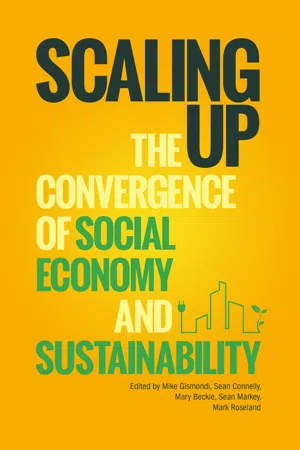
- 316 pages
- English
- ePUB (mobile friendly)
- Available on iOS & Android
eBook - ePub
About this book
Information
Subtopic
Sustainable DevelopmentIndex
EconomicsTable of contents
- Cover
- Title Page
- Copyright Page
- Dedication
- Contents
- List of Tables and Figures
- Acknowledgements
- Introduction: Social Economics and Sustainability
- 1 Towards Convergence: An Exploratory Framework
- 2 The Green Social Economy in British Columbia and Alberta
- 3 The Role of the Social Economy in Scaling Up Alternative Food Initiatives
- 4 Human Services and the Caring Society
- 5 Towards Sustainable Resource Management: Community Energy and Forestry in British Columbia and Alberta
- 6 Evolving Conceptions of the Social Economy: The Arts, Culture, and Tourism in Alert Bay
- 7 Non-Profit and Co-operative Organizations and the Provision of Social Housing
- 8 Land Tenure Innovations for Sustainable Communities
- 9 Sustaining Social Democracy Through Heritage-Building Conservation
- 10 Strong Institutions, Weak Strategies: Credit Unions and the Rural Social Economy
- Conclusion: “Social Economizing” Sustainability
- List of Contributors
Trusted by 375,005 students
Access to over 1.5 million titles for a fair monthly price.
Study more efficiently using our study tools.
Frequently asked questions
Yes, you can cancel anytime from the Subscription tab in your account settings on the Perlego website. Your subscription will stay active until the end of your current billing period. Learn how to cancel your subscription
No, books cannot be downloaded as external files, such as PDFs, for use outside of Perlego. However, you can download books within the Perlego app for offline reading on mobile or tablet. Learn how to download books offline
Perlego offers two plans: Essential and Complete
- Essential is ideal for learners and professionals who enjoy exploring a wide range of subjects. Access the Essential Library with 800,000+ trusted titles and best-sellers across business, personal growth, and the humanities. Includes unlimited reading time and Standard Read Aloud voice.
- Complete: Perfect for advanced learners and researchers needing full, unrestricted access. Unlock 1.5M+ books across hundreds of subjects, including academic and specialized titles. The Complete Plan also includes advanced features like Premium Read Aloud and Research Assistant.
We are an online textbook subscription service, where you can get access to an entire online library for less than the price of a single book per month. With over 1.5 million books across 990+ topics, we’ve got you covered! Learn about our mission
Look out for the read-aloud symbol on your next book to see if you can listen to it. The read-aloud tool reads text aloud for you, highlighting the text as it is being read. You can pause it, speed it up and slow it down. Learn more about Read Aloud
Yes! You can use the Perlego app on both iOS and Android devices to read anytime, anywhere — even offline. Perfect for commutes or when you’re on the go.
Please note we cannot support devices running on iOS 13 and Android 7 or earlier. Learn more about using the app
Please note we cannot support devices running on iOS 13 and Android 7 or earlier. Learn more about using the app
Yes, you can access Scaling Up by Mike Gismondi, Sean Connelly, Mary Beckie, Sean Markey, Mark Roseland in PDF and/or ePUB format, as well as other popular books in Economics & Sustainable Development. We have over 1.5 million books available in our catalogue for you to explore.