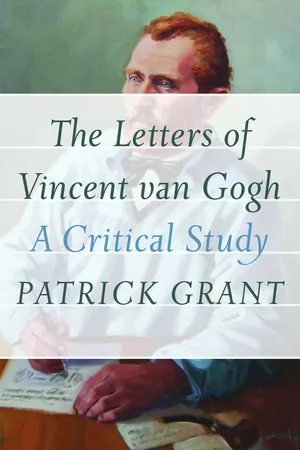
When he died at the age of thirty-seven, Vincent van Gogh left a legacy of over two thousand artworks, for which he is now justly famous. But van Gogh was also a prodigious writer of letters—more than eight hundred of them, addressed to his parents, to friends such as Paul Gauguin, and, above all, to his brother Theo. His letters have long been admired for their exceptional literary quality, and art historians have sometimes drawn on the letters in their analysis of the paintings. And yet, to date, no one has undertaken a critical assessment of this remarkable body of writing—not as a footnote to the paintings but as a highly sophisticated literary achievement in its own right. Patrick Grant's long-awaited study provides such an assessment and, as such, redresses a significant omission in the field of van Gogh studies.As Grant demonstrates, quite apart from furnishing a highly revealing self-portrait of their author, the letters are compelling for their imaginative and expressive power, as well as for the perceptive commentary they offer on universal human themes. Through a subtle exploration of van Gogh's contrastive style of thinking and his fascination with the notion of imperfection, Grant illuminates gradual shifts in van Gogh's ideas on religion, ethics, and the meaning of art. He also analyzes the metaphorical significance of a number of key images in the letters, which prove to yield unexpected psychological and conceptual connections, and probes the relationships that surface when the letters are viewed as a cohesive literary product. The result is a wealth of new insights into van Gogh's inner landscape.
- 254 pages
- English
- ePUB (mobile friendly)
- Available on iOS & Android
eBook - ePub
The Letters of Vincent van Gogh
About this book
Information
Topic
ArtSubtopic
History of ArtAgonistes
Religion,
Morality,
Art
CHAPTER 1
Religious Convictions, Moral Imperatives
Long ago, Aristotle pointed out that the sheer bulk of a great literary work is a significant part of its aesthetic effect.1 He was thinking mainly of Homer, but the world’s great books written since Aristotle’s time also illustrate his point. Tolstoi and Proust, Dante and Spenser, Joyce and Dostoevsky might well wear a reader down with complexities so intricate and narratives of such scale that their sheer weight leaves one wrung out, yet with the knowledge of having experienced something remarkable, perhaps life altering. The reader’s patience and endurance then become part of the gratification, built into the hard-won understanding that profound insight cannot be expected to come easily but is often all the more powerful and affecting for that.
Reading the entire collection of Van Gogh’s letters produces a similar range of effects. It is all so massive, the story so gripping, the density and entanglement of the personal relationships so conflicted, the joy and distress, affection and anger, hope and disappointment so engaging and disconcerting that a reader might buckle on occasion under the weight of these hundreds of letters, thousands of pages. But when all is done, the grandeur, courage, and tragic beauty that gather and fill as the letters tell their remarkable story leave a reader feeling as though affected by a great work of literature, as if taken up by something deeply humanizing and pervaded, as Wordsworth has it, by “thoughts that do often lie too deep for tears.”2
Certainly, the going is not easy, and the dense texture of Van Gogh’s correspondence can make it difficult to keep one’s bearings or to be sure about his opinions or about lines of development in his thinking. Yet I suggest that this difficulty is in itself a significant aspect of Van Gogh’s exploration of the ideals to which he aspired and which preoccupied him throughout his life.
Idealism and the Negative Contrast
As we might expect, these ideals often gave rise to conflict for Van Gogh, despite the fact that what they recommend is, precisely, the transcendence of conflict — this is a problem that attends idealism wherever we find it. The theologian Edward Schillebeekx uses the phrase “negative contrast” to explain this conundrum.3 Briefly summarized, Schillebeekx points out that ideals set standards in light of which we discover, by (negative) contrast, how imperfect we actually are. This discovery, in turn, generates dissatisfaction and energizes us to bring about change. The negative contrast therefore need not invalidate the ideal but can actually enhance it, while also engendering protest and indignation.
Throughout his life, Van Gogh experienced the negative contrast phenomenon with special intensity because he was, consistently and incorrigibly, a passionate idealist.4 “Imperfect and full of faults as we are,” he explains to his friend Van Rappard, “we’re never justified in stifling the ideal” (341/6:330).5 With these words in mind, I suggest that the narrative of Van Gogh’s life can be read as a story of how his ideals repeatedly break against a series of negative contrast experiences until, at last, he formulates an ideal that paradoxically thematizes imperfection itself as a marker of authenticity and humaneness. This narrative — or quasi-narrative — is not biographical in the usual sense. Rather, it describes Van Gogh’s struggles with a series of negative contrasts that both challenge and define his idealism, especially in relation to his lifelong preoccupations with religion, morality, and art.
Throughout the letters, Van Gogh’s discussions of these central preoccupations are everywhere interwoven, each of them rising to a favoured or dominant position during a particular phase of his career. Yet his progression from one to the other does not occur by way of simple or direct replacement. For instance, Van Gogh’s religion was always enhanced and promoted by art, and even when he abandoned conventional Christianity, his sensibility continued to be informed by it. Likewise, art and religion continued to have an indispensable moral dimension for him, so that no one of these topics can be well understood in his letters without reference to the others.
In claiming, then, that Van Gogh’s idealism shifted from religion to morality and from morality to art, I am suggesting not a straightforward substitution but rather a dialogical process. Mikhail Bakhtin argues that in literature, truth always comes to us dialogically.6 In this, he is not far removed from Heidegger’s idea, which I cited in the introduction, about truth as the revelation of new dimensions of familiar things by way of personal encounter. It is also important to note that the open-endedness of dialogue does not pre-empt coherence, and I will suggest below that the dialogical complexities of Van Gogh’s writing provide a convincing and sustaining integrity to his engagement with the ideals that informed and shaped his thinking.
Early Letters: Brave New Worlds
One thing that strikes a reader straightaway about Van Gogh’s early letters from The Hague (1872–73) and from London (1873–75) is his concern for the family from whom he had recently been separated. His expressions of interest and attachment are straightforward and generous: “How is Uncle Hein?; how is Aunt doing?” (5/1:25); “tell me how you’re spending your days at present” (9/1:30); “How are Mauve and Jet Carbentus? Write to me with news of them” (22/1:44). He is lonely (“I sometimes yearn so much for Holland” [22/1:45]), even though he puts a brave face on things: “Sometimes I start to believe that I’m gradually beginning to turn into a true cosmopolitan. . . . With the world as my mother country” (18/1:42). In later letters, he would continue to counteract homesickness by expressing a desire to make another kind of home to supply the original loss: similar combinations of nostalgia and utopian aspiration recur throughout his correspondence, not least towards the end of his life.
In the early letters from London, Van Gogh is enthusiastic about paintings he has seen and museums he has visited. He describes books he has read, and he praises the beauty of the countryside (12/1:35). “Find things beautiful as much as you can, most people find too little beautiful” (17/1:41), he tells Theo eagerly. Among his admired authors, he lists Michelet and Renan, both of whom were anticlerical, valuing Jesus’s morality above the creeds and institutional structures of the church. Vincent tells Theo that Michelet’s L’amour “was a revelation and immediately a gospel to me” (27/1:51), and he approves of Renan’s call for self-sacrifice (33/1:57) on the grounds that we are not here to be happy but “to accomplish great things through society, to arrive at nobleness, and to outgrow the vulgarity in which the existence of almost all individuals drags on” (33/1:52).7 In his exploration of these thinkers who put morality before religion and secularism before ecclesiastical orthodoxy, Van Gogh was already finding ways to challenge the religion of his parents, whose solicitous concern about his career and prospects had precipitated his transfer to London and caused him to feel resentment.8
Vincent tells Theo that he has recently started drawing again, though he is dismissive of the results (“it was nothing special” [23/1:45]).9 As with much else during his early stay in London, his impulse to draw was not connected to any career goal; his main concerns were finding good lodgings and taking in the cultural richness of his new surroundings.
In general, then, these early letters, both from The Hague and from London, show the young Van Gogh full of ardour, and insofar as we can identify the stirrings of idealism, they are diffuse, expressed in an exploratory enthusiasm for Michelet’s L’amour, for Renan’s grand gesture about accomplishing “great things,” and in a nostalgically tinged longing for home and for a new cosmopolitanism. To “a good and a single eye,” Van Gogh says, “it’s beautiful everywhere” (27/1:51), and an open, energetic curiosity pervades his writing, which, by and large, is as yet without vigorous partisan rancour or polemical intensity.
But things changed for Van Gogh after he left London for Paris in May 1875. As I mentioned in the introduction, his attempt to make a home for himself with the Loyers failed, much to Van Gogh’s disappointment. About his later amorous misadventures with Kee Vos, Sien Hoornik, and Margot Begemann, Vincent would confide at length in Theo, but in no surviving letter does he discuss why or how he came to grief with the Loyers; we are left to assess the depth of his disappointment from the fact that, as Naifeh and Smith point out, he stopped writing home, stopped drawing, and neglected his duties at work.10 This neglect caused him to be transferred temporarily to Paris, where his dissatisfaction with the art-dealing business became increasingly clear, leading to his being fired by Goupil early in 1876. The main reason for his loss of interest in art dealing is simple: he had found religion — the first powerful ideal upon which he consciously focused his attention and energy. This focus remained until, in the Borinage in 1880, his religious enthusiasm yielded to a new conviction that he should become an artist.
Religion and the Challenge of Suffering
During his religious phase, which we can date roughly from 1875 to 1880, Van Gogh seized especially on St. Paul’s challenging advice to Christians to be “sorrowful yet always rejoicing” (2 Corinthians 6:10). This verse, which distills St. Paul’s understanding of the core Christian message that suffering precedes resurrection, had a strong appeal for Van Gogh, to whom asceticism came easily. “Sorrowful yet alway rejoicing,” he tells Theo, writing from Paris in June 1875, “and that we must become” (35/1:61). From Isleworth in 1876, he describes St. Paul’s advice as “words that accompany us and grow up with us, as it were” (90/1:114). In these examples, the homesick sorrow countered by optimism in Van Gogh’s earliest letters is transformed into a more deeply felt sense of loss countered, in turn, by a more intensely felt religious idealism.
In the biographical outline in the introduction, I indicated how, in pursuing his newly discovered religious vocation, Van Gogh moved from Paris to England, Dordrecht, Amsterdam, Brussels, and the Borinage before returning in 1881 to his parents in Etten. But in the present chapter, I am mainly interested in Van Gogh’s religious idealism in relation to the negative contrast experiences that transformed it, and with this in mind, I note that although his main focus during the years between 1875 and 1880 was on religion, his interest in art remained vigorous and he continued to bring high moral standards to bear on what he understood religion to be. And so, although art and morality were subordinate to faith, they remained part of a continuing dialogue by means of which Van Gogh was better able to understand what faith meant to him in the first place. Thus, for instance, in 1875, he acknowledges “a feeling for art” that he and Theo share, but he also provides a caution, keeping art in its place: “Don’t give in to that too much either.” Worshipping God “in spirit and in truth” (49/1:74) remains the first priority, although Van Gogh does not dismiss art or fail to be moved by it. When he goes to a sale of Millet’s drawings in Paris in June 1875, for instance, he cites Exodus as a way of expressing his feelings about the sanctity of the occasion: “Put off thy shoes from off they feet, for the place whereon thou standest is holy ground” (36/1:62). In various letters, he admires Holbein (85), Boughton (89), Scheffer (116), Ruisdael (120), and Millais (122), among others, expressing the feeling, as he would continue to do throughout his life, that great art touches us spiritually, beyond the material confines of the world. When, in Etten, shortly before he went to the Borinage, he commends “those who work with their heart and with their mind and spirit,” he assures Theo how “that too is high art” (145/1:230).
During his religious phase, Van Gogh continued to draw, and he admits that even when reading the Bible, “I cannot help making a little drawing now and then” (120/1:177). But when he thinks about some sketches he would like to make, he decides that they “would most likely keep me from my real work,” so “it’s better I don’t begin” (148/1:233). Art thus remains the handmaiden of religion, subordinate to Van Gogh’s desire to know the Bible by heart (108/1:150) and to “our desire to become Christians” (56/1:182) on the model, especially, of the “Christian labourer” (109/1:151) or workman in the name of Christ.
For Van Gogh, Christianity also entailed a heavy burden of moral responsibility.11 His sense of solidarity with the poor and the marginalized is clear from his desire to minister to slum dwellers in London when, as he tells us, he was too young to qualify (85/1:104) and from his compassion for his fellow inmates at the asylum in St. Rémy (776/5:23). God’s help, he says, is “not far from those who have a broken heart and a contrite spirit” (118/1:166), and partly for that reason, he found a special beauty and sanctity in the poor. Writing from Isleworth on 3 October 1876, he recalls that autumn in Paris is indeed splendid, and so is Notre Dame Cathedral, but there is something more beautiful still, “and that is the poor people there” (92/1:118).12 Later, Van Gogh’s evangelizing activity in the Borinage was inspired especially by a desire to comfort the overworked, impoverished, and frequently ill miners, whose living conditions he went to great lengths to share. His academic study of theology had always been of secondary importance to his missionary fervour, which helps to explain why he failed to complete his course in Amsterdam. He preferred to be directly in contact with people such as he found in the Borinage: the “many sickly and bedridden people, lying emaciated on their beds, weak and miserable” (151/1:239). He wanted these unfortunates to know that they could find comfort in Jesus Christ, “because He himself is the great Man of Sorrows, who knows our diseases” (149/1:236), and during the years of his religious enthusiasm, Ary Scheffer’s well-known painting, Christus Consolator, appealed strongly to him (85, 101).
Writing from the Borinage in 1879, Vincent explains to Theo that he experiences “a familiar feeling” among the miners and that “foreigners who are homesick may come to feel at home here” (150/1:238). Once more, Van Gogh’s homesickness caused him to look for an alternative homeland that he felt would satisfy his nostalgia by supplying a more authentic sense of community than did his family in Holland. This conflict between attachment to his Dutch home and his aspiration to a community based on shared principles and values persisted throughout Van Gogh’s life, as we shall see in chapter 7. Still, a reader might be inclined to doubt the degree to which he really did “feel at home” among the miners, to whom he was, quite conspicuously, a stranger. This does not mean that the sincerity of his desire is to be doubted — only that there might be an element of whistling in the dark here, as Van Gogh himself would discover on more than one occasion in relation to his utopian aspirations.13
The moral imperative that informed Van Gogh’s religious commitment might cause us to ask why morality on its own was not a sufficient motivation for serving the poor. His answer is straightforward, as he explains to Theo from Amsterdam in 1877. The problem of evil is simply too overwhelming for morality to deal with it unaided:
There is evil in the world and in ourselves, terrible things, and one doesn’t have to have gone far in life to dread much and to feel the need for unfaltering hope in a life after this one, and to know that without faith in a God one cannot live — cannot endure. But with that faith one can long endure. (117/1:164)
Here, the problem of evil threatens to traumatize individual moral agency, and God alone has the power to carry us through, enabling us to sustain the fight. This is a perennial theme in Christian spirituality: just as art can help to bring us to God, so morality is energized by religious faith. Van Gogh’s favourite reading during his religious period included Thomas à Kempis, Bunyan, Bossuet, and Fénelon.14 These writers have in common an insistence on the castigation of selfwill, enabling one to live entirely in Christ. But when, as a result of the Borinage experience, Van Gogh no longer regarded morality as the handmaiden of a dominant religious ideology, he abandoned these writers altogether. By contrast, socially reforming writers such as Dickens and Beecher-Stowe, among others, remained favourites to the end.
In this context, it is worth mentioning that when he set out to pursue a religious vocation, Van Gogh reversed his early enthusiasm for Michelet. Like Renan, the antiecclesiastical Michelet emphasized the moral dimension of Christianity at the expense of traditional theology. In 1875, the intensely religious Vincent tells Theo, “I’m going to get rid of all my books by Michelet etc. etc.” and then adds, “you should too” (50/1:75).15 By and by, when Van Gogh broke with official Christianity, he again reversed his opinion of Michelet, embracing him once more as an ally.
The flexibility of Van Gogh’s opinions about Michelet is typical of the dialogical transformations that the letters record, especially when Van Gogh’s idealism encountered the negative contrast experiences that caused him to take new bearings. In response to the ignominious end of his career as an art dealer, for instance, he intensified his interest in religion, which he decided to pursue as a vocation, a higher ideal that would transcend his disappointment. But, in turn, his religious devotion gave rise to a heightened awareness of everything in the world that stands in contrast to the blessed community of the kingdom of heaven that Christianity promises. As we have seen, the weight of this negative contrast appears in Van Gogh’s writing as an awareness of the relationship between religious belief and the problem of suffering among the Borinage miners. It also appears by way of an intensified sensitivity to death.
When his friend Harry Gladwell’s sister, Susannah, died at age seventeen, Van Gogh set out in the late morning to attend the funeral, walking some thirty kilometres from Isleworth to Lewisham and arriving some six hours later, around five in the afternoon. He recounts how the mourners had by that time returned from the funeral service, and how he “had feelings of embarrassment and shame at seeing that deep, estimable grief.” He talked with Harry until late in the day “about all kinds of things, about the kingdom of God and about his Bible.” He then took a train to Richmond, from where he walked home. While he waited for the train, he says, “we walked back and forth on that station, in that everyday world, but with a feeling that was not everyday.” He explains how “I’d have liked to comfort the Father, but I was embarrassed” (88/1:109).
Intensity and delicacy combine in this account as the strength and vigour of Van Gogh’s all-day walk stands in counterpoint to his shyness and inarticulacy faced with the grief of the mourners, especially the girl’s father. We sense...
Table of contents
- Cover Page
- Title Page
- Copyright Page
- Dedication
- Contents
- Preface and Acknowledgements
- Introduction: Letters as Literature
- Part I Vincent Agonistes: Religion, Morality, Art
- Part II Thinking in Images
- Part III Exploring with Ideas
- Conclusion: “My Own Portrait in Writing”
- Notes
- Index
Trusted by 375,005 students
Access to over 1.5 million titles for a fair monthly price.
Study more efficiently using our study tools.
Frequently asked questions
Yes, you can cancel anytime from the Subscription tab in your account settings on the Perlego website. Your subscription will stay active until the end of your current billing period. Learn how to cancel your subscription
No, books cannot be downloaded as external files, such as PDFs, for use outside of Perlego. However, you can download books within the Perlego app for offline reading on mobile or tablet. Learn how to download books offline
Perlego offers two plans: Essential and Complete
- Essential is ideal for learners and professionals who enjoy exploring a wide range of subjects. Access the Essential Library with 800,000+ trusted titles and best-sellers across business, personal growth, and the humanities. Includes unlimited reading time and Standard Read Aloud voice.
- Complete: Perfect for advanced learners and researchers needing full, unrestricted access. Unlock 1.5M+ books across hundreds of subjects, including academic and specialized titles. The Complete Plan also includes advanced features like Premium Read Aloud and Research Assistant.
We are an online textbook subscription service, where you can get access to an entire online library for less than the price of a single book per month. With over 1.5 million books across 990+ topics, we’ve got you covered! Learn about our mission
Look out for the read-aloud symbol on your next book to see if you can listen to it. The read-aloud tool reads text aloud for you, highlighting the text as it is being read. You can pause it, speed it up and slow it down. Learn more about Read Aloud
Yes! You can use the Perlego app on both iOS and Android devices to read anytime, anywhere — even offline. Perfect for commutes or when you’re on the go.
Please note we cannot support devices running on iOS 13 and Android 7 or earlier. Learn more about using the app
Please note we cannot support devices running on iOS 13 and Android 7 or earlier. Learn more about using the app
Yes, you can access The Letters of Vincent van Gogh by Patrick Grant in PDF and/or ePUB format, as well as other popular books in Art & History of Art. We have over 1.5 million books available in our catalogue for you to explore.