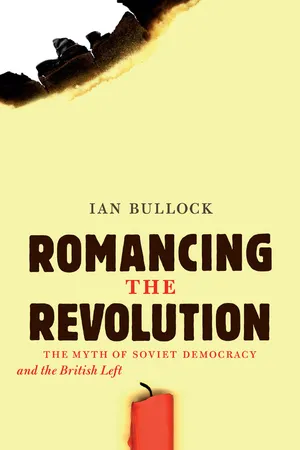
Over two decades have passed since the collapse of the USSR, yet the words "Soviet Union" still carry significant weight in the collective memory of millions. But how often do we consider the true meaning of the term "Soviet"? Drawing extensively on left-wing press archives, Romancing the Revolution traces the reactions of the British Left to the idealized concept of Soviet democracy. Focusing on the turbulent period after the 1917 Russian Revolution, author Ian Bullock examines the impact of the myth of Soviet democracy: the belief that Russia was embarking on a brave experiment in a form of popular government more genuine and advanced than even the best forms of parliamentarism. Romancing the Revolution uncovers the imprint of this myth on left-wing organizations and their publications, ranging from those that presented themselves as "British Bolsheviks"—the British Socialist party and The Call, the Socialist Labour party's The Socialist, Sylvia Pankhurst's Workers' Dreadnought —to the much more equivocal Labour Leader and The New Statesmen.
- 439 pages
- English
- ePUB (mobile friendly)
- Available on iOS & Android
eBook - ePub
Romancing the Revolution
About this book
Information
1
WELL-PREPARED GROUND
The British Left on the Eve of the Russian Revolution
The Main Constituents of the British Left
Prior to the events of 1917, the shape and contours of the British Left were significantly different from the pattern that was subsequently to emerge. The Labour Party had existed since 1900, until 1906 under the official title of the Labour Representation Committee (LRC). But there was no individual membership until the introduction of the new constitution in 1918, the effects of which took some time to work through. Prior to this, one joined the party either by being a member of one of the affiliated unions (which, essentially, provided the cash) and paying the political levy or by becoming a member of the Independent Labour Party (ILP), which saw itself with some justification as its parent: the Labour Party was Keir Hardie’s “Labour Alliance” idea of the 1890s made flesh. The ILP aspired to provide the Labour Party’s socialist ethos and policies. As a Bristol ILP leaflet seeking to explain the difference between the two parties put it: “The I.L.P supplies the driving force.”1 This was in 1919, when Labour’s new constitution seemed to put in question the role — even the existence — of the ILP.
Membership statistics for political organizations are notoriously unreliable — and even if they were accurate there would still be questions about how large a proportion of the membership was in some sense “active” and how many were simply “book members.” But certainly, by British standards at least, the ILP was large for a socialist organization. It was by far the largest of the parties and groupings we shall be focusing on in this study. Gidon Cohen begins his book on the ILP, The Failure of a Dream, by pointing out that, though its membership had declined from a peak in the mid-1920s, at the time of its ill-fated disaffiliation from Labour in 1932 it “was over five times the size of the Communist Party.”2 In the years immediately following World War I, the ILP had about thirty thousand members.3 The ILP’s radical appeal was at this time largely based on its opposition to the war.
The next largest socialist organization was the British Socialist Party. Its origins went back to the 1881 foundation, by Henry Hyndman and others, of the Democratic Federation, which changed its name to the Social-Democratic Federation (SDF) in 1884. Renamed the Social-Democratic Party in 1907, it became the core of the British Socialist Party (BSP) in 1911. Although the leadership of the ILP discouraged the idea, there had long been a desire among at least some British socialists to form a single, united socialist party. In the 1890s and 1900s, this effort could count on the support of Robert Blatchford’s popular (for a left-wing publication) weekly, The Clarion. The Unity Conference of 1911 failed to bring about the unity sought by many British socialists, but it did bring over to the new BSP a small number of ILP branches and some other, largely local, socialist organizations. The war tore the BSP apart, however, with the party as a whole refusing to support the war and a minority of “Hyndmanites,” who saw themselves as the “Old Guard of the S.D.F.” and who regarded the war as legitimate “national defence,” walking out of the party’s 1916 conference.
The SDF had participated in the setting up of the LRC in 1900 but had left the following year. A substantial section of the membership continued to favour returning to the Labour fold, and, during the war, the BSP affiliated to the Labour Party. In 1920, the party affiliated on the basis of a membership of ten thousand.4 The SDF-BSP is normally regarded as Marxist, which is accurate enough provided that later, more assertive and dogmatic, forms of Marxist thought are not read back into the party’s early years. Or at least not as far as the mainstream of the pre-1917 organization was concerned.
The failure of the SDF to adopt a sufficiently “rigorous” Marxist identity had led to the “impossibilist” split in the early years of the twentieth century. The main result of this ideological schism was the formation of the Socialist Labour Party (SLP), composed predominantly, to begin with, of former SDF branches in Scotland that espoused the variety of uncompromisingly purist Marxism advocated by the American socialist Daniel De Leon.5 One of the SLP’s founders and an early editor of its paper, The Socialist, was James Connolly, later to be executed for his part in the 1916 Easter Rising of the Irish republican movement in Dublin. The SLP’s membership was always small, which SLPers tended to see as a sign of revolutionary vigour and rectitude. Walter Kendall notes that the party’s 1920 conference report listed 1,258 members and estimates that by 1924 this had fallen to not more than a hundred.6 But for a few years either side of the war, the SLP exercised a disproportionate influence on British socialism generally, largely through its press’s provision of otherwise unavailable Marxist “classics.”
The complicated provenance of Sylvia Pankhurst’s organizations has already been summarized. Their stronghold — if that is the right word — was in the East End of London. We can assume that, whatever the name at the time, Pankhurst’s groups were always even smaller than the SLP. Kendall gives the membership of the CP (BSTI) as six hundred when it merged with the Communist Party of Great Britain (CPGB) early in 1921, although this is based on the party’s own report and is probably on the generous side. Pankhurst’s “Left Communist” organization, the Communist Workers’ Party, subsequent to her expulsion from the CPGB must have been tiny. But, as with the SLP, the small size of these bodies did not prevent them — and, above all, Pankhurst herself — from playing a prominent role in the years following 1917.
The shop stewards’ movement flourished in the exceptional wartime circumstances and its main organ, Solidarity, will feature quite frequently in this exploration of left-wing reactions to the notion of soviet democracy. The early ideas and attitudes of the shop stewards’ movement can be traced most immediately to the wave of strikes and union amalgamation campaigns that preceded the war and to the Industrial Syndicalist Educational League and other broadly syndicalist or “industrial unionist” initiatives and influences. In wartime, the crucial importance, on the one hand, of industry, especially such industries as engineering, and, on the other, the government’s desperate need to conscript more and more men despite the exemption promised to skilled workers, led to intense industrial conflict, including major strikes, and, from November 1916 onwards, to attempts to create a coordinated national shop stewards’ movement.
The origins of guild socialism, which was also to play its part in the story of soviet democracy in Britain, also went back to the years before the war. It is usual to begin an account of its origins with A.J. Penty’s 1906 book, The Restoration of the Guild System, and the writings of A.R. Orage, editor of The New Age. But much more decisive in attracting people from the Left seems to have been S.G. Hobson’s National Guilds: An Inquiry into the Wage System and the Way Out, published in 1914, and the adhesion of younger Fabian intellectuals — most notably G.D.H. Cole — in the last couple of years of peace. The National Guilds League was created in 1915, after a policy document advocating guild socialism, written by Cole and William Mellor, a former secretary of the Fabian Research Department, was rejected at the Fabians’ annual meeting.
There were of course other socialist organizations such as the Daily Herald League and the Plebs League, which will be mentioned from time to time but have not been investigated in depth. Between them, the ILP, the BSP, the SLP, and the Pankhurst groups, plus the shop stewards who gathered around Solidarity and the guild socialists, provide a sufficiently wide and varied spectrum of opinion for the purposes of this enquiry. Members of these organizations would not usually have regarded the Fabian Society as part of the “real” Left. Much criticized for being a small, London-based group of intellectuals, the Fabian Society was more like what today would be called a “think tank” than a political faction. Its most prominent members were Sidney and Beatrice Webb and George Bernard Shaw, who in 1913 had taken the lead in founding the New Statesman. This journal’s changing views on soviet democracy will also feature in later chapters, to give an indication of just how far beyond the Left as generally conceived the influence of the idea of soviet democracy had penetrated.
Radical Plebeian Democracy in British Socialism
From as early as the 1880s, versions of what the Fabians dismissed as “primitive democracy” had flourished in some parts of the British socialist movement. As the New Statesman reviewer of the Webbs’ Constitution for the Socialist Commonwealth of Great Britain noted in 1920, the authors’”central thesis” concerned the “proved inadequacy of the present machinery of democracy … to express and enforce the will of the people.” The reviewer went on to comment: “Years before the Bolsheviks came forward with their demand for a ‘dictatorship’ of the proletariat, the ‘extreme left’ in this country, as well as in America and France, had learned to speak of ‘Parliamentary’ institutions with open scorn.”7
Such attitudes went beyond what would normally be understood as the “extreme left.” In 1917, the masthead of George Lansbury’s Herald proclaimed the paper to be “The National Labour Weekly.” After the war, when it was able to resume daily publication, the paper expressed the hope that “what the Manchester Guardian is to the Liberal Party, so will be the Daily Herald to the Parliamentary Labour Party.”8 It is worth noting in relation to this declaration that Lansbury was to become leader of the Labour Party between 1932 and 1935, albeit in unique circumstances following Ramsay MacDonald’s formation of a “National” government. In July 1917, The Herald attributed to the effects of the war “the degradation of the House of Commons to a mere submissive tool of the Executive, its preoccupation with trivial matters, its deviation by catchwords and empty phrases, its control by vested interests, its indifference to human freedom and human life.” The paper called for fundamental reform of the parliamentary system, including demands that had frequently featured in the advocacy of what Fabians had termed “primitive democracy.”9
The Fabian Society had come close to defining itself in opposition to “primitive democracy” on more than one occasion. “Anti-leadership” attitudes and support for direct democracy in the form of the referendum and initiative were sufficiently widespread on the British Left in 1896 for the Fabians to insist, in a report aimed at that year’s Socialist International congress, that “democracy, as understood by the Fabian Society, means simply the control of administration by the freely elected representatives of the people” and to reject any notion that “the technical work of government administration” or the appointment of officials should “be carried out by referendum or any other form of popular decision.”10 And ten years later, in a Special Committee report, the Fabians were even more explicit: “Democracy is a word with a double meaning. To the bulk of Trade Unionists and labourers it means an intense jealousy and mistrust of all authority, and a resolute reduction of both representatives and officials to the position of mere delegates and agents of the majority.” Between this and the Fabians’ conception of democracy as “government by consent of the people” was a “gulf” that, the report said, “unfortunately cuts the Labour movement right down the middle.”11
On the far side of this “gulf” was the Social-Democratic Federation (SDF), whose program from 1884 demanded, in its first three points, the election of all “officers and administrators” by “Equal Adult Suffrage” and ratification of all legislation or decisions on “Peace or War” by referendum.12 In the 1890s, the SDF and its paper, Justice, continued to support “a system of pure democracy by means of the ‘Initiative’ and ‘Referendum,’ ”13 as did Blatchford’s influential socialist weekly, The Clarion. Blatchford’s colleague, Alex Thompson, also advocated these methods in three Clarion pamphlets.14 This was accompanied by attacks on “leadership,” whether in mainstream politics, in the ILP, or, as the episode of the ill-fated Clarion federation in the late 1890s demonstrated, in the trade unions.15 The essence of this approach to democracy was the implementation of all means whereby real power would be put into the hands of the citizen — or member, in the case of the unions — rather than an elected representative. The referendum and initiative was the key demand. Enthusiasm for the referendum and initiative tended to be episodic in early twentieth-century Britain, but it was nearly always to be found in the most “anti-establishment” sections of the Left. This version of “real democracy” by no means disappeared in what we may call the “early soviet” era — even among some of the most fervent advocates of the soviet system.
Soon to become a fervent supporter of soviet democracy and the Bolsheviks, in September 1916 J.B. Askew, a prominent member of the BSP, contributed an article to its paper, The Call, titled “Socialists and the Referendum.” “One reform to which, it seems to me, Socialists have paid far too little attention,” he wrote, “is that all measures passed by Parliament should be submitted, on demand of a certain percentage of the voters, to the verdict of a popular vote, and similarly, that the electorate should have the right in the same way to initiate legislation.” Although the system was not a panacea, Askew concluded, the referendum and initiative could...
Table of contents
- Cover Page
- Title Page
- Copyright Page
- Dedication
- Contents
- Acknowledgements
- List of Abbreviations
- Introduction
- 1 Well-Prepared Ground The British Left on the Eve of the Russian Revolution
- 2 Initial Responses to the Russian Revolution The British Left in 1917 and the Leeds “Soviet” Convention
- 3 The Bolsheviks and the British Left The October Revolution and the Suppression of the Constituent Assembly
- 4 The Myth Established The Positive View of Soviet Democracy
- 5 Polarized Social-Democrats Denunciation and Debate
- 6 Equivocal Reformists The Independent Labour Party, the Guild Socialists, and the Reaction to Kautsky
- 7 The Dictatorship of the Proletariat
- 8 The Independent Labour Party and the Third International A Crucial Test for Belief in Soviet Democracy
- 9 “An Infantile Disorder” Communist Unity and the Brief Life of the Communist Party (British Section of the Third International)
- 10 British Bolsheviks? The Socialist Labour Party
- 11 Pankhurst’s Dreadnought and the (Original) Fourth International “Left Communism” and Soviet Democracy
- 12 The Early British Communist Party Soviet Democracy Deferred and Redefined 307
- 13 Endings and Conclusions
- Notes
- Bibliography
- Index
- Footnote
Trusted by 375,005 students
Access to over 1.5 million titles for a fair monthly price.
Study more efficiently using our study tools.
Frequently asked questions
Yes, you can cancel anytime from the Subscription tab in your account settings on the Perlego website. Your subscription will stay active until the end of your current billing period. Learn how to cancel your subscription
No, books cannot be downloaded as external files, such as PDFs, for use outside of Perlego. However, you can download books within the Perlego app for offline reading on mobile or tablet. Learn how to download books offline
Perlego offers two plans: Essential and Complete
- Essential is ideal for learners and professionals who enjoy exploring a wide range of subjects. Access the Essential Library with 800,000+ trusted titles and best-sellers across business, personal growth, and the humanities. Includes unlimited reading time and Standard Read Aloud voice.
- Complete: Perfect for advanced learners and researchers needing full, unrestricted access. Unlock 1.5M+ books across hundreds of subjects, including academic and specialized titles. The Complete Plan also includes advanced features like Premium Read Aloud and Research Assistant.
We are an online textbook subscription service, where you can get access to an entire online library for less than the price of a single book per month. With over 1.5 million books across 990+ topics, we’ve got you covered! Learn about our mission
Look out for the read-aloud symbol on your next book to see if you can listen to it. The read-aloud tool reads text aloud for you, highlighting the text as it is being read. You can pause it, speed it up and slow it down. Learn more about Read Aloud
Yes! You can use the Perlego app on both iOS and Android devices to read anytime, anywhere — even offline. Perfect for commutes or when you’re on the go.
Please note we cannot support devices running on iOS 13 and Android 7 or earlier. Learn more about using the app
Please note we cannot support devices running on iOS 13 and Android 7 or earlier. Learn more about using the app
Yes, you can access Romancing the Revolution by Ian Bullock in PDF and/or ePUB format, as well as other popular books in Politics & International Relations & Communism, Post-Communism & Socialism. We have over 1.5 million books available in our catalogue for you to explore.