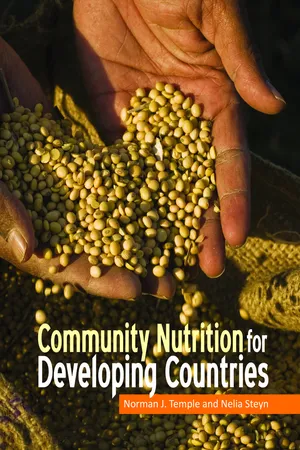
Nutrition textbooks used by universities and colleges in developing countries have very often been written by scholars who live and work in North America or the United Kingdom. And while the research and information they present is sound, the nutrition-related health challenges with which developing countries must grapple differ considerably from those found in highly industrialized Western nations. The primary aim of Community Nutrition for Developing Countries is to provide a book that meets the needs of nutritionists and other health professionals living and working in developing countries. Written by both scholars and practitioners, the volume draws on their wealth of knowledge, experience, and understanding of nutrition in developing countries to provide nutrition professionals with all the information they require. Each chapter addresses a specific nutrition challenge currently faced by developing countries such as food security, food safety, disease prevention, maternal health, and effective nutrition policy. In addition, the volume serves as an invaluable resource for those developing and implementing nutrition education programmes. With an emphasis on nutritional education as a means to prevent disease and effectively manage health disorders, it is the hope of the nearly three dozen contributors to this work that it will enhance the health and well-being of low-income populations throughout the world.
- 510 pages
- English
- ePUB (mobile friendly)
- Available on iOS & Android
eBook - ePub
Community Nutrition for Developing Countries
About this book
Information
Topic
MedicineSubtopic
Nutrition, Dietics & BariatricsPART 1
THE FOOD AND NUTRITION SITUATION IN DEVELOPING COUNTRIES
CHAPTER 1
A HUMAN RIGHTS-BASED APPROACH TO COMMUNITY AND PUBLIC NUTRITION
Theoretical Underpinnings and Evolving Experiences
Outline
• Human rights in community nutrition
• Nutrition, social justice, and human rights
• Protecting human rights in the context of economic and social development
• Economic, social, and cultural rights especially relevant to nutrition
• Implementation of rights at the country level
Objectives
At the completion of this chapter you should be able to:
• Explain the origin of the concept of universal human rights
• Describe the Millennium Declaration and the Millennium Development Goals of the United Nations
• Understand the difference between a rights-based approach and a charity-based approach to nutritional problems
• Describe the UNICEF conceptual framework for the causes of malnutrition
• Explain your understanding of social injustice in relation to nutrition and health
• Explain the obligations of the state as a “duty-bearer”
• Describe the seven core principles of a human rights–based approach
• Describe the United Nations international human rights system
• Understand what is meant by a “right to food”
• Explain the terms progressive realization and available resources in relation to the right to food
1. HUMAN RIGHTS AND COMMUNITY NUTRITION
1.1 The Concept of Human Rights
Human nutrition was, for many years, viewed within a medical framework. In development circles, however, the emphasis has recently shifted towards a more integrated approach to addressing problems of human nutrition – within the concept of human rights. This approach recognizes that human nutritional status is not determined simply by biological factors but also by social and political forces. While these forces can work to promote good nutritional status, they can also contribute to glaring social inequalities, with the result that certain population groups become especially vulnerable to economic and social changes that affect their food security and nutritional health. When adequate nutrition is understood to be a right, then one can reasonably say of the undernourished that one of their human rights has been violated.
Human rights are grounded in values and moral principles that are deemed to apply to all human beings. These rights have been enshrined in international law and, in some cases, in the laws of specific nations. All people have the same human rights, regardless of their skin colour, gender, age, language, religion, political affiliations, national or ethnic origin, innate physical and mental endowments, level of education, wealth, social class, and so on. The overriding goal of an approach based on human rights is to identify and protect those who may have been overlooked, if not more or less deliberately ignored, in development processes that in fact put their interests and needs at risk. As Judith Asher (2004, p. 2) explains in The Right to Health, “When health is not described simply in terms of needs but also in terms of rights, governments find it far more difficult to justify the withholding of basic provisions and services on account of alleged financial constraints or because of discriminatory priorities” (Asher, 2004, p. 2).
A clear difference exists between a rights-based approach and one based on charity. The latter sees the world’s hungry and malnourished as passive recipients of handouts from the state or benevolent individuals or groups. Whereas charity depends on the moral will and compassion of the giver, who chooses to provide food to people who are hungry or who suffer from food insecurity, a rights-based approach regards hungry people as active citizens deserving of respect and dignity. A right-based approach is founded on the belief that hunger and malnutrition are largely the product of man-made injustices, sometimes compounded by random factors such as natural disasters. Such an approach holds that it would be immoral of a state and its citizens to stand by and do nothing when people are in danger of starvation. Such an approach therefore firmly establishes a legal obligation of states to address hunger and malnutrition.
1.2 Human Rights and the Legacy of the United Nations
Questions concerning the fundamental rights of human beings have been debated for centuries, but it was the United Nations (UN) that formulated the modern concept of universal human rights and made it a core element of international law. When the UN was founded, in 1945, the leaders of the world’s nations hoped that the atrocities of the Second World War would never be repeated. They therefore joined hands to establish this new international organization, with the goal of fostering peace and protecting all populations against insecurity and injustice. The work of the UN is founded on the principles outlined in the Charter of the United Nations, to which all member nations are expected to adhere. Chapter I, Article 1, of the charter lays out the organization’s overarching goals (see Box 1.1).
This first article sets as one purpose of the UN to encourage “respect for human rights and for fundamental freedoms for all.” Peaceful relations among nations are unlikely to be achieved, however, if gaping disparities exist in economic and social circumstances of the world’s people. Article 55, in Chapter IX (“International Economic and Social Cooperation”), accordingly recognizes that “conditions of stability and well-being,” in which respect for human rights can flourish, are essential to international harmony (see Box 1.2). The creation of such conditions depends in part on solving the problems that contribute to the economic and social gaps among nations, including poverty, disease, and malnutrition.
Box 1.1: Article 1 of the Charter of the United Nations
The Purposes of the United Nations are:
1. To maintain international peace and security, and to that end: to take effective collective measures for the prevention and removal of threats to the peace, and for the suppression of acts of aggression or other breaches of the peace, and to bring about by peaceful means, and in conformity with the principles of justice and international law, adjustment or settlement of international disputes or situations which might lead to a breach of the peace;
2. To develop friendly relations among nations based on respect for the principle of equal rights and self-determination of peoples, and to take other appropriate measures to strengthen universal peace;
3. To achieve international cooperation in solving international problems of an economic, social, cultural, or humanitarian character, and in promoting and encouraging respect for human rights and for fundamental freedoms for all without distinction as to race, sex, language, or religion; and
4. To be a centre for harmonizing the actions of nations in the attainment of these common ends.
Box 1.2: Article 55 of the Charter of the United Nations
With a view to the creation of conditions of stability and well-being which are necessary for peaceful and friendly relations among nations based on respect for the principle of equal rights and self-determination of peoples, the United Nations shall promote:
a. higher standards of living, full employment, and conditions of economic and social progress and development;
b. solutions of international economic, social, health, and related problems; and international cultural and educational cooperation; and
c. universal respect for, and observance of, human rights and fundamental freedoms for all without distinction as to race, sex, language, or religion.
Human rights and fundamental freedoms needed to be formulated more specifically, however. Thus, in 1948, the UN General Assembly formulated the Universal Declaration on Human Rights (UDHR), which was adopted on December 10 – a day that has come to be known as Human Rights Day. Article 1 of the UDHR states: “All human beings are born free and equal in dignity and rights.” In other words, human rights are innate. The UDHR contains general provisions for civil, political, economic, social, and cultural rights.
Starting in the early 1950s, however, the Cold War developed between capitalist nations and communist ones. The advent of the Cold War complicated the understanding of human rights as one integrated “package,” as individual UN member states adopted differing approaches to safeguarding these rights, privileging some over others. The Eastern bloc – the Soviet Union and communist Eastern Europe – took the position that it was the responsibility of the state to feed and care for its people but placed little value on personal freedoms, such as free speech. In contrast, Western states, led by the United States, strongly promoted civil and political rights, while limiting the state’s responsibility to secure the material well-being of its citizens. This divide prevailed until 1989, when the fall of the Berlin Wall precipitated changes that brought the Cold War to an end.
1.3 A Renewed Interest in Human Rights
The end of the Cold War made it possible to adopt a more unified perspective on human rights. In 1993, a World Conference on Human Rights was held in Vienna. It underlined that human rights are universal, interrelated, interdependent, and indivisible. Throughout the 1990s, interest in economic, social, and cultural rights, alongside civil and political rights, was growing, as was the understanding that these rights should be understood as an integrated whole.
Still, it took time to incorporate human rights into broader international debates and plans for economic and social development, including those rights particularly relevant to food security and nutrition. In 2000, at the turn of the millennium, the leaders of all UN member states gathered in New York for a “Millennium Summit,” which resulted in the Millennium Declaration. In this document, the leaders of the world’s nations agreed that, in addition to their responsibilities to their own populations, they had “a collective responsibility to uphold the principles of human dignity, equality and equity at the global level” and “a duty therefore to all the world’s people, especially the most vulnerable and, in particular, the children of the world, to whom the future belongs” (I, 2).
The Millennium Declaration also listed certain fundamental values seen as essential for good international relations in the twenty-first century: freedom, equality, solidarity, tolerance, respect for nature, and shared responsibility (I, 6). In order to translate these shared values into actions, they identified the following key objectives of special significance:
• Peace, security, and disarmament
• Development and poverty eradication
• Protecting our common environment
• Human rights, democracy, and good governance
• Protecting the vulnerable
• Meeting the special needs of Africa
• Strengthening the United Nations
These objectives were to be pursued in an integrated manner so that they would mutually reinforce each other.
Under the objective “Development and poverty eradication,” a series of development goals was listed, for the time being formulated in relatively broad terms. These goals included targets such as the reduction in the proportion of hungry people, of under-five mortality, and of maternal mortality. These goals were later refined and condensed into the eight Millennium Development Goals (MDGs), with specific targets set for 2015 (further described in section 2.6). But while these eight goals are widely used to promote and assess progress in different countries and the world, there is an unfortunate flaw in the way they were originally presented: they did not explicitly indicate how they were to be pursued, namely, in combination with the fourth objective, “Human rights, democracy, and good governance” (Alston, 2005). Many may have assumed that the link would automatically be recognized, but this is unfortunately not yet always the case. Many governments, as well as people in general, know relatively little about human rights, or they are not interested in them, or they may see them as running counter to their own political and economic interests. Nevertheless, from the end of the last century and into the new millennium, the world has witnessed a revitalized concern with human rights.
1.4 Human Rights and the Community
The term community has both a narrower and a wider meaning. The word is most often understood in its narrower sense, as referring to the locality in which an individual or a family lives an...
Table of contents
- Cover Page
- Title Page
- Copyright Page
- Dedication
- Contents
- Foreword: Frits Pannekoek
- Preface
- Introduction
- Part 1 The Food and Nutrition Situation in Developing Countries
- Part 2 Lifecycle Nutrition
- Part 3 The Role of Nutrition in The Prevention and Treatment of Disease
- Part 4 From Food Guides to Nutrition Education
- Part 5 Key Components of Community-Based Nutrition Programmes
- Part 6 Population Nutrition and the Role of Government
- Part 7 Assessing Nutrition Status
- Part 8 Food Services and Food Safety
- Part 9 A Broader Perspective
- Appendix I Sources of Reliable Information on Nutrition
- Appendix II Aids to Calculations
- Appendix III Dietary Reference Intakes (DRI)
- List of Contributors
Trusted by 375,005 students
Access to over 1.5 million titles for a fair monthly price.
Study more efficiently using our study tools.
Frequently asked questions
Yes, you can cancel anytime from the Subscription tab in your account settings on the Perlego website. Your subscription will stay active until the end of your current billing period. Learn how to cancel your subscription
No, books cannot be downloaded as external files, such as PDFs, for use outside of Perlego. However, you can download books within the Perlego app for offline reading on mobile or tablet. Learn how to download books offline
Perlego offers two plans: Essential and Complete
- Essential is ideal for learners and professionals who enjoy exploring a wide range of subjects. Access the Essential Library with 800,000+ trusted titles and best-sellers across business, personal growth, and the humanities. Includes unlimited reading time and Standard Read Aloud voice.
- Complete: Perfect for advanced learners and researchers needing full, unrestricted access. Unlock 1.5M+ books across hundreds of subjects, including academic and specialized titles. The Complete Plan also includes advanced features like Premium Read Aloud and Research Assistant.
We are an online textbook subscription service, where you can get access to an entire online library for less than the price of a single book per month. With over 1.5 million books across 990+ topics, we’ve got you covered! Learn about our mission
Look out for the read-aloud symbol on your next book to see if you can listen to it. The read-aloud tool reads text aloud for you, highlighting the text as it is being read. You can pause it, speed it up and slow it down. Learn more about Read Aloud
Yes! You can use the Perlego app on both iOS and Android devices to read anytime, anywhere — even offline. Perfect for commutes or when you’re on the go.
Please note we cannot support devices running on iOS 13 and Android 7 or earlier. Learn more about using the app
Please note we cannot support devices running on iOS 13 and Android 7 or earlier. Learn more about using the app
Yes, you can access Community Nutrition for Developing Countries by Norman J. Temple, Nelia Steyn in PDF and/or ePUB format, as well as other popular books in Medicine & Nutrition, Dietics & Bariatrics. We have over 1.5 million books available in our catalogue for you to explore.