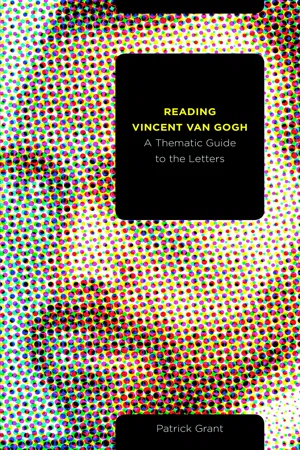
Soon after his death, Vincent van Gogh's reputation grew and developed through the remarkably symbiotic relationship evident between his paintings and letters. However, the sheer bulk and complexity of Van Gogh's complete surviving correspondence presents a formidable challenge to those who wish to read and analyze the whole text as a literary work. Reading Vincent van Gogh is at once an interpretive guide to Van Gogh's letters and a distillation of the key themes that reoccur throughout his collected letters—foremost among them the motifs of suffering, love, imagination, and the ineffable. In this indispensable, synoptic view of the letters, Patrick Grant makes the main lines of Vincent van Gogh's thinking accessible and displays the arresting vividness of the well-known artist's writing.
- 198 pages
- English
- ePUB (mobile friendly)
- Available on iOS & Android
eBook - ePub
Reading Vincent van Gogh
About this book
Information
Subtopic
Literary LettersIndex
LiteratureCHAPTER ONE Shaping Commitments
Intensely idealistic throughout his life, Van Gogh pursued a variety of utopian goals with a wholeheartedness that made his inevitable disappointments all the more painful. His letters provide many moving accounts of his enthusiasms and frustrations and of his continuing struggles to realize his aspirations.
Van Gogh’s first all-consuming ideal was religious. While he was still an employee of Goupil and Cie, he concluded that the art-dealing business was not for him, and he set out to become a preacher, like his father. His religious phase lasted roughly from 1875 to 1880, ending in disillusionment when he discovered that the Borinage miners needed material help more than evangelism. Prior to this recognition, morality for Van Gogh had been closely bound up with, but subordinate to, religion. The moral problem of unjust suffering was, for example, so overwhelming to him that he believed he could not deal with it without God. As he explains to Theo from Amsterdam in 1877, the “terrible things” in the world are so dreadful that “without faith in God one cannot live—cannot endure” (117/1:164). Here, religion subsumes the moral life, and in the same spirit, Van Gogh sees art and literature as also mainly supportive of his religious values. As we might expect, during his period of religious enthusiasm, he cited the Bible frequently and was an avid reader of religious classics by authors such as Thomas à Kempis and John Bunyan.
After Van Gogh’s crisis of conscience in the Borinage, religion surrendered its pre-eminence for him, and citations from Christian texts simply disappear from the letters. Instead of religion, the moral problems of poverty and oppression took precedence. Van Gogh’s decision at this time to become an artist was driven by the conviction that he could illustrate the lives of working people, thereby affirming their vitality while also registering a moral protest against the social conditions they were forced to endure.
After leaving the Borinage, Van Gogh went to live with his parents in Etten, and as a result of his amorous relationships with Kee and, subsequently in The Hague, with Sien, his antagonism to his father’s traditional religious values flared up into a series of angry confrontations. But although Van Gogh broke decisively with conventional religion, his sense of wonder at the mystery of the universe and his acceptance of a benign, transcendent power remained strong. He used a range of terms to express his intuition of a spiritual reality that was not religious in the usual sense, seeking, as he says, for “something altogether new” that “will have no name” but that offers the same consoling effect “of making life possible that the Christian religion once had” (686/4:282). In the third section of chapter 5, I deal with Van Gogh’s “spiritual but not religious” experience in more detail, thereby completing the circle, as it were, by bringing the conclusion of this book back to its beginning. For now, my main point is that although morality displaced traditional religion for Van Gogh, the moral life continued to have a spiritual value for him, and art increasingly became an embodiment of the transcendent mystery for which religion was no longer an adequate vehicle.
The aesthetic did not emerge fully as Van Gogh’s governing ideal until he discovered his ability as a painter—and especially as a colourist. While living in Drenthe (1883) and Nuenen (1883–85), he continued to focus on the lives of working people, but in Nuenen, he read about the colour theories of Eugène Delacroix, which had a transformative effect on him, the consequences of which became dazzlingly evident in Paris (1886–88) and Arles (1888–89). By then, his concern for the poor, which had found expression especially in his drawings, was replaced by an overriding conviction that art was itself the bearer of a higher morality beyond the conventional distinctions between good and evil. As he advises Theo from Arles in 1888, “We know so little about life that we’re not really in a position to judge between good and bad, just and unjust” (787/5:56). Rather, as he tells the art critic Albert Aurier, “a good painting should be equivalent to a good deed” (853/5:198). In short, art had assumed pre-eminence for Van Gogh over both morality and religion, providing a sense of the sacredness of the world as well as a compassionate understanding of our suffering human condition.
Van Gogh’s ideology of the aesthetic inspired him to found an artists’ community in Arles. But again, this utopian aspiration crashed on the rocks of bitter experience, as the relationship with Paul Gauguin (who Van Gogh hoped would be a founding member) disintegrated and Van Gogh’s mental illness became debilitating. Although he continued to paint, in his last days, he came to realize that the “artistic life” is not “the real one,” even admitting that he would have preferred to produce children rather than paintings (885/5:260). In St. Rémy and Auvers, he took steps to reconnect with his family, appreciating the value of personal relationships over and beyond his earlier utopian ideals.
As this brief outline suggests, a dialogical interchange among religion, morality, and art operates as a powerful organizing force throughout Van Gogh’s correspondence. Within this continuing dialogue, none of these three topics completely displaces the others, even though each is in the ascendant at a different phase of his career.
Religion
For five years, from 1875 to 1880, Van Gogh was intensely religious, wishing to emulate his greatly admired preacher father. But he did not do well in his studies preparing him for admission to the University of Amsterdam and went instead to the Borinage as an evangelist. Following the crisis of conscience in the Borinage, which he described as a “moulting” time, Van Gogh’s relationship with his father took a turn for the worse, before descending into outright acrimony. Yet Van Gogh never made a complete break with his father (see the first section of chapter 5), and despite his increasingly fierce repudiations of what he took to be the hypocrisies of organized religion, he continued to engage with the traditional “God question.” He did so in a range of registers, evolving gradually towards a position that is the topic of the final section of chapter 5.

Van Gogh’s early Christian belief was based on a traditional acceptance of divine providence and was practiced in a spirit emphasizing the close connection between work and prayer (1). The authority of the Bible was paramount, so much so that Van Gogh wanted to learn the Bible by heart (2). Family values enshrined for him the ideal of the “Christian labourer,” as well as the importance of continuity and shared duty (3). These ideals and commitments were characteristic of his moderate Calvinist upbringing.
Van Gogh was also especially sensitive to the problem of suffering, which, in his early years, he thought was unendurable without religious faith (4). But in the Borinage another note began to sound, as Van Gogh turned his attention to the “many people” there who were ill (5). His experience among the miners did much to shift his focus away from the orthodox beliefs of his youth and towards a more direct concern with the dire social conditions of the poor.
(1) Let us do our daily work, whatever the hand finds to do, with all our might, and let us believe that God will give good gifts, a part that shall not be taken away, to those who pray to Him for it. And let us trust in God with all our heart and lean not unto our own understanding. [50]
Paris, Saturday, 25 September 1875. To Theo van Gogh
(2) I cannot tell you how much I sometimes yearn for the Bible. I do read something out of it every day, but I’d so much like to know it by heart and to see life in the light of that word of which it is said: Thy word is a lamp unto my feet, and a light unto my path.
I believe and trust that my life will still be changed, and that that longing for Him will be satisfied. [108]
Dordrecht, Friday, 16 March 1877. To Theo van Gogh
(3) In our family, which is indeed a Christian family in the full sense of the word, there has always been a minister of the gospel as far back as one can see, from generation to generation. Why should that voice not be heard in this and in following generations? Why should a member of that family not now feel himself called to that office and think, with some reason, that he can and must declare himself and seek the means to achieve that goal? It is my prayer and deepest desire that the spirit of my Father and Grandfather may rest upon me, and that it may be given me to be a Christian and a Christian labourer, that my life may resemble that of them whom I name—the more, the better—for behold, that old wine is good and I desire not the new. [109]
Dordrecht, Friday, 23 March 1877. To Theo van Gogh
(4) There is evil in the world and in ourselves, terrible things, and one doesn’t have to have gone far in life to dread much and to feel the need for unfaltering hope in a life after this one, and to know that without faith in a God one cannot live—cannot endure. [117]
Amsterdam, Wednesday, 30 May 1877. To Theo van Gogh
(5) How Jesus Christ is the Master who can strengthen, comfort and enlighten a man like the Macedonian, a workman and labourer who has a hard life. Because He himself is the great Man of Sorrows, who knows our diseases, who himself is called the carpenter’s son, even though He was the Son of God and the great physician of sick souls. Who worked for 30 years in a humble carpenter’s workshop to carry out God’s will; and God wants man to live and walk humbly upon the earth, in imitation of Christ, minding not high things, but condescending to men of low estate, learning from the gospel to be meek and lowly in heart.
I’ve already had the opportunity to visit a few sick people, for many people here are ill. [149]
Wasmes, Thursday, 26 December 1878. To Theo van Gogh
When Van Gogh left Belgium and returned to live with his parents in Etten, tensions rapidly developed because of his infatuation with his widowed cousin, Kee. His parents’ disapproval escalated dramatically when Vincent subsequently moved to The Hague and set up house with Sien. In asserting the claims of love against the interdictions of his parents’ religion, Vincent looked especially to the free-thinking Jules Michelet’s books, La femme and L’amour (6). But he also wrestled with the problem of how to maintain belief in God while declaring his unbelief in the God of conventional religion. Sometimes, he states the problem paradoxically (7, 8) in order to suggest how difficult it is. He also sought alternative ways to define God (9, 10), and he rejected the straightforward charge of atheism (7). However, disrespect for orthodox theology was another matter, and Van Gogh did not hold back from confrontation with the claims and attitudes of conventional believers, especially his father (11, 12).
During Van Gogh’s years in The Hague, Drenthe, and Nuenen, his dealings with orthodox religion remained consistently hostile (13, 14): he accuses conventionally religious people of being bourgeois, hypocritical, and oppressive, in contrast to the freedom of love, which he saw as the real truth preached by Christ. The religion of “respectable people” (15) turns the truth upside down, because true religion is based on love, even though love might scandalize those who remain bound by conventional proprieties (16).
In making these points, Van Gogh looks increasingly to morality as the expression of values he admires, which are measured by what one does rather than by adherence to religious dogma (17). Whether God exists or not, a person should not act in an ungodly manner, as many adherents of respectable religion—and especially the clergy—repeatedly do (18).
By the time Van Gogh went south, first to Paris and then Arles, his difficulties with the religion of his father had loosened their grip on him—which is not to say that religious questions ceased to be a matter of interest and concern. For instance, he registers a note of puzzlement to his sister Willemien on the topic of providence (19), and he is satirically amused by the idea that God botched the creation of the world, as if making an artistic blunder (20). These passages suggest a general lightening of Van Gogh’s attitude to the God question, even though he continued to search for something to replace the Christianity of his youth (21). In doing so, he found help in Tolstoi’s humanist, non-supernatural vision of a renovated Christianity (22, 23).
Still, the old religious problems continued to haunt Van Gogh (24–26), partly as a consequence of his disturbed mental state in Arles and St. Rémy. But the important exchange became not so much the one between religion and morality (as it was during the Dutch years) as that between religion and art. That is, Van Gogh insists that artistic creativity is itself an expression of religious value (21, 24). Thus, in letters to Émile Bernard, Van Gogh describes Christ as the greatest of artists, making “living men” rather than paintings (27, 28). Despite his continuing opposition to conventional religion, therefore, he did not entirely discount it as a source of value, however much it might need to be reconstituted for its real worth to be realized.
(6) Michelet even says things completely and aloud which the gospel merely whispers to us germinally, and Stowe actually goes as far as Michelet. It should come as no surprise if I tell you, at the risk of your thinking me a fanatic, that I consider it absolutely essential to believe in God in order to be able to love. To believe in God—by that I mean (not that you should believe all those petty ser...
Table of contents
- Cover
- Title Page
- Copyright
- Dedication
- Contents
- Preface and Acknowledgements
- Introduction
- Chapter One: Shaping Commitments
- Chapter Two: Enduring Adversity
- Chapter Three: What Holds at the Centre
- Chapter Four The Power of Words
- Chapter Five: Matter and Spirit
- Appendix One: Some Facts About the Letters
- Appendix Two: Suggestions for Further Reading
Trusted by 375,005 students
Access to over 1.5 million titles for a fair monthly price.
Study more efficiently using our study tools.
Frequently asked questions
Yes, you can cancel anytime from the Subscription tab in your account settings on the Perlego website. Your subscription will stay active until the end of your current billing period. Learn how to cancel your subscription
No, books cannot be downloaded as external files, such as PDFs, for use outside of Perlego. However, you can download books within the Perlego app for offline reading on mobile or tablet. Learn how to download books offline
Perlego offers two plans: Essential and Complete
- Essential is ideal for learners and professionals who enjoy exploring a wide range of subjects. Access the Essential Library with 800,000+ trusted titles and best-sellers across business, personal growth, and the humanities. Includes unlimited reading time and Standard Read Aloud voice.
- Complete: Perfect for advanced learners and researchers needing full, unrestricted access. Unlock 1.5M+ books across hundreds of subjects, including academic and specialized titles. The Complete Plan also includes advanced features like Premium Read Aloud and Research Assistant.
We are an online textbook subscription service, where you can get access to an entire online library for less than the price of a single book per month. With over 1.5 million books across 990+ topics, we’ve got you covered! Learn about our mission
Look out for the read-aloud symbol on your next book to see if you can listen to it. The read-aloud tool reads text aloud for you, highlighting the text as it is being read. You can pause it, speed it up and slow it down. Learn more about Read Aloud
Yes! You can use the Perlego app on both iOS and Android devices to read anytime, anywhere — even offline. Perfect for commutes or when you’re on the go.
Please note we cannot support devices running on iOS 13 and Android 7 or earlier. Learn more about using the app
Please note we cannot support devices running on iOS 13 and Android 7 or earlier. Learn more about using the app
Yes, you can access Reading Vincent van Gogh by Patrick Grant in PDF and/or ePUB format, as well as other popular books in Literature & Literary Letters. We have over 1.5 million books available in our catalogue for you to explore.