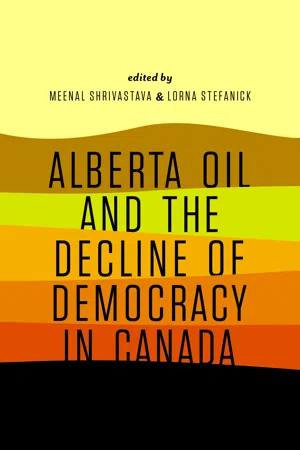
Prior to May 2015, the oil-rich jurisdiction of Alberta had, for over four decades, been a one-party state. During that time, the rule of the Progressive Conservatives essentially went unchallenged, with critiques of government policy falling on deaf ears and Alberta ranking behind other provinces in voter turnout. Given the province's economic reliance on oil revenues, a symbiotic relationship also developed between government and the oil industry. Cross-national studies have detected a correlation between oil-dependent economies and authoritarian rule, a pattern particularly evident in Africa and the Middle East. Alberta Oil and the Decline of Democracy in Canada sets out to test the "oil inhibits democracy" hypothesis in the context of an industrialized nation in the Global North.In probing the impact of Alberta's powerful oil lobby on the health of democracy in the province, contributors to the volume engage with an ongoing discussion of the erosion of political liberalism in the West. In addition to examining energy policy and issues of government accountability in Alberta, they explore the ramifications of oil dependence in areas such as Aboriginal rights, environmental policy, labour law, women's equity, urban social policy, and the arts. If, as they argue, reliance on oil has weakened democratic structures in Alberta, then what of Canada as whole, where the short-term priorities of the oil industry continue to shape federal policy? The findings in this book suggest that, to revitalize democracy, provincial and federal leaders alike must find the courage to curb the influence of the oil industry on governance.
- 440 pages
- English
- ePUB (mobile friendly)
- Available on iOS & Android
eBook - ePub
Alberta Oil and the Decline of Democracy in Canada
About this book
Information
Subtopic
Political Economypart one
The Context of Democracy in an Oil Economy
1 Liberal Democracy in Oil-Exporting Countries
A View from the Perspective of Staples Theory
The Many Modes of Liberal Democracy
The political history of our world could well be written as a continuing struggle to define and refine democracy—from its limited beginnings in the republics of India and the city-states of Greece in the seventh and sixth centuries BC, to the Magna Carta and the French Revolution, and finally to the emergence of so-called liberal democracy, in its many iterations, as the predominant political system throughout the world in the twentieth century. Most often described as a representative form of government that operates according to the principles of liberty and equality first articulated by John Locke and other philosophers of the Enlightenment, liberal democracy seeks to protect basic human rights, civil liberties, and political freedoms for all persons, including minorities. It is characterized by attributes that include fair, free, and competitive elections between multiple distinct political parties, a separation of power into different branches of government, and the rule of law. Liberal democracies often rely on a constitution to delineate the powers of the government and to enshrine the social contract—the legitimacy of the authority of the state over the individual (see Beetham 1992; Macpherson 1977).
Although expressed in widely varying manifestations, first in different parts of Europe, then in the Americas, and finally in the former colonies in the Global South, notions of widespread social, economic, and political equality have formed the basis of the quest for democracy over the past two centuries. However, the path to democracy is fraught with many obstacles in all parts of the world, as is evident from growing income and political inequality in both hemispheres and from the rise of movements such as the Arab Spring in the Middle East, Occupy in North America, Indignados in Spain, Aganaktismenoi in Greece, Movimento dos Trabalhadores Sem Terra (MST) in Brazil, and Naxal in India, among others.
Indeed, historically the vast spectrum of democracy ranges from minimalist, electoral, and polyarchical to many direct and representative types of democracies (Schmidt 2002). Clearly, the term democracy is a highly contested one, and much has been written within the field of democratization studies to try to define it. In the twenty-first century, the global financial crisis that began in 2008, the wars in Iraq and Afghanistan, the economic success of authoritarian China, and increasing inequality in all parts of the world, among other trends and events, have rekindled the debate about threats to democratization and about the probability of a “reverse wave” bringing a revival of authoritarianism (Carothers 2007; Diamond 2008; Krugman 2009, 181–96). Interestingly, despite these global warnings, the vast majority of comparative studies of democracy continue to focus on the reasons for and quality of democratization in the Global South. A quick survey of the most influential journal in this area, Journal of Democracy, reveals a continuing focus on the trends and causes of the emergence or reversal of democratization in the regions of the Global South (e.g., Puddington 2010). This focus appears to presume that democracy and its institutions are sound in the Global North. As recently as 2013, Jørgen Møller and Svend-Erik Skaaning, in their comprehensive analysis of the three waves of democratization, challenged common assumptions about the reversal of democratization, describing the situation as a “trendless fluctuation” (Doorenspleet 2000, quoted in Møller and Skaaning 2013, 105). They correctly acknowledge the inaccuracy of Samuel Huntington’s (1991) description of a “second reverse wave of democratization” occurring between 1958 and 1975, which does not take into account the rise of democratic regimes after the decolonization of Africa in the 1960s (Møller and Skaaning 2013, 105–7). However, Møller and Skaaning’s analysis of democratization trends in the world suffers from a blind spot of its own by only focusing on the non-OECD regions of the world.
Yet the notion that the countries in the Global North are immune from a democratic deficit is questionable, given both growing inequality and restive protests against government austerity measures in various OECD countries (OECD 2008, 2011). Although it is too early to predict their impacts, the ongoing popular movements inspired by increasing income and political inequality are indeed challenging the “authorized” site of politics (political parties, the electoral system, and other formal mechanisms of government), questioning the limits of political representation, and shifting the question of the survival of the economic system to the survival of democracy itself, in both the North and the South.
Ironically, while there has been a steady stream of writing on the relationship between democracy and inequality (Savoia, Easaw, and McKay 2010), as well as on a perceived democratic deficit in OECD countries such as the United States, Canada, and countries in the European Union (Bexell and Mörth 2010; Krugman 2007; Lenard and Simeon 2012; Lindgren and Persson 2011; Norris 2011; Tamas 2011), the insights from these studies have been slow to inform large-scale comparative studies of democratization spanning various regions. This may be the consequence of a world view that continues to conceptualize the globe as divided into North/South silos that are perceived as static social, economic, and political spheres rather than as dynamic and uneven constructions that interact, collide, and overlap unpredictably in a deeply connected international system. Additionally, the tendency of comparative studies to focus on the Global South can be seen as a reflection of the discrepancy between liberal democratic theory and its application—in other words, as ignoring the disjuncture between the principles and the practice of liberal democracy in various parts of the world. In this context, the worldwide trend toward economism—the theoretical separation of economic activity from a social and political ensemble and, specifically, the reduction of this ensemble to its economic causes (Gramsci 1971, 369–84)—has emerged as a particularly significant paradox of liberal democracies, inasmuch as giving primacy to the economic over the political has marginalized issues of justice and equality.
As demonstrated by a number of studies (e.g., Herb 2005; Karl 1997; Lowi 2004; Mahdavy 1970; Ross 2001, 2009; Shaxson 2007; Shrivastava and Stefanick 2012; Tsui 2011; Wantchekon 2002), oil-exporting countries of the world are at a particularly crucial juncture of economism and politics, since the tensions between the two core assumptions of liberal democratic theory—capitalist market relations and developmental liberalism—are heightened further in a resource-driven economy. The role of the state in providing the conditions for and thus the possibility of economic development underlies the concept of developmental liberalism within a liberal democratic framework (Chan 2002). The financial crisis of 2008–9, in particular, not only accentuated the virtues of state regulation of financial sectors but also brought back focus on the role of equality in ensuring economic stability. A recent report (G20 2012) notes the growing disparities in earnings and working conditions in the G20 countries, inequities that are undermining social cohesion, economic performance, and political legitimacy. This joint report identifies labour market and social protection policies, tax policies, and regulatory measures as the tools needed to reverse income inequality and ensure sustainable economic growth (9–13). This re-emphasis of the role of state policies in ensuring economic development, which used to be a staple of development studies literature focused on the Global South, is now experiencing a global resurgence of sorts in the context of the growth and assertiveness of emerging economies and the slowing economic growth in the Global North (Cammack 2012).
In the context of oil and democracy, another set of literature has emerged that incorporates the concerns of developmental liberalism, highlighting that it is not oil but the vast wealth that it generates in a short span that depletes democracy by tipping the balance too far away from the principles of liberal democracy, such as economic and political equality (e.g., Boschini, Pettersson, and Roine 2007; Gylfason 2001, 2006; Mitchell 2011; Rosser 2006). These studies emphasize the cruci...
Table of contents
- Cover
- Title Page
- Copyright Page
- Contents
- Acknowledgements
- Introduction • Framing the Debate on Democracy and Governance in an Oil-Exporting Economy
- Part One • The Context of Democracy in an Oil Economy
- Part Two • Rights Claims in an Oil Economy
- Part Three • Governance, Identity, and Citizenship in an Oil Economy
- Conclusion • Of Democracy and Its Deficits: Surviving Neoliberalism in Oil-Exporting Countries
- List of Contributors
- Index
Trusted by 375,005 students
Access to over 1.5 million titles for a fair monthly price.
Study more efficiently using our study tools.
Frequently asked questions
Yes, you can cancel anytime from the Subscription tab in your account settings on the Perlego website. Your subscription will stay active until the end of your current billing period. Learn how to cancel your subscription
No, books cannot be downloaded as external files, such as PDFs, for use outside of Perlego. However, you can download books within the Perlego app for offline reading on mobile or tablet. Learn how to download books offline
We are an online textbook subscription service, where you can get access to an entire online library for less than the price of a single book per month. With over 1.5 million books across 990+ topics, we’ve got you covered! Learn about our mission
Look out for the read-aloud symbol on your next book to see if you can listen to it. The read-aloud tool reads text aloud for you, highlighting the text as it is being read. You can pause it, speed it up and slow it down. Learn more about Read Aloud
Yes! You can use the Perlego app on both iOS and Android devices to read anytime, anywhere — even offline. Perfect for commutes or when you’re on the go.
Please note we cannot support devices running on iOS 13 and Android 7 or earlier. Learn more about using the app
Please note we cannot support devices running on iOS 13 and Android 7 or earlier. Learn more about using the app
Yes, you can access Alberta Oil and the Decline of Democracy in Canada by Meenal Shrivastava, Lorna Stefanick in PDF and/or ePUB format, as well as other popular books in Politics & International Relations & Political Economy. We have over 1.5 million books available in our catalogue for you to explore.