Working People in Alberta traces the history of labour in Alberta from the period of First Nations occupation to the present. Drawing on over two hundred interviews with labour leaders, activists, and ordinary working people, as well as on archival records, the volume gives voice to the people who have toiled in Alberta over the centuries. In so doing, it seeks to counter the view of Alberta as a one-class, one-party, one-ideology province, in which distinctions between those who work and those who own are irrelevant. Workers from across the generations tell another tale, of an ongoing collective struggle to improve their economic and social circumstances in the face of a dominant, exploitative elite. Their stories are set within a sequential analysis of provincial politics and economics, supplemented by chapters on women and the labour movement and on minority workers of colour and their quest for social justice.Published on the occasion of the 100th anniversary of the Alberta Federation of Labour, Working People in Alberta contrasts the stories of workers who were union members and those who were not. In its depictions of union organizing drives, strikes, and working-class life in cities and towns, this lavishly illustrated volume creates a composite portrait of the men and women who have worked to build and sustain the province of Alberta.With contributions by Jason Foster, Winston Gereluk, Jennifer Kelly and Dan Cui, James Muir, Joan Schiebelbein, Jim Selby, and Eric Strikwerda
- 360 pages
- English
- ePUB (mobile friendly)
- Available on iOS & Android
eBook - ePub
Working People in Alberta
About this book
Information
Subtopic
North American HistoryIndex
History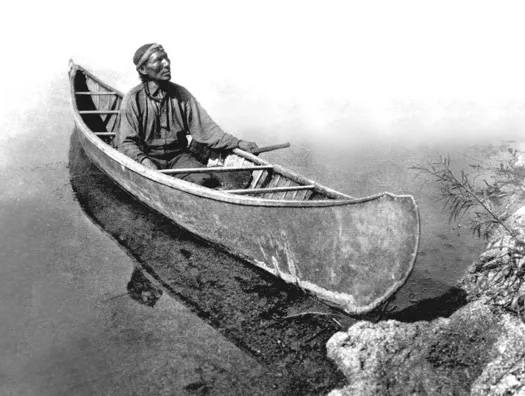
FIG 1-1 A Cree man in his canoe, illustrated by Edward S. Curtis, ca. 1910. Glenbow Archives, NA-1700-6.
1 MILLENNIA OF NATIVE WORK
ALVIN FINKEL
The world is round and each society has been given the right to exist in this world within its territory. This is how the Creator had arranged it. Therefore, the traditional territory of the Blackfoot Nation was given to our people by our Creator. We respected and protected this traditional territory with our minds and our hearts and we depended on it for what it encompasses for our survival. Everything that we ever needed for our way of life and survival existed in our traditional territory, such as herbs for medicine, roots, rivers, game animals, berries, vegetables, the buffalo.1
Elder Adam Delaney’s description of the Blackfoot people’s views of their lives in the millennia before the arrival of Europeans is largely echoed by the other First Nations people of Alberta, though in each natural region the resources allegedly bestowed by the Creator differed. Any history of Alberta that accurately reflects historical time should devote 98 percent of its space to Native peoples, who, according to the most conservative estimates, have lived within what is now called Alberta for at least thirteen thousand years. The post-contact period (the period in which both Natives and newcomers have lived in Alberta) is less than three hundred years old, a blip in historical time.
The Native view of their traditional past emphasizes the role of the Creator and the importance to Native people of following the Creator’s teachings. Like Christianity, Islam, and Judaism, Native religions are monotheistic. The great religions of the Old World, however, have creation stories in which God gave dominion to humans over all other animals as well as plants. In contrast, according to Aboriginal religions, the Creator gave spirits to all animals and plants, and humans, while they needed to consume other living things, were instructed to do so in ways that respected them as God’s creations. If they failed to do so, the Creator would punish them by depriving them of game and plants. In their view, the Creator expected them to take only what they needed and to demonstrate respect for non-humans via elaborate rituals.2
Humans were also expected to respect one another, particularly within their primary affinity group, which was also their work group. Cree communities in the parklands region gathered regularly in circles to collectively pray, talk, heal, and reconcile, and to make supreme efforts to treat one another as equal children of the Creator. The Dene or Athabascan in the North, the Cree in the north-central region, and Blackfoot peoples in the centre and south of the province had similar beliefs and ceremonies. Although it is important to emphasize that each Native culture had its own language, its own story of how the Earth was created, and its own social structures, for all of these cultural groups, land was the property of the Creator, not of individuals, and everyone had to work together to use, share, and conserve the land and resources that the Creator had bestowed upon the group.3
On the surface, then, it might seem that Native peoples in Alberta experienced no historical development during the thirteen thousand years before they began contact through the fur trade with strangers from Europe. Some people, particularly during the period of colonial conquest of the Americas, used the word primitive to describe pre-contact Native societies in Alberta and the rest of Canada and the Americas. (The term pre-contact generally refers to the period before an Aboriginal society developed regular contact with Europeans.) They suggested that Natives hunted and gathered using never-changing, almost intuitive, techniques. In this view, Native societies in 1700 AD were no different than they had been in 9000 BC. To some, this meant that they were uncivilized and needed to be swept away by the Europeans, who were supposedly more advanced in areas such as technology and religion. Others argued for leaving them alone and treating the Americas much like a game preserve for early humans. While the latter, minority point of view would have benefited the Natives more over the long term, it was, like the former view, based on a completely incorrect dichotomy of allegedly “civilized” societies — European cultures — and “savage” societies — virtually all other cultures. In fact, Native societies changed dramatically over time as they constantly tried to find ways to better shape the resources that the Creator had given them to ensure that their material and spiritual needs were met.
The view that Native societies in the Americas were less advanced technologically than European societies was based largely on the superiority of European weapons and on the “logic” of conquerors that those whom they are conquering are inferiors. That view was reinforced in the Americas by the conquerors’ destruction of many Native societies and the burying of the Natives’ achievements. Archaeology and the oral histories that have been passed on from generation to generation of Aboriginal survivors have challenged the “cowboys and Indians” caricatures of the European-Aboriginal conflicts. We now know that the knowledge of various Native groups was immense and that terms such as Stone Age and primitive, once used to denigrate these societies, cover up the complexities and ever-changing character of the cultures of the Americas. The pre-contact Native peoples had long histories of interacting with a changing environment, and though the names of individual inventors and developers are largely unknown, the collective knowledge of these peoples that developed over time was impressive. Some of it may never be recovered because colonial germs and violence resulted in millions of deaths over a short period of time.
The Inca Empire centred in Peru, for example, synthesized the architectural, mathematical, astronomical, agricultural, and religious knowledge of the various Andean peoples whom the Inca conquered. Among the achievements of these peoples, who used stone and not metals, was the construction of earthquake-proof buildings and flood-proof roads. Their understanding of how stones could be chiseled to fit together so as not to be dismantled by natural forces was one application of their sophisticated mathematical and geological knowledge. In contrast, the Spanish conquerors and their successors deprecated the people they conquered and never bothered to learn anything from them about survival in the Andes region; instead, they applied their “developed” European technologies to build lovely edifices that were frequently ruined by earthquakes and ambitious roadway projects that stood covered in water and mud when flooding occurred. The sophisticated irrigation systems that the Andean peoples had developed in the desert conditions of their region remained unmatched for at least the first three hundred years of Spanish occupation.4
On the surface, the achievements of the peoples of pre-contact Alberta may seem modest compared to those of cultures such as the Inca, Maya, and Aztec, who built huge temples and thousands of miles of roads and irrigation canals. But this is only true if one measures societies in terms of what one can see on the surface. Prairie Native cultures also had complex technologies that resulted from the collective labour of their peoples. As archaeologist Jack Brink, who led the team that reconstructed Head-Smashed-In Buffalo Jump, now a UNESCO World Heritage Site, in southwestern Alberta, concluded:
Alone in that basin that day, I knew that I stood among the remains of a huge construction project involving the collection and careful placement of thousands of individual rocks. Each one was selected for certain size and weight and placed in a spot deemed just right by a team of people who must have discussed and debated how the map was to be made. What started off as simple clusters of stone had morphed into a mental blueprint of complex, group-based decision-making on a scale and for a purpose that had mostly eluded consideration by archaeologists, anthropologists, animal ecologists, and pretty much everyone else.5
Brink argues that the Europeans first in contact with the prairie Natives, wanting to minimize the achievements of the First Peoples, assumed that it must be easy to herd buffalo over cliffs and then crudely cut up their bodies to get food and clothing. In fact, it took years of invention and experimenting to determine where and by what means buffalo, which were wary animals, could be herded to cliffs from which a fall would kill them, with the least risk to humans in the process.
Equal ingenuity was needed in knowing what to do once the buffalo had jumped. Natives could only cut up and process the meat of a small number of buffalo, and not just any buffalo would do. They needed buffalo that had sufficient fat at that time of year to ensure a nutritious food supply for the people who had conducted the kill. To determine which animals were worth taking from a herd, they searched for hair over the eyes and on the horn, and for stripes on the spine. In addition to using buffalo meat for food, the people learned over time which parts of buffalo could be used to make such items as clothing, toboggans, cutlery, and powder flasks.
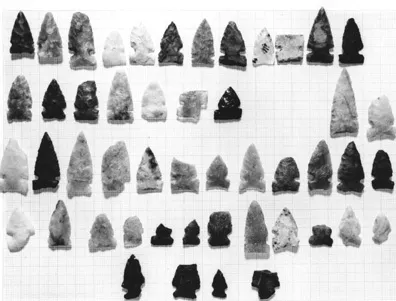
FIG 1-2 Dig from below Old Women’s Buffalo Jump near Cayley, Alberta. Glenbow Archives, B20-B-1.
Such knowledge, along with prairie, parklands, and northern peoples’ more general hunting expertise — as well as their understanding of horticulture, natural medicines, and social relations — did not develop overnight. Archaeological evidence shows that small groups of hunters lived on the prairies of Alberta at least thirteen thousand years ago when the glaciers of a long ice age were beginning to retreat. It is likely that they crossed an ice-free corridor from British Columbia through a section of the Rocky Mountains. By that time, they had developed projectiles with large fluted points suited to killing big game as well as smaller animals, but the mammoths and mastodons that they hunted soon disappeared, perhaps because of overhunting.6
The First Peoples of Alberta adapted by turning their attention to the bison of southern Alberta, developing bone and antler tools and experimenting with and perfecting their projectiles. Sturdier projectiles were needed since there was limited access to stone for resharpening and for changing broken segments. Archaeologist Trevor Peck explains the importance of the development of “Folsom points,” some 12,800 to 12,200 years ago:
The regularity and exquisite form of Folsom points suggests that knowledge transmission within tight kin-groups or working with designated craft specialists was an intricate part of an individual’s upbringing. Practices of stone conservation, the use of biface cores, multifunction stone tools, and Folsom point preforms as tools were all elegant adaptive responses to a highly mobile lifeway focused on hunting bison in stone-poor areas.7
Over time, there were more inventions and more adaptations. For example, archaeological remains suggest that sometime between 7200 and 6500 BC, Native peoples began fine-tuning darts to fit the spear thrower. The melting of glaciers brought greater population movements within Alberta and between that territory and other parts of North America. For example, an unearthed burial complex dating back to the period from 4900 to 4400 BP (2950 to 2450 BC) included copper and evidence of the use of stone boiling, which suggest the migration of peoples from elsewhere, probably the Great Lakes region, where stone boiling to extract bone grease had become common by the third millennium BC. The bone grease was used to preserve meat, reducing dependence on fresh meat and allowing communities to grow. Subsequently, there was a migration of Indigenous peoples from today’s American Midwest, as evidenced by discoveries of iron and copper projectile points as well as a style of pottery that was clearly introduced rather than developed locally.8
New technologies and techniques, whether brought by newcomers or developed locally, helped to make hunting more successful. The successive adoptions of the atlatl (spear thrower), the bow and arrow, and finally the buffalo pound were particularly important in enabling the growth of more and larger communities, first in southern Alberta and later in the northern reaches of the province. The buffalo pound was an enclosure that Native peoples built with logs and hides, generally at the bottom of a hill, to trap buffalo. Even though the animals were strong enough to crash through the wall that suddenly appeared before them, their instincts told them to stop in their tracks when confronted by a barrier. Thus trapped, they were speared by hunters who aimed through holes in the walls of the enclosure. The success of this method encouraged the bolder concept of the buffalo jump, in which Natives steered the buffalo along a path that ended not with a barrier but with a high cliff from which the stampeding buffalo fell to their death. Beginning in the first millennium BC, encampments of more than a hundred people were established at repeatedly used buffalo jump sites.9
Over time, the various Native peoples developed beliefs sacred to themselves about their origins and about the values that the Creator expected them to embody. They also developed a variety of rituals to appease the Creator and the spirits that the Creator had given to all living things. The Sun Dance, though its features varied among different peoples, was especially critical to prairie Aboriginals. It brought together related communities, allowed for the renewing of relationships, and offered young men the opportunity to demonstrate their bravery through a ceremony involving self-inflicted pain.10 Among the Blackfoot peoples, it was a multi-day event. An all-male warrior society chose the site, but the event was presided over by a holy woman. The highly ritualized Sun Dance was actually a series of religious ceremonies involving feasting, dancing, and singing. Each person carried a Sun Dance bundle in a rawhide bag filled with objects bestowed upon them at birth or for special achievements. Every item in the bag was made sacred by carrying it on vision fasts — fasts meant to induce a connection with the relevant spirits — and by learning special songs associated with that item. Individuals’ performances at a Sun Dance had to conform both with the special gifts bestowed upon them in their medicine bundle and with the rituals of the First Nation overall. Unsurprisingly, given the importance of the buffalo to the Plains peoples, the rituals of sacrifice and thanks to the buffalo spirits occupied as much time during the Sun Dance as the ceremonies devoted to the Sun Spirit.11
Labour was organized along lines that reflected the Aboriginal communities’ need to carefully balance the spirit world’s demands on the collective and on individuals. Everyone played a role in providing the community’s essential material goods, especially its food supply, but not everyone made the same contribution or received the same share of the total product. By the 1500s, the further south one might have travelled in Alberta, the more inequality one might have found, though compared to European societies of the time, all of the First Nations of Alberta were relatively egalitarian. The rigid divisions between European nobles and peasants, merchants and day labourers, and owners and slaves that had developed in Europe had some echoes among the Aztec, Maya, and Inca, but they were not replicated anywhere in Alberta.
Among the Dene peoples of northern Alberta, a class system did not develop in the pre-contact period. The Dene lived in small communities, usually of about twenty or thirty people, and harvested local resources including fish, small game, caribou, trees, and berries. They co-operated in the tasks necessary to maintain their communities, which relocated on a seasonal basis according to food sources. While these communities were largely self-sufficient and minimally involved in trade with other communities, they were generou...
Table of contents
- Cover Page
- Title Page
- Copyright Page
- Dedication
- Contents
- Acknowledgements
- Introduction: Those Who Built Alberta
- 1 Millennia of Native Work
- 2 The Fur Trade and Early European Settlement
- 3 One Step Forward: Alberta Workers 1885–1914
- 4 War, Repression, and Depression, 1914–1939
- 5 Alberta Labour and Working-Class Life, 1940–1959
- 6 The Boomers Become the Workers: Alberta, 1960–1980
- 7 Alberta Labour in the 1980s
- 8 Revolution, Retrenchment, and the New Normal: The 1990s and Beyond
- 9 Women, Labour, and the Labour Movement
- 10 Racialization and Work
- Conclusion: A History to Build Upon
- Notes
- Bibliography
- Contributors
- Index
Trusted by 375,005 students
Access to over 1.5 million titles for a fair monthly price.
Study more efficiently using our study tools.
Frequently asked questions
Yes, you can cancel anytime from the Subscription tab in your account settings on the Perlego website. Your subscription will stay active until the end of your current billing period. Learn how to cancel your subscription
No, books cannot be downloaded as external files, such as PDFs, for use outside of Perlego. However, you can download books within the Perlego app for offline reading on mobile or tablet. Learn how to download books offline
Perlego offers two plans: Essential and Complete
- Essential is ideal for learners and professionals who enjoy exploring a wide range of subjects. Access the Essential Library with 800,000+ trusted titles and best-sellers across business, personal growth, and the humanities. Includes unlimited reading time and Standard Read Aloud voice.
- Complete: Perfect for advanced learners and researchers needing full, unrestricted access. Unlock 1.5M+ books across hundreds of subjects, including academic and specialized titles. The Complete Plan also includes advanced features like Premium Read Aloud and Research Assistant.
We are an online textbook subscription service, where you can get access to an entire online library for less than the price of a single book per month. With over 1.5 million books across 990+ topics, we’ve got you covered! Learn about our mission
Look out for the read-aloud symbol on your next book to see if you can listen to it. The read-aloud tool reads text aloud for you, highlighting the text as it is being read. You can pause it, speed it up and slow it down. Learn more about Read Aloud
Yes! You can use the Perlego app on both iOS and Android devices to read anytime, anywhere — even offline. Perfect for commutes or when you’re on the go.
Please note we cannot support devices running on iOS 13 and Android 7 or earlier. Learn more about using the app
Please note we cannot support devices running on iOS 13 and Android 7 or earlier. Learn more about using the app
Yes, you can access Working People in Alberta by Alvin Finkel in PDF and/or ePUB format, as well as other popular books in History & North American History. We have over 1.5 million books available in our catalogue for you to explore.