![]()
1 Mathematics and Visual Arts Education
Teaching and Learning Between the Lines
A line defies simple definition. Within mathematics, it has been described as a geometrical object having length but no depth or width formed by a straight set of points that extends to infinity in both directions, and as a set of the points whose coordinates satisfy a given linear equation on the Cartesian plane or in Euclidean space. In visual arts, the line has been referred to as a “basic element,” often defined as a continuous mark made on a surface. In art, a line may be straight, curved, bent, thick, thin, broken, vertical, horizontal, or freehand; it is a tool used to visually communicate patterns, two-dimensional shapes, and three-dimensional spaces or objects. The study and use of “line” has also formed a major component, with related skills, of both the mathematics and visual arts curricula in formal schooling.
Teaching and learning “between the lines,” metaphorically speaking, involves the recognition of this similarity and the celebration of this and many other connections that exist between these two rich disciplines. There are many
reasons why it is beneficial to connect mathematical concepts with visual arts education. This chapter presents how individuals develop both mathematical and visual literacies, and how these two academic journeys can and do intersect and overlap. Herein we discuss teaching and learning theories and strategies that support learning experiences that explore in significant ways these important connections. These types of pedagogical approaches include constructivism, problem-based learning, interdisciplinary learning, brain-based learning, differentiated instruction, and universal design for learning. This chapter also highlights the positive and synergetic effects of integrating mathematics and visual arts on the overall educational experience of children. We briefly present how mathematics and art phobias, or anxieties, are perpetuated and what can be done to offset these negative realities for teachers, parents, and most importantly, students.
Two Significant Perspectives on the World
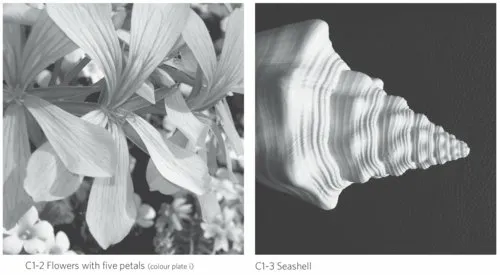
Why do many flowers have five or eight petals, but very few six or seven? Why do snowflakes have six-fold symmetry? Why do tigers have stripes but leopards spots? Throughout human history, artists and scientists alike have been inspired by the form and beauty of the natural world. Our changing vision of the universe, and of our place within it, reflects an ever-growing understanding of pattern and structure in nature. Human mind and culture have invented a formal system of reasoning that lets us recognize, classify, and exploit patterns, whatever they may be and wherever they arise. (Stewart, 1995, cover overleaf introduction)
According to Stewart, this formal system of reasoning is called system mathematics. Others have described the interpretation of the natural world as art, or aesthetic awareness. Are both types of perspectives possible, valid, and widely available? Doczi (1981) presents a less systematic approach to understanding the visual world, as characterized in the following aesthetically inspired description of similar natural phenomena:
Why do apple blossoms always have five petals? Only children ask such questions . . . When we look deeply into the patterns of an apple blossom, a seashell, or a swinging pendulum, however, we discover a perfection, an incredible order, that awakens in us a sense of awe that we know as children. (p. i)
Children enjoy exploring natural and human-designed environments through their senses of sight, sound, smell, taste, and touch. These experiences can teach a great deal about how and why things are put together. Children can learn about many mathematical concepts, as well as the elements of visual composition, or design, which comprise line, shape, texture, form, tone (value), and colour.
These elements are to be found in natural forms such as bees’ nests, seashells, spider webs, flowers, and bird wings, to name but a few. They are also the elements that have been mathematically organized into human-designed forms. For example, numbers and shapes were represented in the Lascaux paintings of early cave artists in France and Spain. They are, mathematically speaking, two-dimensional maps of objects in space; yet they are also historic and beautiful.
Some Historical Connections
Culture, Mathematics, and Visual Art
Many writers, scientists, and mathematicians give credit to the Egyptian, Greek, and Roman cultures for their strong influence on our present understanding of mathematics, art, and architecture. While there are obviously many contributions made by the above-mentioned cultures, some of which we shall highlight in this chapter, we also acknowledge that there are many Indigenous world cultures that have also demonstrated a strong understanding of mathematics in their writing, artworks, and built structures/environments.
Indigenous peoples have continually looked to nature for guidance and inspiration when creating images, functional forms, and architectural designs; hence a number of these connections will also be made explicit throughout the text within the descriptions of the various learning experiences. Ethnomathematics is a branch of mathematics education dealing with the study of the relationship between mathematics and culture (see, for example, D’Ambrosio (1985); Ascher (1991); Jarvis & Namukasa (2009)). In terms of the relationship between art education and culture, Freedman (1987) provides an expansive overview in her book Art Education as Social Production: Culture, Society, and Politics in the Formation of Curriculum.
The Ancient Greeks
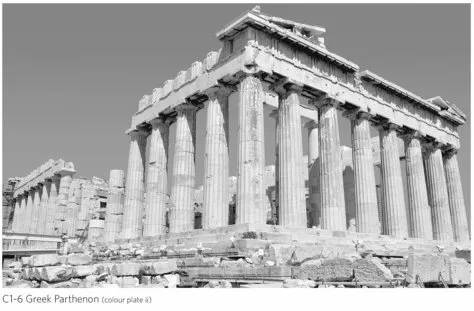
Mathematics and the visual arts have coexisted since the dawn of human history. Furthermore, beyond mere coexistence, they have been intricately interwoven through issues of form and function throughout every cultural era. In ancient Greece, sculptors such as Phidias, designer of the Parthenon frieze panels and the monumental ivory and gold statue of Athena for which the temple was built, used the golden ratio extensively in their work. This mathematical proportion was believed by the Greeks to hold the profound secret of visual harmony in the universe. The legacy of this concept, which would later be referred to as the “divine proportion” during the Renaissance, is still evident in both modern and postmodern styles of architecture and fine art. Alex Colville, one of Canada’s most widely recognized artists and who has used the golden ratio in his compositions, described the aesthetic experience involved:
Once you begin to perceive these relationships, circles, spirals, triangles and rectangles appear as if on their own. The beauty of it comes as a surprise, and its harmonies inspire joy. Part of the excitement is that these discoveries, though new to us, are about immutable laws that have been in force since time and space began. (cited in Fry, 1994, p. 35)
Throughout history, artists have made use of many other mathematical elements, including “the geometric shapes, symmetry, the earth’s measurements, the proportions of humankind, the patterns of the stars, conic sections [circle, ellipse, parabola, hyperbola], as well as the computer” (Attenborough, Pattison, Patsiatzis, & Muller, 1997). Newman and Boles (1992) maintain that although these two disciplines are often viewed as polarities, they are in fact “the left and right hand of cultural advance: one is the realm of metaphor, the other, the realm of logic . . . Our humanness depends upon a place for the fusion of fact and fancy, emotion and reason. Their union allows the human spirit freedom” (p. xiv).
Socrates, Plato, and Aristotle represent a rich lineage of effective pedagogical transfer. All three of these teachers held to strong, but distinct, educational philosophies. Socrates, master of the strategic question-and-answer method that bears his name, was convinced that education and healing were closely related, and therefore defined teaching as the “building, in a pupil, of a system of value priorities and preferences that defined the healthy soul” (Broudy & Palmer, 1965). Socrates was also one of the first Western educators to hold the belief that unless citizens had an understanding of art and music, they were not considered to be adequately educated (Naisbitt & Aburdene, 1990). In The Republic, Plato, using his metaphor of the divided line, describes four “states of mind” or “ways of knowing.” The lower levels of illusion (eikasia) and belief (pistis) encompass the “distorted perceptions” found within poetry and art (trans. 1955/1987, p. 316). To the third level of reason (dianoia) belong mathematics and the sciences. “For Plato the study of mathematics was to shape the soul, just as music and literature shape the soul” (Broudy & Palmer, 1965, p. 44). Only at the fourth and highest level, known as intelligence (noesis), is the clearest mental vision and recognition of truth achieved through dialectic (pp. 41–42).
Whereas both Socrates and Plato acknowledged the important, yet separate and unequal, emphases on mathematics and education in the arts, it was Aristotle, the most prized student of Plato’s Academy, who is remembered for encouraging the cognitive “search for relationships between things apparently disconnected” (Newman & Boles, 1992). And so, it is this latter quest, no doubt influenced in part by his predecessors and their teachings, that bears directly on an integrated approach to the two disciplines.
For the Greeks of the ancient world, much of their mathematics dealt with geometry (a word derived from “land measure”), a topic that had been explored by and learned from the Egyptians. Euclid of Alexandria, often referred to as the “father of geometry,” founded a school in the Hellenistic period and collected many of the then-existing mathematics manuscripts into a carefully organized, thirteen-volume set known as The Elements. This popular text would be widely consulted by mathematicians for the next 2,000 years.
Finally, one would be remiss in discussing Grecian influence on interdisciplinary education with...