Length Tension Testing Book 2, Upper Quadrant
eBook - ePub

Length Tension Testing Book 2, Upper Quadrant

  1. 112 pages
  2. English
  3. ePUB (mobile friendly)
  4. Available on iOS & Android
eBook - ePub

Length Tension Testing Book 2, Upper Quadrant

About this book

Length Tension Testing Book 2, Upper Quadrant provides clear and comprehensive descriptions and illustrations for assessing flexibility and length tension in the muscles of the upper quadrant. It includes techniques for the cervical spine, temporomandibular joint, thoracic spine, shoulder, elbow, and wrist and hand.

Each technique listing includes concise, standardized descriptions of the actions and positions involved, high-quality colour photos and alternative positions to accommodate patient variability and comfort. Most of these tests can be adapted into treatment techniques. This resource will help physiotherapists, kinesiologists, chiropractors, and massage therapists improve patient care, and it will be an invaluable reference for students at the college and university level.

Also available: Length Tension Testing Book 1, Lower Quadrant.
Frequently asked questions

Yes, you can cancel anytime from the Subscription tab in your account settings on the Perlego website. Your subscription will stay active until the end of your current billing period. Learn how to cancel your subscription.
No, books cannot be downloaded as external files, such as PDFs, for use outside of Perlego. However, you can download books within the Perlego app for offline reading on mobile or tablet. Learn more here.
Perlego offers two plans: Essential and Complete
  • Essential is ideal for learners and professionals who enjoy exploring a wide range of subjects. Access the Essential Library with 800,000+ trusted titles and best-sellers across business, personal growth, and the humanities. Includes unlimited reading time and Standard Read Aloud voice.
  • Complete: Perfect for advanced learners and researchers needing full, unrestricted access. Unlock 1.4M+ books across hundreds of subjects, including academic and specialized titles. The Complete Plan also includes advanced features like Premium Read Aloud and Research Assistant.
Both plans are available with monthly, semester, or annual billing cycles.
We are an online textbook subscription service, where you can get access to an entire online library for less than the price of a single book per month. With over 1 million books across 1000+ topics, we’ve got you covered! Learn more here.
Look out for the read-aloud symbol on your next book to see if you can listen to it. The read-aloud tool reads text aloud for you, highlighting the text as it is being read. You can pause it, speed it up and slow it down. Learn more here.
Yes! You can use the Perlego app on both iOS or Android devices to read anytime, anywhere — even offline. Perfect for commutes or when you’re on the go.
Please note we cannot support devices running on iOS 13 and Android 7 or earlier. Learn more about using the app.
Yes, you can access Length Tension Testing Book 2, Upper Quadrant by Paolo Sanzo, Murray MacHutchon in PDF and/or ePUB format, as well as other popular books in Medicine & Alternative & Complementary Medicine. We have over one million books available in our catalogue for you to explore.

Information

The Cervical Spine


figure-9781550595963.c001.f001

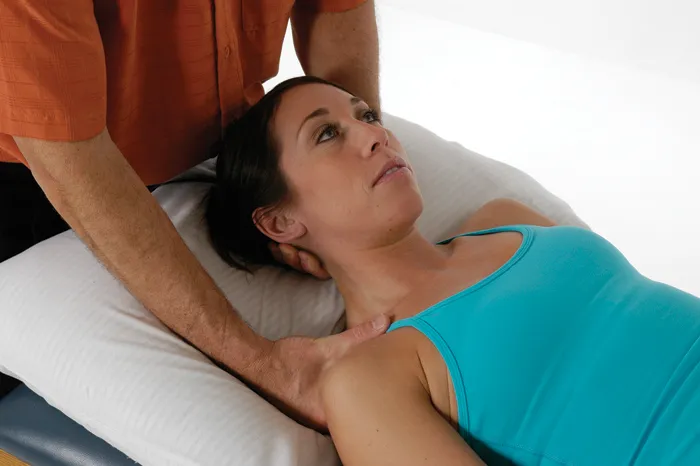
Trapezius—Upper Fibers

Technique 1

Technique described for the right trapezius muscle.
Patient: Positioned in supine lying with the arms resting by the side and the knees flexed.
Therapist: Standing at the head of the bed.
Action: Support the posterior aspect of the patient’s head with both hands and then passively flex the craniovertebral joint. Your right hand stabilizes the lateral one-third of the patient’s right clavicle and acromion while palpating the muscle. Using your left hand, gently and slowly flex, left-side flex and right rotate the mid and lower cervical spine. Both the stabilizing hand and the hand moving the body part sense the tension in the muscle and barrier. Assess the amount of range and the end feel and note the reproduction of any symptoms. Repeat this test on the contralateral side and compare the two results.
Note also the reproduction of any dural symptoms. To differentiate between neuromeningeal tissue and the patient’s muscle, add various sensitizing movements of the upper extremities and note any change in the amount of range, the end feel and the symptoms produced.
figure-9781550595963.c001.f002

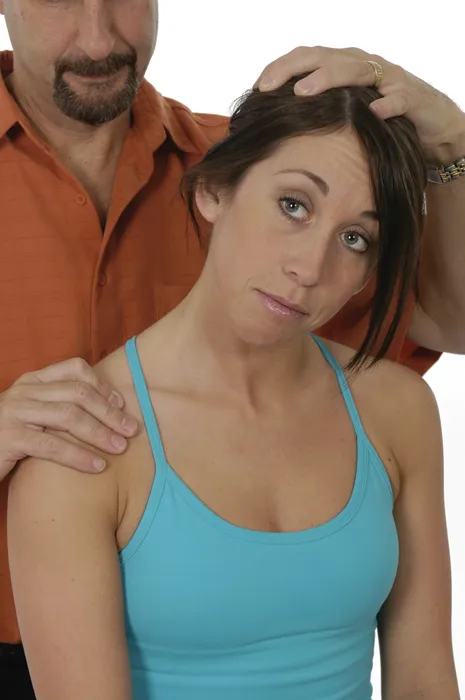
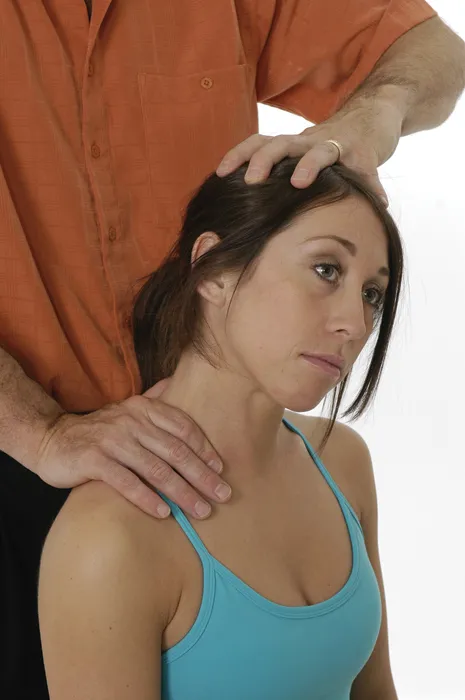
Trapezius—Upper Fibers

Technique 2

Technique described for the right trapezius muscle.
Patient: Positioned in sitting.
Therapist: Standing behind the patient.
Action: The patient actively flexes their craniovertebral joint. Use your right hand to stabilize the lateral one-third of the patient’s right clavicle and acromion while palpating the muscle. Using your left hand, passively flex, left-side flex and right rotate the mid and lower cervical spine. Both the stabilizing hand and the hand moving the body part sense the tension in the muscle and barrier. Assess the amount of range and the end feel and note the reproduction of any symptoms. Repeat this test on the contralateral side and compare the two results.
Note also the reproduction of any dural symptoms. To differentiate between neuromeningeal tissue and the patient’s muscle, add various sensitizing movements of the upper extremities and note any change in the amount of range, the end feel and the symptoms produced.
figure-9781550595963.c001.f003

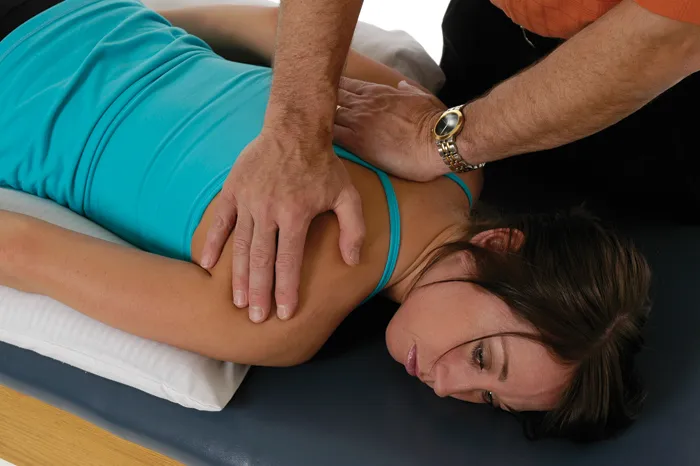
Trapezius—Middle Fibers

Technique 1

Technique described for the right trapezius muscle.
Patient: Positioned in prone lying with the arms resting by their side and the neck resting in right rotation.
Therapist: Standing on the left side of the bed.
Action: Stabilize the left transverse processes of T1 to T5 with the palmar aspect of your left hand. Employing a cross-hand technique, use your right hand to depress and protract the lateral aspect of the patient’s right scapula. Both the stabilizing hand and the hand moving the body part sense the tension in the muscle and barrier. Assess the amount of range and the end feel and note the reproduction of any symptoms. Repeat this test on the contralateral side and compare the two results.
figure-9781550595963.c001.f004

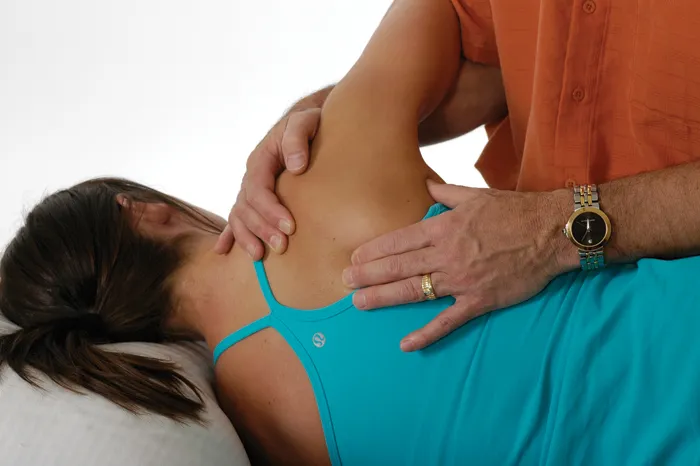
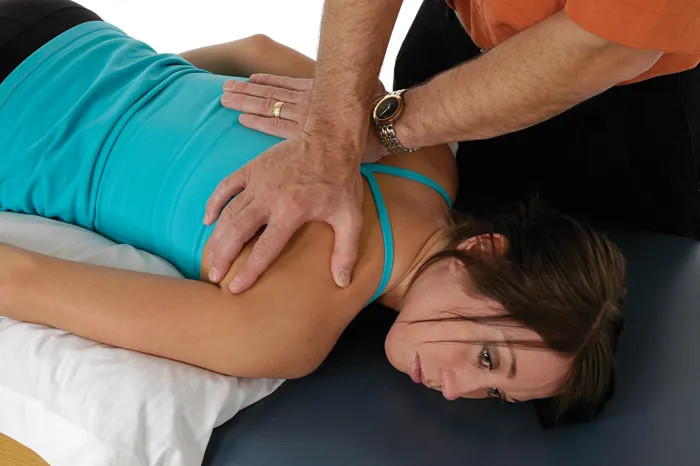
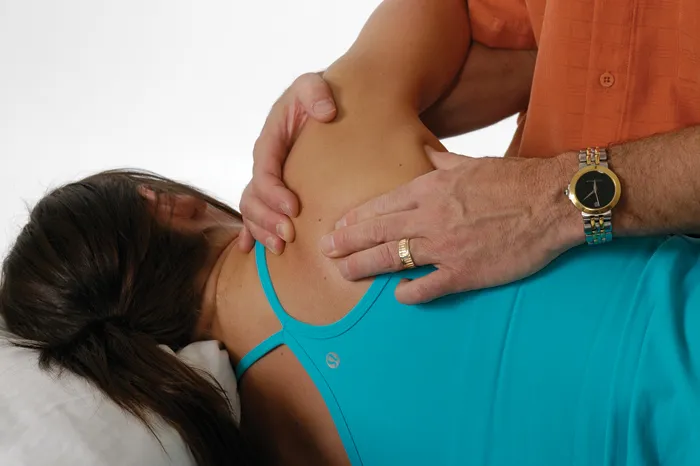
Trapezius—Middle Fibers

Technique 2

Technique described for the right trapezius muscle.
Patient: Positioned in left side lying with a pillow between the knees.
Therapist: Standing on the left side of the bed, facing the patient.
Action: Grasp the inferior aspect of the medial and lateral border of the patient’s right scapula with your left hand and the superior aspect of the medial and lateral border of their right scapula with your right hand. Depress and protract the patient’s right scapula. Both the stabilizing hand and the hand moving the body part sense the tension in the muscle and barrier. Assess the amount of range and the end feel and note the reproduction of any symptoms. Repeat this test on the contralateral side and compare the two results.
figure-9781550595963.c001.f005

Trapezius—Lower Fibers

Technique 1

Technique described for the right trapezius muscle.
Patient: Positioned in prone lying with the arms resting by their side and the neck resting in right rotation.
Therapist: Standing on the left side of the bed.
Action: Stabilize the left transverse processes of T6 to T12 with the palmar aspect of your left hand. Employing a cross-hand technique, use your right hand to elevate, protract and downwardly rotate the patient’s right scapula so that the glenoid faces inferiorly. Both the stabilizing hand and the hand moving the body part sense the tension in the muscle and barrier. Assess the amount of range and the end feel and note the reproduction of any symptoms. Repeat this test on the contralateral side and compare the two results.
figure-9781550595963.c001.f006

Trapezius—Lower Fibers

Technique 2

Technique described for the right trapezius muscle.
Patient: Positioned in left side lying with a pillow between the knees.
Therapist: Standing on the left side of the bed, facing the patient.
Action: Grasp the inferior aspect of the medial and lateral border of the patient’s right scapula with your left hand and the superior aspect of the medial and lateral border of their right scapula with your right hand. Elevate, protract and downwardly rotate the patient’s right scapula so that the glenoid faces inferiorly. Both the stabilizing hand and the hand moving the body part sense the tension in the muscle and barrier. Assess the amount of range and the end feel and note the reproduction of any symptoms. Repeat this test on the contralateral side and compare the two results.
figure-9781550595963.c001.f007

Rectus Capitis Posterior Major

Technique 1

Technique described for the right rectus capitis posterior major muscle.
Patient: Positioned in supine lyin...

Table of contents

  1. Cover
  2. Title Page
  3. Acknowledgements
  4. Contents
  5. Introduction
  6. The Cervical Spine
  7. The Temporomandibular Joint
  8. The Thoracic Spine
  9. The Shoulder
  10. The Elbow
  11. The Wrist and Hand
  12. References
  13. About the Authors