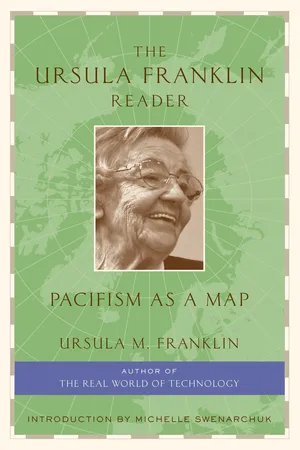
Feminist, educator, Quaker, and physicist, Ursula Franklin has long been considered one of Canada's foremost advocates and practitioners of pacifism. The Ursula Franklin Reader: Pacifism as a Map is a comprehensive collection of her work, and demonstrates subtle, yet critical, linkages across a range of subjects: the pursuit of peace and social justice, theology, feminism, environmental protection, education, government, and citizen activism. This thoughtful collection, drawn from more than four decades of research and teaching, brings readers into an intimate discussion with Franklin, and makes a passionate case for how to build a society centered around peace.
TO MAKE THE CASE for the practice of pacifism, I must first of all introduce the reader to the core of my view of life and living: the Quaker vision of the world.
The first writings in this part are unpublished notes that I hope illustrate the centrality of conscience and discernment in Quaker faith. They were originally compiled as part of the background for a legal team that was preparing an appeal to the Supreme Court of Canada to test the interpretation of the Freedom of Religion provisions of the Canadian Charter of Rights and Freedoms.
The specific issue to be tested was that of conscientious objection to paying taxes for military expenditures in peacetime. Quakers and others had argued that because modern wars were being largely conducted by technological means, the modern nation-state was in effect conscripting the money, rather than the physical activities, of its citizens in its preparations for war (or “defence” by military means). Just as pacifists could claim conscientious objection to physical conscription and accept alternative service, guarantees of freedom of religion should permit conscientious objectors to redirect to peaceful purposes that portion of their personal income tax used for war preparation.
Accordingly, a number of Canadian pacifists had placed the war portion of their personal income tax—corresponding to the percentage of revenue allotted to the Department of National Defence—into a collective trust account before paying the remainder of their taxes. The trust account, in the care of an organization created for this purpose, would be available to the Government of Canada at any time for all but military uses.
The government did not accept this Charter argument, and those who chose this path were charged with tax offences. Once in court they were tried under the Income Tax Act. Even on appeal, they were unable to make the case that they were not refusing to pay taxes, but were attempting to redirect the use of their taxes to non-military purposes. They had no chance to show that their action was the compelling consequence of their religious belief, and that therefore such redirection should be allowed under the Freedom of Religion provisions of the Charter. They hoped to test this interpretation of the Charter provisions in an appeal to the Supreme Court of Canada. Regrettably, leave to appeal was not granted and the factum, into which my discussion was to be incorporated, was not put forward.
However, my notes here may serve as an introduction to the Religious Society of Friends (Quakers) and to the centrality of conscience and discernment in the practice of their faith.
The next papers in this part were intended to illuminate peace perspectives on daily life, first for an audience of Quakers and then for those within the broader religious community. The unpublished “Reflections on Theology and Peace” was written at the same time as the background for the factum on taxes for war or peace. It was presented in 1987 at an interfaith seminar. The gathering was occasioned, or at least catalyzed by, the—at times negative—responses from within church communities to a brief by the Canadian Council of Churches on Canada’s foreign policy. The brief had been presented to a parliamentary hearing in 1985. In my contribution I tried to clarify the forms and concepts that define differing stances of concerned citizens vis-à-vis the policies of their country, without specifying explicitly the practice of pacifism.
The remainder of this part contains papers and lectures in more or less chronological order, and these are intended to show the centrality of peace to the approach to so many issues of the day. In all of them, peace is looked upon as the prerequisite of a civilized and just society, as the foundation for constructive work and collaboration in the great tasks of finding ways for people to live together. Peace is not, in and of itself, the goal or end of our political struggle, but the enabling start of a different social order. Many of the talks in this part were addressed to audiences under the shadow of the Cold War; it was the Soviet Threat, “The West vs. the Eastern Bloc,” and the danger of Communism that coloured the political discourse, carrying with them the spectre of nuclear war. Yet it was the threat system itself, embodied in patriarchal structures—well known to women—and also part of the rationale of the arms race, that was of interest to me.
The Dove Memorial Lecture reflects on the change that the collapse of the Soviet Union in 1989 brought to the political landscape, without, I contended, advancing peace. The threat system, as an instrument of power and control, appeared to be immune to the loss of its official enemy, its stated raison d’être of the Cold War. Indeed, the threat system per se remained and grew at the end of the Cold War. The enemy’s identity morphed, but wars and threats of war and violence continued without ever advancing peace.
Peace remained the ongoing issue; the events of September 11, 2001, and my response to them inform the final papers in this section. Never had I been more convinced than after this date that pacifism provides the only possible map into a livable future, a livable future for the earth and the human family. It seemed so self-evident just how dysfunctional the threat system, as a response to violence, had become. This realization left me quite desperate.
I asked myself: Doesn’t the world see the need for clarity and the inescapable necessity of dealing with the causes of war? Why is it so difficult to turn away from images of the enemy as the root of nations’ problems and as the obstacles to peace? Why is it so difficult for the powerful to understand that peace is the presence of justice and that justice and peace are indivisible? And I keep asking myself: Why has 9/11 and its aftermath not made it abundantly clear that the means of violence are no help to anyone, not even to those who claim every moral right to use them.
THE NATURE OF CONSCIENCE AND THE NATURE OF WAR
Unpublished manuscript, August 1987.
TO APPRECIATE THE centrality of conscience in the lives of individual Quakers it is perhaps best to begin with a few general and historical remarks. It may be helpful to know what Quakers do not do in order to better see the significance of what they actually do. It should, however, be understood that what follows is a rough sketch, intended as an aerial survey locating Quakerism in terms of larger historical and societal processes.
Belief Systems and Reality
All religions and all belief systems reconstitute the world for their followers, giving a culturally acceptable interpretation of what life and death entail, both individually and collectively, explaining what the world is in contrast with what it ought to be or what it could be, and defining what stands in the way of transcending the “is” to the “ought.” Troubles arise among groups of believers when serious contradictions occur between the publicly expressed principles and teachings on the one hand, and the real life conduct and practice on the other. This generalization holds, of course, whether the belief systems are religious or political. There are essentially three ways in which such contradictions can be resolved:
1 to revise conduct and practice so as to conform with the belief system
2 to revise the belief system so as to conform with the new practices or forms of conduct
3 to abandon binding principles and beliefs in order to deal with each problem individually and situationally.
Quakerism should be seen as an attempt—however modest—to use option 1 to cope with the contradictory demands of being a Christian and a citizen in a particular place and time. Mainstream churches have often chosen option 2 when practices and beliefs clash; examples include the “just war” theory, the elevation of the sovereign as head of the church, anti-Semitism, and the role assigned to women. The political dimension of option 3 is self-evident, on both the left and the right. Quakers have always believed that it was practically—not merely theoretically—possible for people to conduct their lives and affairs, and the affairs of community and state, according to basic Christian principles. Thus, in contrast to groups such as the Mennonites and the Brethren, who have often isolated themselves from a world they regarded as intrinsically evil, Quakers have remained in the world. They did so partly as an act of conscious witness to another way of living and dealing with life. William Penn’s holy experiment and the lives of Quakers such as John Bright, John Bellers, Elizabeth Fry, and Lucretia Mott come to mind as illustrations.
Remarks on Quaker History
Early Friends saw their task largely as freeing the basic Christian message from the worldly encrustations of rules, regulations, and habits that church practice rather than faith had produced over the centuries. The social climate of seventeenth-century England was one of intense questioning of established values and structures in the wake of the Reformation. In this setting Quakers rediscovered the glorious equality of all before God and the “Inner Light,” the inherent ability to respond to God’s prompting, to discern the truth, and to act accordingly. When Quakers speak of “that of God in everyone,” they mean that every person is worthy of reverence and that each has within himself or herself a seed that will illuminate their conscience and help them to grow spiritually. Friends left behind what they regarded as lifeless forms or empty professions of faith rendered on fixed occasions and in set phrases, and refused to accept arbitrary divisions between the sacred and the secular. All life was to be lived under God’s guidance and every act was equally sacred.
To Fox and the early Friends the whole of life seemed sacramental, and they refused to mark off any one particular practice or observance as more sacred than others. They took the same stand with regard to Sunday, or First Day; it was not in itself more holy than Saturday or Monday; every week-day should be a Lord’s Day. Their whole attitude was gloriously positive, not negative. They were ‘alive unto God’ and sensed him everywhere.1
Without the traditional sacraments of baptism, marriage, ordination, and holy communion, life itself became the sacrament, the testimony of faith. In 1684 William Penn described the work of early Friends as follows:
The bent and stress of their ministry was conversion to God, regeneration and holiness, not schemes or doctrines and verbal creeds or new forms of worship, but a leaving off in religion the superfluous and reducing the ceremonious and formal part, and pressing earnestly the substantial, the necessary and profitable part, as all upon a serious reflection must and do acknowledge.2
Living a sacramental life, even in the most modest meaning of the word, entails the constant presence of an internal yardstick—that Inner Light—to which decisions, be they small or big, are constantly held up. To quote William Penn again:
We judged not after the sight of the eye, or after the hearing of the ear, but according to the Light and the sense this blessed principle gave us; we judged and acted in reference to things and persons, ourselves and others, yea, towards God our maker. For being quickened by it in our inward man, we could easily discern the difference of things, and feel what was right, and what was wrong, and what was fit and what not, both in reference to religion and to civil concerns.3
For Friends, the Inner Light, both as a concept and as a process, represents conscience: the link between faith and practice.
The Centrality of Conscience
One cannot overemphasize the centrality of conscience in the life of individual Friends. Once the Society of Friends had rejected the detailed and prescriptive rules of conduct and structure that traditional churches provided for their members, Quakers had to develop a process of discernment in order to become sensitive to the choices each one had to make every day. Conscience therefore is the inner gyroscope pointing to the practical implications of Quaker testimonies. Throughout the centuries conscience has given direction to Quakers’ lives and enabled Friends to make internally consistent choices in the small and large decisions that life brings. The process of bringing the Inner Light, the individual conscience, to bear on decisions and the growing sensitivity of the discernment can be compared with the process of tuning musical instruments. As musicians become more proficient, they tune with greater care; they also hear dissonances more keenly and find them painful. In just this manner Quakers try to tune their moral sensitivities. To them the only instruments they can use are their lives. Each life needs to be “in tune” so as to avoid the discord between faith and practice.
The Advices and Queries
The Religious Society of Friends has no fixed creeds, regulations, or prescriptive documents defining how members should conduct themselves in specific situations, but the Advices and Queries provide ongoing guidance in the perfecting and exercise of the process of discernment.4 The following quotations from the Advices and Queries are intended to illustrate that the presence of a value system can be demonstrated by the internally consistent choices made by concerned individuals and to indicate the range of issues to which these principles apply. Decisions small and large are held up to the same light and regarded with the same seriousness.
• Bring the whole of your daily life under the ordering of the spirit of Christ.
• Live adventurously. When choices arise, take the way that offers the fullest opportunity for the use of your talents in the service of God and the community.
• In your relations with others, exercise imagination, understanding, and sympathy. Listen patiently, and seek whatever truth other people’s opinions may contain for you. Think it possible that you may be mistaken. In discussion, avoid hurtful and provocative language; do not allow the strength of your convictions to betray you into making statements or allegations that are unfair or untrue.
• Endeavour to make your home a place of peace and happiness where the presence of God is known. Try to live simply. Remember the value of beauty in all its forms.
• Encourage the appreciation of music, literature, and the other arts and the development of a taste that will reject the worthless and the base. God’s good gifts are for all to enjoy; learn to use them wisely.
• Choose recreations that do not conflict with your service to God and man, and in that service, be willing to lay them aside. Be discriminating in the use of radio and television and other means of information, persuasion, and entertainment. Give thought to the right use of Sunday with its special opportunities for both service and leisure.
• Remember your responsibility as citizens for the government of your own town and country, and do not shirk the effort and time this may demand. Do not be content to accept things as they are, but keep an alert and questioning mind....
Table of contents
Cover Page
Title Page
Copyright Page
Dedication
Contents
Acknowledgements
Introduction
Prelude
Part One: The Pursuit of Peace: Pacifism as a Map
Part Two: Here and Now: The Technological World
Part Three: Coping with and Changing the Technological World
Part Four: Teaching and Learning
From Ursula’s Bookshelf
Trusted by 375,005 students
Access to over 1.5 million titles for a fair monthly price.
Study more efficiently using our study tools.
Frequently asked questions
Yes, you can cancel anytime from the Subscription tab in your account settings on the Perlego website. Your subscription will stay active until the end of your current billing period. Learn how to cancel your subscription
No, books cannot be downloaded as external files, such as PDFs, for use outside of Perlego. However, you can download books within the Perlego app for offline reading on mobile or tablet. Learn how to download books offline
Perlego offers two plans: Essential and Complete
Essential is ideal for learners and professionals who enjoy exploring a wide range of subjects. Access the Essential Library with 800,000+ trusted titles and best-sellers across business, personal growth, and the humanities. Includes unlimited reading time and Standard Read Aloud voice.
Complete: Perfect for advanced learners and researchers needing full, unrestricted access. Unlock 1.5M+ books across hundreds of subjects, including academic and specialized titles. The Complete Plan also includes advanced features like Premium Read Aloud and Research Assistant.
Both plans are available with monthly, semester, or annual billing cycles.
We are an online textbook subscription service, where you can get access to an entire online library for less than the price of a single book per month. With over 1.5 million books across 990+ topics, we’ve got you covered! Learn about our mission
Look out for the read-aloud symbol on your next book to see if you can listen to it. The read-aloud tool reads text aloud for you, highlighting the text as it is being read. You can pause it, speed it up and slow it down. Learn more about Read Aloud
Yes! You can use the Perlego app on both iOS and Android devices to read anytime, anywhere — even offline. Perfect for commutes or when you’re on the go. Please note we cannot support devices running on iOS 13 and Android 7 or earlier. Learn more about using the app
Yes, you can access The Ursula Franklin Reader by Ursula Franklin in PDF and/or ePUB format, as well as other popular books in Politics & International Relations & Philosophy History & Theory. We have over 1.5 million books available in our catalogue for you to explore.