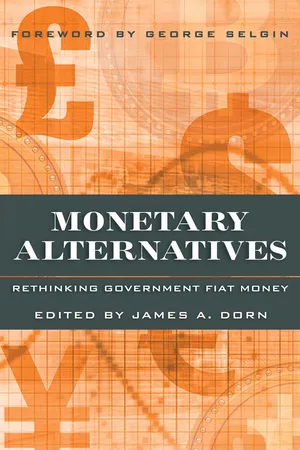
What monetary system best serves society? The current system of pure government fiat monies, managed by discretionary central banks, is inefficient and unstable. Monetary Alternatives explores fundamental and controversial ideas that move our monetary system and economy beyond repeated crises to sustainable stability and prosperity. The contributors to this volume energetically question the status quo and provide compelling arguments for moving to a monetary system based on freedom and the rule of law.
- 304 pages
- English
- ePUB (mobile friendly)
- Available on iOS & Android
eBook - ePub
About this book
Information
1
INTRODUCTION
TOWARD A NEW MONETARY REGIME
James A. Dorn
The only adequate guarantee for the uniform and stable value of a paper currency is its convertibility into specie—the least fluctuating and the only universal currency. I am sensible that a value equal to that of specie may be given to paper or any other medium, by making a limited amount necessary for necessary purposes; but what is to ensure the inflexible adherence of the Legislative Ensurers to their own principles and purposes?—James Madison (1831)
Rethinking Government Fiat Money
Today we live a world of pure discretionary government fiat monies. Any link of the dollar to gold ended in August 1971, when President Nixon closed the Treasury’s “gold window,” which had allowed foreign central banks to freely covert their dollars for gold at the official exchange rate. The end of convertibility left the dollar without an anchor except for the Federal Reserve’s promise to maintain price stability. That objective, however, has often been sacrificed in the vain attempt to promote full employment.
The global financial crisis of 2007–08, increased the Fed’s discretionary authority and ushered in unconventional policies—notably, largescale asset purchases known as quantitative easing (QE), and ultra-low interest rates with a lower bound on the federal funds rate near zero. Macro-prudential regulation was also added to the policy mix. By suppressing interest rates, the Fed has increased risk taking, misallocated capital, and inflated asset prices. Other central banks have followed suit. When rates rise, bubbles will burst—and the hoped for wealth effect of monetary stimulus will be recognized as a pseudo wealth effect.
The politicization of monetary policy and the failure of central banks to generate robust economic growth have led to calls for rethinking the current monetary regime and for recognizing the limits of monetary policy. The U.S. Congress has constitutional authority to “coin money” and “regulate the value thereof” (Article 1, Section 8). Using that authority, some members of Congress have advocated establishing a bipartisan Centennial Monetary Commission to review the Fed’s performance and to consider ways to reduce uncertainty, safeguard the long-run value of the dollar, and mitigate financial crises.
The debate over rules versus discretion—and the choice of alternative monetary rules—is at the heart of this volume. Before discussing those issues, however, the book begins with an overview of the current state of central banking and the case for restoring a monetary constitution.
Central Banking at a Crossroads
The persistence of near-zero interest rates and the failure of the Fed to reduce the size of its balance sheet pose serious problems for policymakers. If the Fed waits too long to raise rates and end discretionary credit allocation, distortions in capital markets will worsen. But if it moves too fast, another recession could occur.
More fundamentally, if central banks are guided by erroneous monetary theory, the damage to the real economy could be substantial. Experiments with unconventional monetary policy need to be questioned and alternatives proposed. The authors in Part 1 do so.
Claudio Borio, who heads the Monetary and Economic Department at the Bank for International Settlements, revisits three “intellectual pillars of monetary policy”: (1) the natural or equilibrium interest rate is best understood as one consistent with price stability and full employment; (2) money is neutral in the medium to long run; and (3) deflation is always costly. He argues that none of these beliefs are sufficient to understand current monetary policy or to guide future policy.
First, the definition of the equilibrium interest rate would be improved by including financial and macroeconomic stability, not just price stability and full employment. Second, monetary disequilibrium, as reflected in distorted interest rates and misallocated credit, can persist for 10–20 years; it is not just a short-run phenomenon. Third, one should distinguish between deflation caused by deficient aggregate demand (as during the Great Depression) and deflation due to productivity gains. The former should be avoided, but the latter should be welcomed. The Fed and other central banks typically treat any deflation as bad, while striving to increase inflation. That is a recipe for trouble. A positive agenda for reform, argues Borio, requires that central bankers recognize that “easy monetary policy cannot undo the resource misallocations” brought about by distorted interest rates, and that the focus should be on “facilitating balance sheet repair and implementing structural reforms.”
Jeffrey Lacker, president of the Federal Reserve Bank of Richmond, argues that central banks should not be in the business of credit allocation and income redistribution. Instead, they should focus on achieving long-run price stability through traditional open-market operations. He is concerned about the same distortions discussed by Borio. According to Lacker, intervention in credit markets “can redirect resources from taxpayers to financial market investors and, over time, can expand moral hazard and distort the allocation of capital.” In addition, such intervention is “a threat to financial stability.”
By engaging in credit/fiscal policy, rather than pure monetary policy, the Fed threatens its independence and credibility. Thus, Lacker prefers a “Treasuries-only” policy, which he believes would enable the Fed to better honor its commitment to supply “an elastic currency.”
John Allison, former chairman and CEO of BB&T, is highly critical of the growing power of the Fed as a result of the financial crisis. He thinks interest rates should be set by markets, not manipulated by central banks. The Fed’s ultra-low interest rate policy has increased borrowing for housing consumption, but has had a negative effect on productive private investment. Meanwhile, burdensome financial regulations have been a poor substitute for strong capital requirements and market discipline.
The public needs to recognize the limits of central banks and expose the “fatal conceit” that a centrally planned monetary system can outperform a system based on free markets, individual responsibility, and well-enforced private property rights. More telling, when central banks try to allocate credit, they are bound to reduce economic and personal freedom. That is why Allison favors making “it illegal for the Fed to bail out insolvent firms.” He also advocates eliminating government deposit insurance and constraining central banks by a monetary rule. Ideally, he would do away with central banks and adopt free banking under a commodity standard.
Bennett McCallum, professor of economics at Carnegie-Mellon University, is “appalled” by the Fed’s “major excursions into credit policy. . . and thereby into the unauthorized exercise of fiscal policy.” He favors a rules-based monetary regime that reduces uncertainty and provides a framework for price level stability. In that regard, he examines several alternatives to discretionary government fiat money: the gold standard, private competitive currencies, and the Yeager-Greenfield proposal for stabilizing a broad price index. McCallum recognizes that there is no perfect system, and “the best that can be done . . . is to adopt institutions that are less subject to temptation than others and that promise to provide stability of a broad price index.”
As a first step toward monetary reform, McCallum would end the Fed’s dual mandate and have Congress amend the Federal Reserve Act to make the Fed accountable for a single mandate—long-run price stability. That recommendation is consistent with his earlier proposal for a monetary feedback rule that would stabilize nominal income growth (McCallum 1989: 336–51; also see White 1999: 223–24).
Restoring a Monetary Constitution
Preoccupation with the conduct of monetary policy within a given monetary regime can easily detract from the more fundamental issue of a monetary constitution—that is, the rules of the game that underlie any monetary regime. Although the Federal Reserve is based on an act of Congress, there is a higher law of the Constitution that is meant to safeguard the public’s property right in a stable-valued money. It is clear from a careful reading of the U.S. Constitution’s monetary clauses that the Framers had in mind a monetary system based on convertibility to the precious metals, not one based on fiat money under a discretionary central bank. In that regard, Milton Friedman (1984: 47) told members of Congress, “As I read the original Constitution, it intended to limit Congress to a commodity standard.”
In December 1913, when Congress passed the Federal Reserve Act, the United States was still on the gold standard. World War I put an end to the old monetary order. At first the Federal Reserve was narrowly limited, but over time its powers grew, especially during periods of crisis. The authors in Part 2 emphasize the need for a monetary constitution to safeguard the value of money and facilitate mutually beneficial exchanges. They discuss both the case for restoring the Framers’ monetary constitution as well as searching for monetary rules that can improve upon the current discretionary government fiat money regime.1
Richard Timberlake, an emeritus professor of economics and finance at the University of Georgia, and author of Constitutional Money: A Review of the Supreme Court’s Monetary Decisions (2013), provides a concise history of the metallic (gold-silver) standard in the United States, the origins of the Federal Reserve, and the drift toward a pure fiat money system as the Supreme Court and Congress eroded the Framers’ Constitution. He argues that although it may not be politically possible to restore the original constitutional monetary system, Congress should remove the Fed’s discretion by imposing a single mandate: price level stability.
James Buchanan, recipient of the Nobel Memorial Prize in Economic Sciences in 1986, the cofounder of the public choice school of economics, and a long-time adherent of “constitutional economics,” argues for adopting a monetary constitution that has as its primary objective “predictability in the value of the monetary unit.” He views this as a responsibility of government akin to protecting private property rights and enforcing contracts. Under current U.S. monetary law, notes Buchanan, “There exists no monetary constitution . . . . What does exist is an institutionally established authority charged with an ill-defined responsibility to ‘do good,’ as determined by its own evaluation.”2
Buchanan contends that modern macroeconomics has diverted attention from the rules needed to bring about monetary and economic order, and instead has focused on models that operate in an institutional vacuum. He does not seek to define the optimal monetary rule, but rather to escape conventional thinking and engage in constitutional dialogue to increase the chances of improving the monetary regime. By reducing transactions costs, an improved monetary regime would enlarge the scope for voluntary exchange and increase the wealth of the nation.
Peter Bernholz, an emeritus professor of economics at the University of Basel, relies on his extensive knowledge of monetary history to explore the problem of implementing and maintaining a monetary constitution. He argues that long-run price stability “can be maintained only if politicians and central bankers have no discretionary authority to influence the stock of money.”
In thinking about how to design a monetary constitution and maintain it, Bernholz recommends six measures, including “a mechanism limiting the stock of money,” a requirement that the monetary constitution can only be amended by a supermajority vote, and a prohibition against the use of “emergency clauses.” The money supply could be limited by either a convertibility rule or a quantity rule. Bernholz favors the former under a pure gold standard—or what Milton Friedman (1961) called a “real gold standard” (as opposed to a “pseudo gold standard”). In moving to a pure gold standard, Bernholz would abolish central banks, institute free banking with unlimited liability for shareholders, and outlaw state-owned banks. Such a laissez-faire monetary system has historical precedents, argues Bernholz, and would facilitate “innovation in the field of money.”
Rules versus Discretion
The long-standing debate over rules versus discretion in the conduct of monetary policy has been energized by the 2007–08 financial crisis, which caught nearly all economists and policymakers by surprise. That crisis has led to more powerful central banks with significantly more discretion, which has increased uncertainty about the direction of monetary policy. The authors in Part 3 argue for limiting central bank discretion and adopting a rules-based monetary regime.
Charles Plosser, former president of the Federal Reserve Bank of Philadelphia, draws on work of Kydland and Prescott (1977) to emphasize the importance of having policymakers commit to a rules-based monetary regime that anchors expectations about the future path of monetary policy. Plosser is interested in “institutional design” and strategies to limit the scope of central banks and increase their credibility. Rather than rely solely on legislated rules, which might politicize monetary policy, he prefers to have central bankers reform from within. In the case of the Fed, he recommends that the Federal Open Market Committee release quarterly reports to inform the public on how well actual policy complies with various monetary rules.
George Selgin, director of Cato’s Center for Monetary and Financial Alternatives, distinguishes between “real and pseudo monetary rules.” The former refer to rules that are “strict” (i.e., rigidly enforced either by contract or design) and “robust,” in the sense that the “monetary system itself automatically implements the rule.” In contrast, pseudo monetary rules are neither rigorously enforced nor robust. Monetary authorities are not subject to penalties for failing to meet targets, policymaking is myopic, and time inconsistency is endemic. Thus, “a pseudo rule is as likely as discretion to turn monetary policy into a plaything of politics.” Selgin provides examples of the two types of rules and concludes that the line between them “is a very fine one, the difference ultimately being one, not in kind, but in degree to which adherence to a rule is regarded as unbreakable.”
John B. Taylor, a professor of economics at Stanford University, has long argued in favor of monetary rules over discretion. When he first introduced the famous Taylor Rule in 1993, it was intended to guide monetary policy, not be enforced by law. “The objective,” notes Taylor, “was to help central bankers make their interest rate decisions in a less discretionary and more rule-like manner, and thereby achieve the goal of price stability and economic stability.” Now, with the increase in the Fed’s discretion and power as a result of the financial crisis, and the Fed’s entry into credit allocation and unconventional monetary policies, Taylor favors enacting a monetary rule. He believes it is time for Congress to exercise its constitutional authority over monetary policy but in a way that does not lead to politicization.
Prior to the Great Recession, central banks gained experience and success using the Taylor Rule, which can be viewed as a nominal income rule, and inflation targeting. That success, argues Taylor, should be utilized in designing legislation to improve monetary policy. The key objective should be “to restore a more strategic rule-like monetary policy with less short-term oriented discretionary actions.” Taylor proposes legislation that would increase accountability and reduce the temptation to engage in credit allocation and fiscal policy.
Scott Sumner, director of the Program on Monetary Policy at George Mason University’s Mercatus Center, is a strong proponent of nominal GDP targeting. One benefit of NGDP targeting is that it bypasses the issue of assigning weights under the Fed’s dual mandate to achieve price level stability and maximum employment. All that needs to be done is to set a target path for nominal GDP, which is the product of the general price level and real output. There is ready data on total spending (or domestic final sales if that metric is used).3 So if the target is set at 5 percent trend growth, then market forces will determine real growth and the Fed will supply the monetary base sufficient to hit the designated nominal GDP target. This strategy avoids having to fine tune monetary policy.
To improve the operation of this monetary rule, Sumner and other “market monetarists” would rely on a futures market for nominal GDP contracts to keep actual GDP in line with the target. “The market, not the central bank, would be setting the monetary base and the level of interest rates.” Once nominal GDP was on a stable growth path, argues Sumner, there would be more transparency, less chance of contagion from financial crises, and less political pressure on the Fed. Keeping no...
Table of contents
- Cover Page
- Title Page
- Copyright Page
- CONTENTS
- FOREWORD
- EDITOR'S PREFACE
- Chapter 1: INTRODUCTION: Toward a New Monetary Regime
- PART 1: CENTRAL BANKING AT A CROSSROADS
- PART 2: RESTORING A MONETARY CONSTITUTION
- PART 3: RULES VERSUS DISCRETION
- PART 4: ALTERNATIVES TO GOVERNMENT FIAT MONEY
- NOTES
- REFERENCES
Trusted by 375,005 students
Access to over 1.5 million titles for a fair monthly price.
Study more efficiently using our study tools.
Frequently asked questions
Yes, you can cancel anytime from the Subscription tab in your account settings on the Perlego website. Your subscription will stay active until the end of your current billing period. Learn how to cancel your subscription
No, books cannot be downloaded as external files, such as PDFs, for use outside of Perlego. However, you can download books within the Perlego app for offline reading on mobile or tablet. Learn how to download books offline
Perlego offers two plans: Essential and Complete
- Essential is ideal for learners and professionals who enjoy exploring a wide range of subjects. Access the Essential Library with 800,000+ trusted titles and best-sellers across business, personal growth, and the humanities. Includes unlimited reading time and Standard Read Aloud voice.
- Complete: Perfect for advanced learners and researchers needing full, unrestricted access. Unlock 1.5M+ books across hundreds of subjects, including academic and specialized titles. The Complete Plan also includes advanced features like Premium Read Aloud and Research Assistant.
We are an online textbook subscription service, where you can get access to an entire online library for less than the price of a single book per month. With over 1.5 million books across 990+ topics, we’ve got you covered! Learn about our mission
Look out for the read-aloud symbol on your next book to see if you can listen to it. The read-aloud tool reads text aloud for you, highlighting the text as it is being read. You can pause it, speed it up and slow it down. Learn more about Read Aloud
Yes! You can use the Perlego app on both iOS and Android devices to read anytime, anywhere — even offline. Perfect for commutes or when you’re on the go.
Please note we cannot support devices running on iOS 13 and Android 7 or earlier. Learn more about using the app
Please note we cannot support devices running on iOS 13 and Android 7 or earlier. Learn more about using the app
Yes, you can access Monetary Alternatives by James A. Dorn in PDF and/or ePUB format, as well as other popular books in Economics & Government & Business. We have over 1.5 million books available in our catalogue for you to explore.