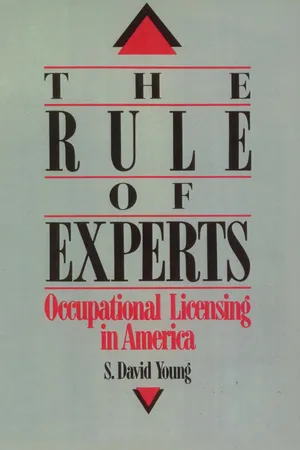
S. David Young argues that occupational licensing results in the misallocation of labor and harms consumers.
- 116 pages
- English
- ePUB (mobile friendly)
- Available on iOS & Android
eBook - ePub
About this book
Information
V. Restrictions on Entry
When the right to practice a particular trade or profession depends not on personal initiative but also on the approval of some agency, ... the industry has laid the foundation for exercise of monopoly power. No longer may anyone perform legal, medical, accounting, architectural, or other tasks. The first condition for a competitive industry-freedom of entry-is gone.-J. K. Ueberman1
Because the major function of licensing is to prevent the unqualified from practicing, licensing is exclusionary. Those who meet a predetermined standard are licensed and allowed to practice; those who do not are excluded. Licensing laws generally require candidates to meet four types of requirements: (1) formal schooling; (2) experience, such as internships, apprenticeships, or supervised practice; (3) personal requirements, such as citizenship, residency, and good moral character; and (4) successful completion of a licensing examination.
The mechanism for enforcing these requirements and maintaining monopolistic control over a licensed occupation is the state licensing board. The state legislature, in effect, grants a charter to the board, and its members, frequently drawn from the regulated profession itself, are appointed by the governor. Many reasons have been given to justify this arrangement, including the importance of maintaining close cooperation between the state and the profeSSion, the importance of ensuring competent, highly qualified board members, and the need for experts who understand the problems faced by practitioners.
An important weakness of this system from a public-interest viewpoint is that many requirements found in licensing statutes and enforced by licensing boards are there by dint of the practitioners' custom or some arbitrary choice, not because the public is really served by them. To illustrate, if a professional group suggests five years of experience as a requirement, a legislator is unlikely to raise the question of whether eight years, or four years, or less would be adequate.2 Seldom are requirements based on careful analysis of what minimum levels of knowledge, skill, ability, and other traits are truly necessary to ensure adequate service. As a result, the impact of the requirements on practitioner competence has rarely been demonstrated.
Where, for example, are data supporting the notion that practitioners trained in different ways are dangerous? Andrew Dolan writes:
Would most patients be in peril if physicians went to undergraduate school for two years instead of four and medical school for three years instead of four? How about 2.5 years of undergraduate school and 3.5 years of medical school? In nursing, where graduates of two-year, three-year, and four-year schools all qualify for taking state licensing examinations, the data do not indicate unacceptable performance among any of those groups.3
One excuse formerly heard in the medical profession for limiting entry was that letting too many people in would lower incomes to such an extent that doctors would resort to unethical practices to increase their income. But as Milton Friedman (1962) wrote: ''This has always seemed . . . objectionable on both ethical and factual grounds. It is extraordinary that leaders of medicine should pro claim publicly that they and their colleagues must be paid to be ethical."4
Doctors are less inclined to make such assertions today, but their current entry-restriction practices, as well as other activities designed to limit competition in the health care field, suggest that professional attitudes have changed little over the years. Indeed, these attitudes have become especially apparent in the medical establishment's response to the so-called doctor glut crisis. Arnold ReIman, editor of the New England Journal of Medicine, wrote:
When there are too many physicians competing for too few patients, one can expect the ethical standards of medical care to be strained and the focus to shift from a primary concern for patients' needs to more preoccupation with the physicians' economic interests.5
This recent flurry of concern over the glut can be traced to a 1980 Graduate Medical Education National AdviSOry Commission study, which predicted a surplus of 90,000 doctors by 1990 and of 140,000 by 2000. As health-care economist Mark Pauly notes, however, the report was more political than technical: "[T]here is no scientific way of determining how many doctors we need, primarily because both physician productivity and the volume of physicians' services that could be absorbed in the treatment of disease are prone to change."6 Indeed, as Pauly points out, the lower productivity of the increasing number of women doctors (because of fewer work hours per week and fewer years in practice than their male counterparts) has caused the Department of Health and Human Services to revise downward its surplus estimates.
Although Reiman insists that the market will not adequately deal with the "oversupply" of physicians, Pauly suggests that it will and notes the recent experience of dental schools: Enrollment is down 23 percent today from its 1978 peak; with even further reductions expected. The decline can be traced to fewer applicants and not to the fact that dental school deans have been pressured into reducing enrollment. Apparently, Pauly concludes, "word got around that the market opportunities were drying up .... Assuming that the surplus [in medicine] is truly genuine, it does seem that medical schools could expect similar results."7
Another problem with entrance requirements is their potential for creating a snowball effect. Whenever some states increase standards for their professional groups, professionals in other states are liable to use the action as justification for higher entry standards in their jurisdictions. Benjamin Shimberg explains why: "No state likes to acknowledge its standards are lower, because this implies that its citizens are not as well protected as citizens of other states." Although the public may go along in the belief that more training is always better, this type of thinking is fallacious. As Shim berg states:
Beyond a certain point, additional training does not mean a higher quality of service. What it may mean instead is that the practitioner can charge more for his or her service because of the long time spent in training and because the supply of practitioners may have been thinned out by the unnecessarily long training requirements.8
Problems with the Requirements
In this section, the problems associated with the four types of requirements-education, experience, citizenship and residency, and licensing examinations-are briefly examined.
Educational Requirements
Educational requirements vary widely across professions; some require little formal schooling, while others require several years of post-graduate study. Schooling requirements in some professions, such as law, are at least partly justified because aspiring professionals learn their trade in pos...
Table of contents
- FOREWORD
- I. INTRODUCTION
- II. A HISTORY OF OCCUPATIONAL LICENSING
- III. LICENSING AND THE PUBLIC INTEREST
- IV. THE DEMAND FOR LICENSING
- V. RESTRICTIONS ON ENTRY
- VI. LICENSING BOARDS: PROMISES AND FAILURES
- VII. EFFECTS ON INCOME AND COSTS
- VIII. LICENSING AND QUALITY
- IX. LICENSING AND OCCUPATIONAL MOBILITY
- X. LICENSING AND INFORMATION CONTROL
- XI. LICENSING AND INNOVATION
- XII. EFFECTS ON MINORITIES AND THE POOR
- XIII. PROFESSIONALS AND THE SCOPE OF PRACTICE
- XIV. THE REFORM MOVEMENT AND THE FUTURE
- REFERENCES
- About the Author
Trusted by 375,005 students
Access to over 1.5 million titles for a fair monthly price.
Study more efficiently using our study tools.
Frequently asked questions
Yes, you can cancel anytime from the Subscription tab in your account settings on the Perlego website. Your subscription will stay active until the end of your current billing period. Learn how to cancel your subscription
No, books cannot be downloaded as external files, such as PDFs, for use outside of Perlego. However, you can download books within the Perlego app for offline reading on mobile or tablet. Learn how to download books offline
Perlego offers two plans: Essential and Complete
- Essential is ideal for learners and professionals who enjoy exploring a wide range of subjects. Access the Essential Library with 800,000+ trusted titles and best-sellers across business, personal growth, and the humanities. Includes unlimited reading time and Standard Read Aloud voice.
- Complete: Perfect for advanced learners and researchers needing full, unrestricted access. Unlock 1.5M+ books across hundreds of subjects, including academic and specialized titles. The Complete Plan also includes advanced features like Premium Read Aloud and Research Assistant.
We are an online textbook subscription service, where you can get access to an entire online library for less than the price of a single book per month. With over 1.5 million books across 990+ topics, we’ve got you covered! Learn about our mission
Look out for the read-aloud symbol on your next book to see if you can listen to it. The read-aloud tool reads text aloud for you, highlighting the text as it is being read. You can pause it, speed it up and slow it down. Learn more about Read Aloud
Yes! You can use the Perlego app on both iOS and Android devices to read anytime, anywhere — even offline. Perfect for commutes or when you’re on the go.
Please note we cannot support devices running on iOS 13 and Android 7 or earlier. Learn more about using the app
Please note we cannot support devices running on iOS 13 and Android 7 or earlier. Learn more about using the app
Yes, you can access The Rule of Experts by S. David Young in PDF and/or ePUB format, as well as other popular books in Política y relaciones internacionales & Política pública. We have over 1.5 million books available in our catalogue for you to explore.