Why has the United States experienced so many crippling financial crises? The popular answer: U.S. banks have long been poorly regulated, subjecting the economy to the whims of selfish interest, which must be tempered by more government regulation and centralization. George Selgin turns this conventional wisdom on its head. In essays covering U.S. monetary policy since before the Civil War, he painstakingly traces financial disorder to its source: misguided government regulation, dispelling the myth of the Federal Reserve as a bulwark of stability.
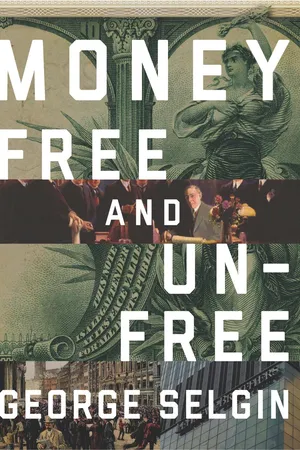
- 382 pages
- English
- ePUB (mobile friendly)
- Available on iOS & Android
eBook - ePub
About this book
Information
PART I
REGULATORY
SOURCES
OF
FINANCIAL
INSTABILITY
REGULATORY
SOURCES
OF
FINANCIAL
INSTABILITY
1
A FISCAL THEORY OF
GOVERNMENT’S ROLE IN MONEY*
WITH LAWRENCE H. WHITE
Economic policy has, up to the turn of the century, been motivated primarily by fiscal considerations. . . . [F]iscal measures have created and destroyed industries . . . even where this was not their intent, and have in this manner contributed directly to the construction (and distortion) of the edifice of the modern economy.
—JOSEPH SCHUMPETER ([1918] 1954: 7)
WHY DO GOVERNMENTS play the roles they do in the monetary system? In particular, why have national governments almost universally taken over the business of issuing coins and paper currency, and replaced precious metals with fiat money as the base supporting bank-issued money? Why have they not (in developed countries, at least) also nationalized the production of checking accounts, choosing instead to tax and regulate private banks?
Standard answers to these questions refer to market failures (natural monopolies, externalities, or information asymmetries) that might render unregulated private production of money inefficient or unstable or infeasible. Market-failure explanations assume that governments shape monetary institutions to serve money holders, by providing a more efficient and stable payments system than would exist under laissez faire. Thus, private competition is not allowed in currency issue because markets inherently would fail (or historically did fail) there, and the legal restrictions we see on deposit banking are ones needed to prevent market failures in that industry.
Recent research supplies three reasons for doubting the adequacy of the market-failure approach for explaining monetary arrangements. First, economic historians have found that the actual forms taken by money and banking regulations, and the timing of their adoption, often have little apparent connection to alleged market failures. Observed regulations (e.g., reserve requirements that freeze rather than enhance liquidity) are ill designed to remedy the suboptimalities that are supposed to have motivated them. Second, monetary historians have found that systems close to laissez faire have (by and large) been at least as successful as more restricted systems. Finally, monetary theorists have pointed out weaknesses in theoretical arguments for market failure in money.1
If the market-failure explanation is doubtful, how else can one explain government’s role in money? Charles Kindleberger (1994: xi) poses the challenge squarely: the economist who doubts the market-failure approach “has to explain why there seems to be a strong revealed preference in history for a sole issuer.” We propose a fiscal hypothesis: governments have come to supply currency, and to restrict the private supply of currency and deposits, not to remedy market failures, but to provide themselves with seigniorage and loans on favorable terms. Government currency monopolies and bank regulations can thus be understood as part of the tax system. The “strong revealed preference in history for a sole issuer” is, fundamentally, the preference of fiscal authorities, not of consumers.2
Economic historians have, of course, often recognized fiscal motives behind specific monetary arrangements, especially those of ancient and medieval autocracies. Analysts of developing countries today have recognized that policies of “financial repression” aim at fostering “financial institutions and financial instruments from which government can expropriate significant seigniorage” (Fry 1988: 14; Giovanni and de Melo 1993). We go further in arguing that fiscal forces have typically shaped the industrial organization of money production, throughout history and across countries, and account for its major institutional features even in advanced democracies today. Such observed legal restrictions as statutory reserve requirements, interest rate ceilings, foreign exchange controls, and monopoly issue of currency impede efficiency but raise revenue.
A RATIONAL DICTATOR MODEL
To develop our hypothesis, we adopt a method found in the writings of the Italian fiscal theorists, especially Amilcare Puviani. According to James Buchanan (1960: 64), Puviani tried to account for overall government tax arrangements by asking “two simple questions.” First, what sort of tax system would a “rational dictator” put in place if his aim were “to exploit the taxpaying public to the greatest possible degree,” gaining the greatest revenue consistent with a given threshold of public resistance? Second, to what extent do actual tax arrangements conform with those predicted by such a rational dictator (or “Leviathan”) model? Puviani found a high degree of correspondence between actual tax arrangements in postunification Italy and ones predicted by his model.3 We argue that a fiscal approach also accounts for monetary arrangements.
To avoid misunderstanding, we are not proposing that governments have consciously designed all monetary arrangements, from scratch, to achieve purely fiscal ends. Such a view would be at odds with the gradual and piecemeal historical development of governments’ monetary roles. Instead, as we discuss in more detail below, revenue-seeking governments have opportunistically modified private-market arrangements as they developed.4 Revenue-enhancing modifications tend to survive, while others are more likely to be discarded. The resulting arrangements thus look as if they were designed from scratch to generate government revenue. The “rational dictator” model of monetary arrangements should be understood in this as-if fashion.
SEIGNIORAGE-ENHANCING INSTITUTIONS
An extensive literature analyzes the revenue-raising device known as seigniorage or inflationary finance. The basic concept is straightforward: a government reaps profit by producing new base money at an expense less than the value of the money produced. The government finances expenditures by spending the new units of base money into circulation.5 Such expansion of the monetary base implicitly taxes base money holders by diluting the value of existing money balances. For the most part, the literature treats the base-money expansion rate (or the associated price inflation rate) as the government’s choice variable, taking monetary institutions as given. The focus lies on the rate that maximizes seigniorage, or alternatively minimizes the deadweight burden of taxation subject to a revenue constraint. In contrast, we inquire here into what sorts of monetary institutions enhance seigniorage.
WHY COLLECT SEIGNIORAGE AT ALL?
Several features make seigniorage an attractive option for raising revenue. First, a tax on money balances might be consistent with the Ramsey rule for minimizing the deadweight burden of raising a given amount of overall government revenue. Several theorists have argued, however, that when money is regarded as an intermediate good, any positive inflation tax is inefficient, even given a positive revenue constraint. The optimal inflation tax is then zero (Banaian et al. 1994; Correia and Teles 1996). If so, the collection of seigniorage, and the shaping of monetary institutions to that end, cannot be justified on the grounds of fiscal efficiency.6
Second, seigniorage is a relatively hidden tax. If the public blames inflation on causes other than the government’s monetary policy, the political resistance provoked by an inflation tax may be lower, for a given amount of revenue, than that of more obvious taxes. A rational dictator concerned with maximizing his survival in power, extracting seigniorage to the point where the marginal political resistance incurred per dollar of revenue is equal to that of alternative taxes, will then exploit the inflation tax even beyond the point where its marginal deadweight burden equals that of other taxes.
Finally, to the extent that changes in the nominal stock of base money can be made unexpectedly, they impose an ex post capital levy on holders of the state’s unindexed nominal liabilities, including base money. Such a levy may yield substantial revenue rapidly, making seigniorage an especially valuable fiscal resource during an emergency that threatens the state’s survival, such as an insurrection or external military threat (Glasner 1997). Its unique revenue-raising speed helps to explain why state monopoly of base money survives into modern times, long after state monopolies of other goods like salt have given way to taxation of private producers. We later discuss surprise inflation and the time-consistency issue it poses.
SEIGNIORAGE FROM COMMODITY MONEY
What sort of outside-money regime would a rational dictator prefer for fiscal purposes? Precious metals offer the potential for seigniorage extraction through debasement. By adding base metal, 100 silver coins can be remade into 105 (or 150 or 200) apparently similar coins. Coins entirely composed of base metal, by contrast, cannot be further debased. A cowrie shell or a peppercorn, being a naturally occurring unit, cannot be easily remade or redenominated. Putting aside fiat money for now, fiscal considerations would incline a rational dictator to favor the precious metals over other commodity monies.
Although the earliest known coins appear to have been privately produced, ancient rulers seeking a new source of revenue (and propaganda, by putting the ruler’s name or face on the coins) soon granted themselves legal monopolies in minting (Burns 1965). A monopoly mint extracts seigniorage from the metal it coins, subject to the accounting identity
M = PQ + C + S,
where M is the nominal value assigned to a batch of coins (e.g., 100 “shillings”), P is the nominal price paid by the mint per ounce of precious metal, Q is the number of ounces of precious metal embodied in the batch of coins, C is the remaining average cost of minting, and S is the nominal seigniorage. Out of every M’s worth of shillings coined, PQ is paid to individuals who brought in precious metal, C covers other mint expenses, and S is retained as profit for the mint owner. Total seigniorage per year depends on how many batches of coins are produced per year.
Greater nominal seigniorage per batch is earned by debasement when Q is reduced for a given M. When reducing silver content, medieval governments typically added base metal, reducing the fineness rather than the size of coins. Minting costs were lower because coin dies did not need to be resized, and the new coins would circulate more readily because they closely resembled the old. The reduction in metallic content might even go undetected for a time, enhancing short-run real revenues. Alternately, each new shilling could simply be declared to have a higher nominal value, increasing M for a given Q.7 Greater seigniorage per batch can also be earned without debasement by reducing P, that is, putting as much silver into each shilling but paying fewer shillings per batch back to the provider of silver.
As an excess profit or rent in coin production, seigniorage cannot persist without legal restrictions on entry. The fiscal motive thus accounts for state-enforced coinage monopolies. In a competitive minting industry with constant returns to scale, competition would enforce the condition of price equal to marginal and average cost, M = PQ + C. Every mint, including the monarch’s, would earn zero seigniorage if competing mints could be established side by side, bullion owners were free to choose where to take their bullion to be coined, and no steps were taken to restrict the circulation of nongovernmental coins so that all coins were valued by precious metal content. The few historical cases where competing private mints were allowed (e.g., gold-rush California) do not exhibit the sort of market failures—fraud, or lack of standardization—that are sometimes hypothesized to provide an efficiency-enhancing role for the state in coinage.8
The efficiency theory of government coinage predicts that coinage systems will vary in geographic scope only in response to changing economies of scale in coin production. The fiscal hypothesis, by contrast, predicts that coinage systems will have exclusive territories that expand and contract with sovereign realms. The history of medieval coinage supports the fiscal hypothesis. European monarchs of the Middle Ages insisted that the right to mint coins belonged exclusively to the sovereign (thus Thomas Bisson [1979] speaks of “the proprietary coinage”), even when diseconomies of plant scale led them to delegate actual coin production to local moneyers. During the early Middle Ages kings and princes had trouble enforcing their laws against independent coinages. This “fragmentation of monetary rights” was not due to changing economies of scale in coin production but “corresponded to the multiplication of territorial powers” (Bisson 1979: 3). When kings regained power over the nobility, one of their first objectives “was to reclaim control over the coinage” (Glasner 1997: 27).
Many rulers also enforced legal restrictions that were designed to secure the profit from issuing debased coins accepted at face value. Marie-Thérèse Boyer-Xambeu and others (1994: 49–59) note, “Until the sixteenth century princes in most countries prohibited the weighing of coins and made people accept them all, even when used up, simply in view of their imprints and inscriptions.” Even when weighing was later allowed (to encourage the return of worn coins to the mint), the practice of valuing coins in exchange by bullion weight rather than by tale was “expressly forbidden.” Payments in metal other than the prince’s coin, and contracts specifying payments by bullion weight, were outlawed. The practice of culling good coin and passing on bad was a crime that “systematically carried the death sentence.” It is hard to imagine an efficiency-enhancing rationale for such restrictions.
Two reasons consistent with the fiscal hypothesis suggest why past monarchs preferred owning monopoly mints to taxing private mints. First, as the modern theory of vertical integration suggests, monitoring and enforcement problems would likely be lower with vertically integrated (state-owned) mints. Second, increases in the seigniorage rate might be accomplished at lower cost than equivalent increases in the rate of mint taxation, in part because the incidence of an increased mint tax would be more transparent, more concentrated, and therefore likely to meet with more political resistance than a debasement. Both considerations become especially relevant during a fiscal emergency, when revenue needs to be raised immediately. Peter Spufford’s (1988) figures indicate that, in times of war, mint-owning medieval rulers raised as much as 60 percent to 92 percent of their total revenues through debasement.
The value of the ability to meet a fiscal emergency also explains why an insecure rational dictator would prefer owning a monopoly mint to the alternative of selling or leasing monopoly franchises to private bidders. Franchising substitutes fixed advance payments for what would otherwise be a variable flow, but rules out recourse to surprise inflation and corresponding emergency capital levies. Accordingly, we observe that central governments have typically retained operational control over mints.
LOCAL VERSUS INTERNATIONAL COIN
A government that seeks seigniorage from the monopoly production of coin may act as a discriminating monopolist when the elasticity of demand with respect to their depreciation rates varies across coins: the revenue-maximizing rate is lower for coins facing relatively elastic demand. During the early Middle Ages in Europe, low-value or “petty” silver coin from local mints circulated almost exclusively in local exchange. Higher-value coin from the same mints was mainly used in international markets (Cipolla 1956), where it competed head-on with foreign coin.9 Because the demand for high-value coins was much more elastic, a rational dictator would subject high-value coins to lower rates of seigniorage (less frequent debasement).
Medieval European governments accordingly extracted less seigniorage from gold coin than from silver, and debasement of silver coins was much less frequent for large denominations than for small.10 Mints went to great lengths to preserve the quality of their “international” monies (monete grosse) even while ruthlessly debasing the locally used petty coins. The Spanish government, for example, took pains to preserve the metallic content of its silver coin, which by the late 15th century had become Europe’s (and the New World’s) most stable and coveted, while actively debasing the petty copper coinage that it produced as a local monopoly (Motomura 1994). The English government debased some small-denomination coins, but carefully protected the international reputation of larger coins, especially sterling (Mayhew 1992).
FIAT VERSUS COMMODITY MONEY
The seigniorage motive favors fiat over commodity money in three respects. First, government captures a one-shot profit from replacing the existing stock of monetary metal with fiat money.11 Second, issuing fiat money is a cheaper way to capture an ongoing flow of seigniorage revenues each year. Finally, the demand for a fiat money is less elastic, because users encounter greater costs in trying to employ any foreign money in its place. We elaborate on these last two points in turn.
Seigniorage flow is most profitably captured with a money that can be produced (in nominal units) at zero resource cost, and whose nominal stock can be expanded at whatever rate desired. In principle, nominal units of money can be created under a silver standard without incurring mining costs...
Table of contents
- Cover Page
- Title Page
- Copyright Page
- Figures and Tables
- Introduction
- Part I: Regulatory Sources of Financial Instability
- Part II: Before the Fed
- Part III: The Federal Reserve Era
- Notes
- References
Trusted by 375,005 students
Access to over 1.5 million titles for a fair monthly price.
Study more efficiently using our study tools.
Frequently asked questions
Yes, you can cancel anytime from the Subscription tab in your account settings on the Perlego website. Your subscription will stay active until the end of your current billing period. Learn how to cancel your subscription
No, books cannot be downloaded as external files, such as PDFs, for use outside of Perlego. However, you can download books within the Perlego app for offline reading on mobile or tablet. Learn how to download books offline
Perlego offers two plans: Essential and Complete
- Essential is ideal for learners and professionals who enjoy exploring a wide range of subjects. Access the Essential Library with 800,000+ trusted titles and best-sellers across business, personal growth, and the humanities. Includes unlimited reading time and Standard Read Aloud voice.
- Complete: Perfect for advanced learners and researchers needing full, unrestricted access. Unlock 1.5M+ books across hundreds of subjects, including academic and specialized titles. The Complete Plan also includes advanced features like Premium Read Aloud and Research Assistant.
We are an online textbook subscription service, where you can get access to an entire online library for less than the price of a single book per month. With over 1.5 million books across 990+ topics, we’ve got you covered! Learn about our mission
Look out for the read-aloud symbol on your next book to see if you can listen to it. The read-aloud tool reads text aloud for you, highlighting the text as it is being read. You can pause it, speed it up and slow it down. Learn more about Read Aloud
Yes! You can use the Perlego app on both iOS and Android devices to read anytime, anywhere — even offline. Perfect for commutes or when you’re on the go.
Please note we cannot support devices running on iOS 13 and Android 7 or earlier. Learn more about using the app
Please note we cannot support devices running on iOS 13 and Android 7 or earlier. Learn more about using the app
Yes, you can access Money by George Selgin in PDF and/or ePUB format, as well as other popular books in Economics & Economic History. We have over 1.5 million books available in our catalogue for you to explore.