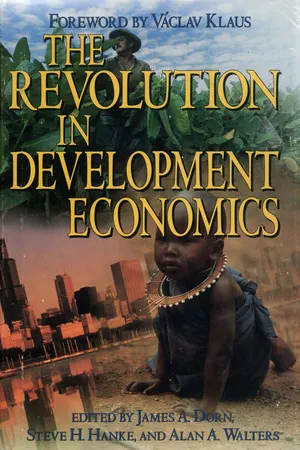
For decades, development economists believed that central planning, not economic freedom, was the key to economic growth in developing countries. In 1956 Gunnar Myrdal, winner of the Nobel Prize in economics in 1974, wrote, "The special advisers to underdeveloped countries who have taken the time and trouble to acquaint themselves with the problem all recommend central planning as the first condition of progress." While the argument that socialism is the key to growth in the developing world appears obviously unreasonable today -- given the collapse of command-and-control economies around the globe -- it was, when Myrdal wrote, the academic consensus. Only a few economists doubted such arguments and proposed alternatives. Foremost among them was Peter Bauer, author of such classics as The Economics of Under-Developed Countries and Dissent on Development. This book contains 20 essays, many of which were originally published in the Cato Journal, and a foreword by Václav Klaus, former prime minister of the Czech Republic.
- 360 pages
- English
- ePUB (mobile friendly)
- Available on iOS & Android
eBook - ePub
The Revolution in Development Economics
About this book
Information
1. Introduction—Competing Visions of Development Policy
James A. Dorn
Economic achievement depends primarily on people's abilities and attitudes and also on their social and political institutions. Differences in these determinants or factors largely explain differences in levels of economic achievement and rates of material progress.—P.T. Bauer
Dissent on Development
Comprehensive Planning versus the Free Market
The love affair with comprehensive central planning ended with the collapse of communism in Eastern Europe in 1989 and with the demise of the Soviet Union two years later. But long before the 1989 liberal revolution, it was clear that state-led development policy was doomed to failure. Economists such as Ludwig von Mises, Friedrich Hayek, and Peter Bauer recognized the internal contradictions of trying to direct a complex economic system without the guidance of prices and profits and without well-defined private property rights protected by the rule of law.
Initial successes with Soviet-style central planning misled development experts into thinking that top-down systems of economic organization could correct for "market failures" and that input-output models could duplicate a competitive price system in allocating scarce resources. Conventional wisdom held that planners could better use existing information and achieve greater economic progress than could free individuals operating in a spontaneous market order.
A few examples will suffice to illustrate the faith placed in central planning during the heyday of state-led development policy in the immediate postwar era. In 1957, Stanford University economist Paul A. Baran wrote, "The establishment of a socialist planned economy is an essential, indeed indispensable, condition for the attainment of economic and social progress in underdeveloped countries" (Baran 1957, p. 261). One year earlier, Gunnar Myrdal had written, "The special advisers to underdeveloped countries who have taken the time and trouble to acquaint themselves with the problem ... all recommend central planning as the first condition of progress" (Myrdal1956, p. 201).
The planning mentality encompassed social engineering: the goal was not merely to control the economy but to control people and remake society. Myrdal's main thesis was, as Bauer (1976, p. 188) pointed out, that "personal conduct and social attitudes are to be restructured in the interest, or at least the declared interest, of higher per capita incomes." The consensus of development experts was that "good advisers and technical experts would formulate good policies, which good governments would then implement for the good of society" (World Bank 1997, p. 1).1
The socialist mentality and the vision of state-led development were so ingrained that as late as 1985, after years of failure, Indian prime minister Rajiv Gandhi could write,
While there is a problem of collecting, coordinating, sorting out and analysing the tremendous amount of information needed for developmental planning at the national level, the solution perhaps lies in improving the tools of collection and analysis of data and not in abandoning the planning effort itself.2
The socialist dream turned out to be a "fatal conceit" (Hayek 1988). Both logiC and history have proven the architects of comprehensive planning to have been less visionary than market liberals who follow the path of Adam Smith and place the individual and liberty above the state and coercion.3 As Vaclav Klaus noted in the foreword, "Where ... institutions emerge from the spontaneous activities of free individuals, they guarantee freedom and progress. Where they emerge from the power of government, they bring oppression rather than freedom, corruption rather than the rule of law, and decay rather than efficiency and equity." Even the World Bank (1997, pp. 1-2) now admits that the costs of state-led development policy far exceeded the benefits: "Governments embarked on fanciful schemes. Private investors, lacking confidence in public policies or in the steadfastness of leaders, held back. Powerful rulers acted arbitrarily. Corruption became endemic. Development faltered, and poverty endured."
The two competing visions of development policy-one that trusts the state, the other that trusts freedom-are the focus of this book. The fall of the Berlin Wall in 1989 marked the rise of market liberalism and the transition from plan to market. Policymakers were confronted with the problem of how to create a spontaneous market order out of the rubble of socialism. By necessity, the focus of development economics had to shift to questions about institutions and incentives, and about the role of government in the post-Cold War era.
Today the search for the determinants of economic growth centers not on physical capital and foreign aid but on human capital and market liberalization. It is also generally recognized that noneconomic factors must to be taken into account and that no general model of economic development is feasible. Thus, in determining whether a country will prosper or stagnate, one needs to consider the property rights regime, culture, and political factors.
The work of Peter Bauer has been instrumental in this shift of focus in the field of development economics. His pioneering work, in which he studied the Malayan rubber industry and West African trade, led him to question and eventually overturn many of the commonly held beliefs of development economics. He
- refuted the idea that poverty is self-perpetuating and showed that central planning and large-scale capital investment are not prerequisites for growth;
- demonstrated that foreign aid, restrictive immigration and population policies, and trade barriers typically hinder economic progress; and
- cautioned against the indiscriminate use of mathematical formalism, as found in simple economic growth models, and criticized the historical determinism inherent in stages-of-growth models.
He emphasized the fundamental role of basic economic principles-in conjunction with a knowledge of institutions, culture, and history-in understanding the development process.4
More recent work, including that done by scholars in the subdisciplines of institutional economics, growth theory, public choice, and constitutional economics, confirms Bauer's view that markets embedded in a regime of private property and limited government are more apt to generate freedom and prosperity than is a command-and-control system designed to satisfy planners' preferences and redistribute income.
Central planning destroys civil society along with economic vitality because, as Bauer (1976, p. 84) writes,
It reinforces the authoritarian tradition of many underdeveloped societies, which inhibits the development of faculties and motivations congenial to material advance. By continuing and extending state control over the lives of the population central planning reinforces the subjection of the individual to authority. Such a development discourages self-reliance, personal provision for the future, sustained curiosity and an experimental turn of mind.
The market-liberal revolution has shattered the Soviet illusion, but the transition from plan to market will take time. Adoption of new institutions and new ways of thinking do not occur overnight. The essays in this book will help lay the basis for that revolution and further entrench the spirit of Bauer's work in the new development economics. Part I provides a detailed discussion of the dissent on development economics; part II examines the role of property rights in the development process; part III considers the failure of state-led development policy; and part IV discusses the relation between economic liberalism and economic growth.
Dissent on Development Economics
The idea that government intervention is "indispensable" for lifting underdeveloped countries out of poverty was "taken for granted" by most development experts when Bauer wrote his now famous essay "The Dissent on Development" in 1969 (Bauer 1976, p. 69). In chapter 2, he reiterates the themes of his earlier essay and emphasizes "the disregard of reality" that characterized much of the postwar literature on development economics. The bias of development experts against the free market and in favor of planning is obvious, as is their misuse of formal growth models and their neglect of social and political institutions. Bauer's forceful argument is that development economics actually regressed because many economists lost sight of basic economic principles and evident reality.
One widely accepted fallacy, notes Bauer, was the notion of a "vicious circle of poverty" -the idea that poor countries cannot generate sufficient savings and investment to lift themselves out of poverty. But as Bauer observes, the reality is that many individuals and countries have escaped the initial poverty that characterizes the human condition: individuals have achieved higher incomes by hard work, thrift, and prudence; and nations have become wealthy by allowing individuals the freedom to trade and pursue happiness under the rule of law. Bauer also criticizes mainstream development experts for accepting the notion that Third World impoverishment is the result of commercial contacts with the West. That belief ignores the principle of comparative advantage and the fact that voluntary exchange is mutually beneficial. As Bauer notes, the less-developed countries (LDCs) that have had the least amount of trade with the West have also experienced the lowest living standards.
The mathematization of economics has resulted in bypassing important noneconomic variables that are difficult to quantify, argues Bauer. That attempt has led to overlooking the relevance of history in determining how nations grow rich and passing over the time dimension in studying the process of development. Cultural factors, personal beliefs, and ambitions, as well as property rights, are all difficult to quantify, notes Bauer, but they play an important role in material advance. In trying to apply the methodology of the natural sciences to the study of society, economists have misunderstood the essential difference between those areas of inquiry. As a result, says Bauer, mainstream development economists have offered policy proposals that are unrelated to reality.
The disregard of reality is also evident in the call by international organizations and world opinion leaders for redistributions of wealth from developed countries to the Third World in the name of equality or "social justice." According to Bauer, that call ignores reality: wealth is dependent on productivity, and forced redistribution weakens incentives to produce and is inconsistent with the real spirit of charity. Relying on First World guilt to relieve Third World poverty is a recipe for disaster. As Bauer points out, that approach to development inevitably invites policies that will undermine...
Table of contents
- FOREWORD The Rise of Market Liberalism
- EDITORS' PREFACE
- 1. Introduction—Competing Visions of Development Policy
- PART I DISSENT ON DEVELOPMENT ECONOMICS
- PART II INSTITUTIONAL CHOICE AND ECONOMIC DEVELOPMENT
- PART III THE FAILURE OF STATE-LED DEVELOPMENT POLICY
- PART IV ECONOMIC LIBERALISM, TRADE, AND GROWTH
- ABOUT THE EDITORS
Trusted by 375,005 students
Access to over 1.5 million titles for a fair monthly price.
Study more efficiently using our study tools.
Frequently asked questions
Yes, you can cancel anytime from the Subscription tab in your account settings on the Perlego website. Your subscription will stay active until the end of your current billing period. Learn how to cancel your subscription
No, books cannot be downloaded as external files, such as PDFs, for use outside of Perlego. However, you can download books within the Perlego app for offline reading on mobile or tablet. Learn how to download books offline
Perlego offers two plans: Essential and Complete
- Essential is ideal for learners and professionals who enjoy exploring a wide range of subjects. Access the Essential Library with 800,000+ trusted titles and best-sellers across business, personal growth, and the humanities. Includes unlimited reading time and Standard Read Aloud voice.
- Complete: Perfect for advanced learners and researchers needing full, unrestricted access. Unlock 1.5M+ books across hundreds of subjects, including academic and specialized titles. The Complete Plan also includes advanced features like Premium Read Aloud and Research Assistant.
We are an online textbook subscription service, where you can get access to an entire online library for less than the price of a single book per month. With over 1.5 million books across 990+ topics, we’ve got you covered! Learn about our mission
Look out for the read-aloud symbol on your next book to see if you can listen to it. The read-aloud tool reads text aloud for you, highlighting the text as it is being read. You can pause it, speed it up and slow it down. Learn more about Read Aloud
Yes! You can use the Perlego app on both iOS and Android devices to read anytime, anywhere — even offline. Perfect for commutes or when you’re on the go.
Please note we cannot support devices running on iOS 13 and Android 7 or earlier. Learn more about using the app
Please note we cannot support devices running on iOS 13 and Android 7 or earlier. Learn more about using the app
Yes, you can access The Revolution in Development Economics by James A. Dorn, Steve H. Hanke, Alan A. Walters in PDF and/or ePUB format, as well as other popular books in Politics & International Relations & Public Policy. We have over 1.5 million books available in our catalogue for you to explore.