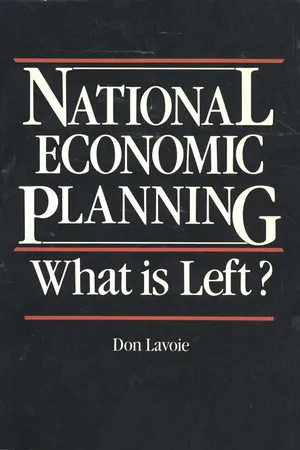
Don Lavoie argues that the radical Left's enthusiasm for planning has been a tragic mistake and that progressive social change requires the abandonment of this traditional view. Lavoie argues that planning—whether Marxism, economic democracy, or industrial policy—can only disrupt social and economic coordination. He challenges both radicals and their critics to begin reformulating our whole notion of progressive economic change without reliance on central planning. National Economic Planning: What is Left? will challenge thinkers and policymakers of every political persuasion.
- 312 pages
- English
- ePUB (mobile friendly)
- Available on iOS & Android
eBook - ePub
About this book
Information
1 PLANNING AND THE RADICAL PERSPECTIVE
In the first moments of a ten-thousand-megaton attack on the United States…when the first wave of missiles arrived, the vast majority of the people in the regions first targeted would be irradiated, crushed, or burned to death. … In the ten seconds or so after each bomb hit, as blast waves swept outward from thousands of ground zeros, the physical plant of the United States would be swept away like leaves in a gust of wind. The six hundred thousand square miles already scorched by the forty or more calories of heat per centimetre squared would now be hit by blast waves of a minimum of five pounds per square inch, and virtually all the habitations, places of work, and other man-made things there—substantially the whole human construct in the United States—would be vaporized, blasted, or otherwise pulverized out of existence….
And this threat of self-destruction and planetary destruction is not something that we will pose one day in the future, if we fail to take certain precautions; it is here now, hanging over the heads of all of us at every moment. The machinery of destruction is complete, poised on a hair trigger, waiting for the “button” to be “pushed” by some misguided or deranged human being or for some faulty computer chip to send out the instruction to fire.
Jonathan Schell (1982: 56–57, 181–82)
The left is not for planning or public ownership or the democratization of investment as an end in itself….
Michael Harrington (1982: 422)
THE NEED FOR A SCIENTIFIC-RADICAL PERSPECTIVE
As Jonathan Schelľs disturbing book The Fate of the Earth eloquently reminds us, our civilization has spawned a technology advanced enough to be capable of completely destroying that civilization, combined precariously with political systems so backward that such destruction is a distinct possibility.
But creating the definite risk of blowing us all up, a kind of “ultimate policy failure,” is symbolic of the quite general failures of political policy, some of which, even if less final, are actually more likely to occur. Indeed, they have been occurring with numbing regularity. The systematic torture by established governments of dissidents for speaking and writing their ideas is not simply a risk or a possibility but an ongoing fact. Direct, brutal oppression combined with institutionalized corruption constitutes the modus operandi of most of the regimes of the “Third” and “Second” worlds, while the Western governments implicate themselves in this oppression indirectly by financially and militarily propping up these regimes.1 Although such open oppression is relatively rare within the Western democracies (except for the special persecution of hated subcultural groups), it is supplanted there by a host of severe socioeconomic problems. The West faces problems with inflation and unemployment, falling productivity and investment, escalating crime and taxes, as well as decaying schools and other public services. And this only scratches the surface.
The peril in which modern civilization finds itself might be just cause for despair were it not for the ironic circumstance that in fact it was not an external force which brought us to the brink of destruction. Rather, it was the astounding rapidity of our own scientific progress. It has been the imbalance between our intellectual progress in the natural sciences and in the social sciences that has delivered us into a world where scientific developments in electricity and biology are diverted into the social production of electric prods for efficient torture and where nuclear physics becomes a threat instead of a benefit to civilization. As Jonathan Schell has written, “We try to make do with a Newtonian politics in an Einsteinian world.” What humanity needs is a way of marshaling the progressive forces that have produced such startling advances in the physical sciences on behalf of a similar development of the social sciences and therefore ultimately of society itself. There is no reason why a species intelligent enough to produce computers cannot learn to organize its own society in such a way that they be used to solve social problems rather than to guide the missiles we aim at one another. Our ultimate social predicament should inspire not futility but rather hope that we can discover why our social institutions work so much less effectively than our machines and how we can set in motion a process for societal rejuvenation which matches our processes of scientific discovery.
It might be thought that there is one basic difference between scientific and social progress which inhibits the possibility of the former’s being harnessed in service of the latter: the often lamented lack of a “social laboratory.” Science, it is said, advances in the minds and practical experiments of a few great men; whereas, for society as a whole to change, great numbers of peoples—from a bewildering variety of cultural, linguistic, and moral backgrounds—must somehow all go along. There may already exist some brilliant social scientist who knows how to save humanity, but those ideas will never even be tried until enough human beings support them, yet how can we expect as many people to support such untried ideas as support the proven ideas of science?
There is an element of truth in this point. While the physical scientists can solve many problems by constructing relatively simple experiments to isolate causally the phenomena under study, social scientists have the more complex subtleties of human history as their only laboratory. In this realm an experiment, such as Lenin’s attempt to institute central planning in the early years of the Soviet Union, may be seen as proving vastly different things to different observers. In the social sciences, it seems, interpretations of facts by means of complicated and often controversial theories are more decisive than the facts themselves.
However, as modern philosophers of science have shown, the physical sciences are not actually all that different in this respect from the social sciences. Even in the physical sciences, facts do not speak for themselves. They require interpretation by means of theoretical frameworks. Truth in the sciences cannot be established by rigorous proof; rather, scientists can only grope toward it in an unending process of mutual criticism and discovery. Even mathematics, once thought an impregnable citadel of certainty, is now a raging battlefield of controversy both among several competing and mutually incompatible schools of thought and among the individuals within each school. Science, then, like social change, involves an interpersonal process of persuasion. An idea in the mind of a great scientist does not become designated as a contribution to science until it achieves the consensus of the scientific community. This consensus is usually not achieved by the unambiguous demonstration of a new theory in an experiment. More often it is the result of heated arguments about the interpretations advanced by rival theories and subtle hints that the new theory somehow explains better.2
Science was once thought of as a logically unassailable structure standing above controversy and mere belief, but is now generally recognized by most philosophers of science as a body of beliefs to which a particular, highly respected subset of society adheres. Of course there are exacting standards within this scientific community and admission to its exclusive ranks is a most difficult endeavor, as anyone who has tried to get a Ph.D. or publish an article in a professional journal will attest. But the point is that science is not an uncontested body of unquestionable truths. It is only a more persuasively justified set of beliefs. It does not stand aloof from controversy. Rather, it depends on controversy so that its social consensus can be continually reformulated. It does not forsake commitment toward ideas (and the passionate belief in them) in favor of a dispassionate, workmanlike, discovery of facts—although that is what scientists often like to think they are doing. Science is actually an edifice of more firmly held, more persuasively defended, more clearly articulated beliefs, but nevertheless beliefs, most of which have never been and could never be conclusively demonstrated in laboratory experiments.
Some have viewed these developments in the philosophy of science as undermining what was once thought to be the bedrock rationalist foundation of our great heritage of science. But the achievements of science are no less permanent or wondrous for having been the result of an inarticulate social process. Our scientific heritage stands firmly in our libraries and universities and is embodied in our feats of engineering, unshaken by the logical quandaries of philosophers. Its justification lies in the values, methods, and standards that sustain it.
Rather than undermining our commitment to science, the modern philosophy of science should be seen as opening up for society the possibility of extending the fruits of the scientific discovery process to other as yet less developed, prescientific realms. If science does not always require laboratories but does require a process for the formation of a social consensus, then social sciences once thought crippled for their unique lack of the former and necessity for the latter can be liberated from their backwardness.
The last two centuries have produced many vain attempts by social scientists to mimic what were thought to be the exact, formal, experimentally proven methods of the natural sciences. Indeed, the intellectual roots of the notion of economic planning are in the confident attempts of nineteenth-century French rationalist philosophers such as Henri Saint-Simon and August Comte to build a complete science of society on the model of Newtonian mechanics. Since this effort was founded entirely upon a mistaken view of the nature of the physical sciences, it was in any case doomed to fail. But if social science is to flourish, it must be governed according to the standards appropriate to its own subject matter. Efforts to borrow analytical tools fashioned for the natural sciences have dominated and seem to have hampered the social sciences throughout this century.3 Surely the path to scientific investigation of human action and social forces does not lie in a blind imitation of the sciences that study matter and energy. The general intellectual processes by which the natural sciences have made such phenomenal progress, however, are capable of adaptation to the study of society, if only society will devote the same intensity of intellectual effort to developing a scientific understanding of itself as it has to the scientific understanding of the physical world it inhabits.
Not that this task will be easy. The more one studies our social maladies, the more one suspects that our politics are not even Newtonian but are more properly designated Neanderthal. The problems are not merely Herculean challenges facing our existing social and political institutions. They seem so utterly immune to any policies we devise that they force us to call into question these institutions themselves. The same symptoms of failure (although to different degrees) seem to plague all societies of the world, whether they call themselves communist, socialist, or capitalist. And worst of all our leaders are still trying to play nineteenth-century war games in a world that is primed with the awesome destructive power to reduce itself, in Schelľs words, to a republic of insects and grass.
In the face of this catastrophic performance of our political institutions, most of our intellectual leaders, whether of the Left or the Right, can be found busily debating the details of the established programs and quarreling about various methods of fine-tuning our society by means of the established institutions. But this world doesn’t need a tune-up; it needs an overhaul, and needs it desperately. To hope that these stale and decrepit political institutions will, in their present form, be able to invent and implement imaginative solutions to the new and perhaps final human problem of the arms race, after they have so miserably failed in the face of far simpler challenges, seems unrealistically Utopian.
But in a sense, what is wrong with these policy debates is precisely that they do not dare to be Utopian enough. That is, they confine their attention to minor modifications in the established and badly rusted political machinery instead of trying to imagine the substitution of a fundamentally different approach altogether. What is needed is a radical perspective, both in addition to a scientific perspective and as a logical consequence of it. We need to locate the root cause of the social maladies we have endured and stop combating their symptoms. We need to elaborate an approach as different from our dominant political-economic paradigm as chemistry is from alchemy. We need to find a principled approach to social issues which will outline a clear goal of a peaceful, prosperous, and just society, and then seek consistent and feasible paths to its realization. We cannot afford to let ourselves be battered about by the winds of political fashion until by some unlucky turn of events we destroy our very cultural and economic existence.
Only principled social action, on the model of clear scientific thinking guided by a consistent set of ideas and deriving from these a clear direction for policy changes, can hope to straighten out the conflicting strands of policy we find ourselves tangled in. We must dare to imagine radical alternatives to the kinds of social institutions to which we have become so accustomed, and to explain why these new institutions would work qualitatively better than the present ones. Only a principled radical approach can effectively combine an uncompromising diagnosis of our contemporary social ills with a clearly articulated vision of what social health would look like. What is needed, in short, is a workable Utopia. As F. A. Hayek (1973: 65) writes,
Utopia, like ideology, is a bad word today; and it is true that most Utopias aim at radically redesigning society and suffer from internal contradictions which make their realization impossible. But an ideal picture of a society which may not be wholly achievable, or a guiding conception of the overall order to be aimed at, is nevertheless not only the indispensable precondition of any rational policy, but also the chief contribution that science can make to the solution of the problems of practical policy.
IS NATIONAL ECONOMIC PLANNING THE ANSWER?
The policy direction that social thinkers of a radical bent have most often advanced as the alternative mechanism for reconstructing society on a scientific basis has been the notion of national economic planning. The diagnosis of contemporary difficulties implicit in these proposals focuses on the essential problem of modern societies although it does not seem to resolve it. That problem is the fundamental contradiction between government, on the one hand, which claims to represent a conscious expression of and instrument for the social will, and society itself on the other, which seems ever to be struggling against its own supposedly democratic instrument. Actions taken by governments seem to reflect the conscious will of their own personnel, or of wealthy or powerful special interests, more often than the will of society as a whole.4 Members of society in turn struggle both against one another and against the government either to gain control over this instrument of power for their own benefit (which modern economists call rent seeking) or to protect themselves from being victimized by that power (rent avoidance). (See Tullock 1967 and Krueger 1974.) In either case a whirlwind of activity revolves around government in the pursuit of control over its special powers, and considerable amounts of scarce resources are diverted from other uses to this struggle.
Our pervasive social problems may be viewed as symptoms of an underlying contradiction between that portion of the sphere of private decisionmaking that is often driven by acquisitive motives and embroiled in competition for scarce resources, and the sphere of public decisionmaking, equipped with a monopoly over coercive power, ostensibly driven by higher motives and reconciled to one conscious, internally consistent purpose. These two spheres combined produce a chaotic result in which the self-serving motives of the private sector strive to direct the apparatus of coercion of the public sphere. Failing that, the private sector attempts to counteract the policies undertaken by the public sphere. The government does not play the role of agent for the social will but simply joins in the self-serving struggles of the private sphere. The public sector interferes with the operation of the private sphere, making war with the private decision-making order, while the competing participants from the private sector respond and attempt to circumvent such interference, to engage in defensive maneuvers, to try to grab state power for themselves and use it against their competitors.
Karl Marx conceived of central planning as an attempt to resolve this inherent contradiction between the private and public spheres of society.5 As in any genuinely radical perspective, his particular diagnosis of the problem is inextricably bound up with his Utopia, his notion of a cure.6 Marx saw the problem as being located in the competitive private sphere, the market system, where separate, divided, or “alienated” interests contend with one another for resources. He argued that, so long as democratic institutions tried to merge themselves with this competitive sphere, they would invariably succumb to it. The solution, then, was to eradicate competitive market relations and to replace them with a broadening of the democratically based public sphere to encompass all of social life. No longer would politicians stoop to being tools of special and conflicting interests, since the private sector would cease to exist as a separate component of society. All social production would be carried out by the “associated producers” in conjunction with a common plan. Production would no longer be a private act of war by some market participants against others in a competitive struggle for wealth, but would instead be the main task of the self-coordinated democratic institution.
According to this perspective, the coercive powers of governments will gradually become unnecessary, since the underlying cause of coercion—the contention or rivalry among members of society—will have been removed. Thus the reason for our pervasive social ills, culminating in the modern threat of total destruction in war, is perceived to be the fact that we have narrowly confined the function of democratic institutions to a tiny part of social life and have left the bulk of economic activity to the unplanned outcome of non-democratic private struggles for wealth in the market. The proposed solution is to widen democracy to the whole sphere of economics and completely abolish private ownership of the means of production, thereby eliminating the competitiveness of market relations as a basis for economic decisionmaking.
Marx was unfortunately averse to describing how his Utopia was supposed to work. Nevertheless, one can still infer from his many indirect references to the communist society that some sort of democratic procedures would be constructed through which th...
Table of contents
- ACKNOWLEDGMENTS
- INTRODUCTION
- 1 PLANNING AND THE RADICAL PERSPECTIVE
- 2 COORDINATION IN SOCIETY Tradition, Market, and Planning
- 3 THE KNOWLEDGE PROBLEM
- 4 LEONTIEF AND THE CRITIQUE OF AGGREGATIVE PLANNING
- 5 PLANNING FROM THE BOTTOM UP? The Myth of Economic Democracy
- 6 REINDUSTRIALIZATION Shoring Up the Economy’s “Structural” Sectors
- 7 WHAT IS LEFT? Toward an Alternative Radicalism
- APPENDIX TACIT KNOWLEDGE AND THE REVOLUTION IN THE PHILOSOPHY OF SCIENCE
- REFERENCES
- ABOUT THE AUTHOR
Trusted by 375,005 students
Access to over 1.5 million titles for a fair monthly price.
Study more efficiently using our study tools.
Frequently asked questions
Yes, you can cancel anytime from the Subscription tab in your account settings on the Perlego website. Your subscription will stay active until the end of your current billing period. Learn how to cancel your subscription
No, books cannot be downloaded as external files, such as PDFs, for use outside of Perlego. However, you can download books within the Perlego app for offline reading on mobile or tablet. Learn how to download books offline
Perlego offers two plans: Essential and Complete
- Essential is ideal for learners and professionals who enjoy exploring a wide range of subjects. Access the Essential Library with 800,000+ trusted titles and best-sellers across business, personal growth, and the humanities. Includes unlimited reading time and Standard Read Aloud voice.
- Complete: Perfect for advanced learners and researchers needing full, unrestricted access. Unlock 1.5M+ books across hundreds of subjects, including academic and specialized titles. The Complete Plan also includes advanced features like Premium Read Aloud and Research Assistant.
We are an online textbook subscription service, where you can get access to an entire online library for less than the price of a single book per month. With over 1.5 million books across 990+ topics, we’ve got you covered! Learn about our mission
Look out for the read-aloud symbol on your next book to see if you can listen to it. The read-aloud tool reads text aloud for you, highlighting the text as it is being read. You can pause it, speed it up and slow it down. Learn more about Read Aloud
Yes! You can use the Perlego app on both iOS and Android devices to read anytime, anywhere — even offline. Perfect for commutes or when you’re on the go.
Please note we cannot support devices running on iOS 13 and Android 7 or earlier. Learn more about using the app
Please note we cannot support devices running on iOS 13 and Android 7 or earlier. Learn more about using the app
Yes, you can access National Economic Planning by Don Lavoie in PDF and/or ePUB format, as well as other popular books in Politics & International Relations & Public Policy. We have over 1.5 million books available in our catalogue for you to explore.