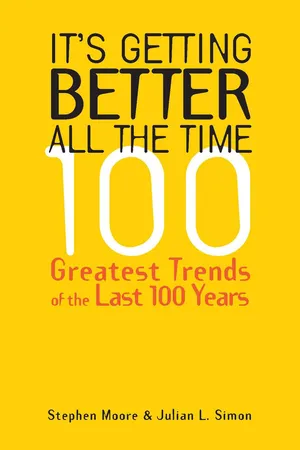
And now, a dose of good news. In a new book that will put the gloom-and-doom industry out of business, the Cato Institute says more human progress has been achieved in the last 100 years than in all of the previous centuries combined. No matter what the variable -- life expectancy, wealth, leisure time, education, safety, gender and racial equality, freedom -- the world is a vastly better place today than it was a century ago, say co-authors Stephen Moore and the late Julian Simon in It's Getting Better all the Time: 100 Greatest Trends of the Last 100 Years. Of course, if things are so great, why do we hear so much bad news? False scares and junk science are partly to blame, but the media also play a role in shaping people's perceptions. In 1998, the authors point out, there was not a single commercial airline crash despite the hundreds of thousands of commercial flights and billions of air passenger-miles traveled. While there was no major news coverage of this amazing record, the media devoted weeks of coverage to the 1999 crash of an Egyptian airliner. This focus on the bad lets us forget how much is good about life in modern America.
eBook - ePub
It's Getting Better All the Time
110 Greatest Trends of the Last 100 Years
- 294 pages
- English
- ePUB (mobile friendly)
- Available on iOS & Android
eBook - ePub
It's Getting Better All the Time
110 Greatest Trends of the Last 100 Years
About this book
Information
Notes
Introduction
New York Times quote from “Living in the American Century: 1900–1910,” Washington Post, September 20, 1999, pp. C1, C8–9.
Quote from Friedman in Thomas L. Friedman, The Lexus and the Olive Tree (New York: Farrar, Straus & Giroux, 1999).
Story on pet obesity from David Crary, “America’s Pets Becoming Fat Cats,” Associated Press, February 20, 2000.
Automobile as pro-environment invention from “Freedom’s Journey: A Survey of the 20th Century,” The Economist, September 11, 1999, p. 7.
Adam Smith quote from Robert L. Heilbronner, The Worldly Philosophers (New York: Touchstone, 1999).
Speed of information during the Middle Ages from Newsweek story on the millennium, January 1, 2000.
Historical per capita income estimates from Joyce Burnett and Joel Mokyr, “The Standard of Living through the Ages,” in The State of Humanity, ed. Julian Simon (Cambridge, Mass.: Blackwell, 1995), pp. 135–46.
Queen Elizabeth quote from Heilbronner, The Worldly Philosophers, 1999.
Jon Carroll quote from Jon Carroll, “What It Means to Be Dead,” San Francisco Chronicle, August 6, 1998.
Depiction of early 20th-century life in America from “Living in the American Century: 1900–1910,” Washington Post, September 20, 1999, pp. C1, C8–9.
Information on influenza pandemic from Gina Bari Kolata, Flu: The Story of the Great Influenza Pandemic and the Search for the Virus That Caused It (New York: Farrar, Straus & Giroux, 1999).
Theodore Dalrymple quote from “Taking Good Health for Granted,” Wall Street Journal, March 31, 1999, p. A-22.
Oliver Wendell Holmes quote from ibid.
H. G. Wells quote from John Tierney, “The Optimists Are Right,” New York Times Magazine, September 29, 1996, p. 92.
New York Times warning about light bulbs causing blindness from ibid., p. 95.
Henry Sigerist quote from Civilization and Disease (Chicago: University of Chicago Press, 1942), p. 176.
Comparison of the material well-being of the poor today versus the rich 100 years ago, from Robert Rector, “How Poor Are America’s Poor?” in The State of Humanity, ed. Julian Simon, pp. 241–52.
The power of the microchip and computing power from Howard Rheingold, “The Underside of Moore’s Law,” IntellectualCapital.com , May 20, 1999; and Bob Kolasky, “The Era of the Cheap PC,” same publication and date.
Declining agricultural prices throughout the past 200 years from Julian L. Simon, The Ultimate Resource II (Princeton, N.J.: Princeton University Press, 1991).
Robert Samuelson quote on child labor from “An Ageless Society,” Washington Post, September 15, 1999, p. A25.
Angus Maddison quote on lack of economic progress throughout the ages from Phases of Capitalist Development (Oxford University Press, 1982).
Black poverty throughout 20th century from Stephan Thernstrom and Abigail Thernstrom, “We Have Overcome,” New Republic, October 13, 1997.
Declining workweek from W. Michael Cox and Richard Alm, Myths of Rich and Poor (New York: Basic Books, 1999).
Increased recreational time available to Americans from John P. Robinson, “Trends in Free Time,” in The State of Humanity, pp. 224–30.
Declining poverty and improved living standards of the poor, see Rector, op. cit. Miles of paved roads in 1900 from “Living in the American Century: 1900–1910,” Washington Post, September 20, 1999, pp. C1, C8–9.
Safety of flying from Peter Spencer, “Smart Talk: What to Make of a Deadly Plane Crash,” IntellectualCapital.com , May 1, 1997.
R. Stanley Williams quote on power of original computers from “Computing in the 21st Century,” Phil. Trans. R. Soc. London, 1998, vol. 356, p. 2.
Fifty percent computer ownership from Cox and Alm, “The New Paradigm,” Federal Reserve Bank of Dallas, 1999 Annual Report.
Figures on education quantity from Julian L. Simon and Rebecca Boggs, “Trends in the Quantity of Education,” in Simon, The State of Humanity, pp. 208–18.
Environment and improved clean air from Ronald Bailey, Earth Report 2000 (McGraw-Hill, 1999), pp. 290–310.
Trends in natural resource availability from Julian L. Simon, Ultimate Resource II, op. cit.
Falling production cost of oil from Peter Huber, “Running Strong,” National Review, April 17, 2000, p. 24.
Booker T. Washington quote from “Predictions from a Century Ago,” USA Today, December 31, 1999, p. 31A.
Black wages relative to white wages from Robert Higgs and Robert A. Margo, “Black Americans,” in Simon, The State of Humanity, pp. 178–87.
The Economist quote on American leadership in 20th century from “Freedom’s Journey: A Survey of the 20th Century,” The Economist, September 11, 1999, p. 11.
U.S. income versus other nations, Joint Economic Committee of Congress, “The U.S. Economy at the Beginning and End of the 20th Century,” Washington, December 1999.
Benefits of immigration from Julian Simon, The Economic Consequences of Immigration (Cambridge, Mass.: Blackwell, 1989).
Freedom and economic growth from James Gwartney, Robert Lawson, and Dexter Samida, Economic Freedom of the World, 2000 Annual Report (Vancouver, B.C.: Fraser Institute, 1999).
David Corn from “History Learned,” The Nation, December 29, 1999, p. 11.
OSHA impact on work safety from Charles Murray, What It Means to Be a Libertarian (New York: Broadway Books, 1998).
Friedman on Food and Drug Administration costing lives, National Public Radio debate with James Tobin, 1997.
Amartya Sen quote from Development as Freedom (New York: Anchor Books, 2000).
Henry George quote on chickens and hawks from John Tierney, “Betting the Planet,” New York Times Magazine, December 2, 1990, p. 58.
Spread of quality of life improvements to all segments of population from Robert Rector in The State of Humanity.
Size of government in 20th century from “The Thing That Won’t Go Away,” The Economist, July 31, 1999, p. 8.
Negative social trends from William Bennett, Index of Leading Cultural Indicators.
Educational declines from Stephen Moore, Government: America’s #1 Growth Industry (Lewisville, Tex.: Institute for Policy Innovation, 1995).
Crime rates from Historical Statistics of the United States (Washington: U.S. Bureau of the Census, 1975), Series H-972; and Health, United States, 1999 (Hyattsville, Md.: National Center for Health Statistics, 1999), Table 46.
Suicide rates historically from Jean-Claud Chesnais, “Worldwide Historical Trends in Homicide and Suicide,” in The State of Humanity, pp. 91–99.
Global 2000 quote from Fay Willey and William J. Cook, “A Grim Year 2000,” Newsweek, August 4, 1980, p. 38.
Simon bet with Ehrlich from John Tierney, “Betting the Planet,” New York Times Magazine, op. cit., pp. 52–78.
Paul Ehrlich quote on England from The Population Bomb, reprint (New York: Bucaneer Books, 1997).
Paul Ehrlich quote that the battle to feed humanity is over from ibid.
Jackie Gleason quoted in Syliva Nasar, “The Economy,” Fortune Magazine, September 14, 1997, p. 39.
False scare about DDT from Roger Meiners, “The Green Scare,” The Freeman, May 1999, pp. 18–19.
No airline crashes in 1998 from Alan Levin, “615 Million People, 0 Crash Deaths in ’98 on U.S. Airlines,” USA Today, January 7, 1999, p. A-2.
Michael Prowse quote from Michael Prowse, “A Deep Debt of Gratitude,” Financial Times, November 25, 1996, p. 20.
Churchill quote from Simon, Ultimate Resource II.
Will Rogers quote in This I Believe, ed. Edward R. Murrow (New York: Simon and Schuster, 1954).
Section I: Health
Summary
Death rates from infectious diseases, cited in Historical Statistics of the United States and Health, United States (1999).
Quote from Cathy Popescu and the American Council on Science and Health in “The Good News About America’s Health,” October 1988.
1. Lengthening Human Life
Quote from John Tierney in “This Way to the Future,” New York Times Magazine, September 29, 1996, p. 94.
Quote from Samuel H. Preston in “Human Mortality throughout History and Prehistory,” The State of Humanity, p. 31.
Life expectancy at birth by race and sex, U.S. National Center for Health and Statistics, Monthly Vital Statistics Report, various years.
Increased male life expectancy from “The Changing Pattern of American Mortality Decline,” Population and Development Review, June 1981, p. 250.
Life expectancy in less developed countries from “Population and Resources,” National Geographic Society, August 1998.
2. Reducing Infant Death
Infant mortality rates from Health, United States, 1998.
Decreasing infant mortality rates in more developed countries from Simon, p. 37. Infant mortality rates by race, Health, United States, 1998.
Child mortality rates in India, “Child Mortality,” The Economist, October 10, 1998, p. 110.
3. Fewer Mothers Die Giving Birth
Maternal death rate from Historical Statistics of the United States, Series B145, p. 57, and Health, United States, 1998.
Prenatal care from Elizabeth Whelan, “The Good News about America’s Health,” American Council of Science and Health, 1988.
Prenatal care for live births from Health, United States, 1998.
Crude death rates for Americans, Historical Statistics of the United States, Series B181, p. 60, and Health, United States, 1999.
Decline in American child mortality rates from Eileen Crimmins, “The Changing Pattern of American Mortality Decline and Its Implications for the Future,” Population and Development Review, vol. 7, no. 2, June 1981, p. 242.
Quote from Dr. Alan Fisher from “The Good News about America’s Health,” October 1988, p. 6.
5. Eradicating the Killer Diseases throughout the Ages
Leading causes of death from CDC, Morbidity and Mortality Weekly Report, 1998, p. 48.
AIDS statistics from HIV/AIDS Surveill...
Table of contents
- List of Figures
- Foreword
- Preface
- Acknowledgments
- Introduction
- SECTION I. HEALTH
- SECTION II. DIETS AND NUTRITION
- SECTION III. WEALTH
- SECTION IV. THE STATE OF POOR AMERICANS
- SECTION V. THE STATE OF CHILDREN AND TEENS
- SECTION VI. THE AMERICAN WORKER
- SECTION VII. LEISURE, RECREATION, AND ENTERTAINMENT
- SECTION VIII. HOUSING
- SECTION IX. TRANSPORTATION AND COMMUNICATIONS
- SECTION X. INVENTION, INNOVATION, AND SCIENTIFIC PROGRESS
- SECTION XI. THE INFORMATION AGE
- SECTION XII. EDUCATION
- SECTION XIII. SAFETY
- SECTION XIV. ENVIRONMENTAL PROTECTION
- SECTION XV. NATURAL RESOURCES: AN AGE OF ABUNDANCE
- SECTION XVI. SOCIAL AND CULTURAL INDICATORS
- SECTION XVII. HUMAN ACHIEVEMENT IN SPORTS
- SECTION XVIII. THE REMARKABLE GAINS BY WOMEN
- SECTION XIX. THE DECLINE OF RACISM
- SECTION XX. FREEDOM AND DEMOCRACY
- SECTION XXI. THE AMERICAN PEOPLE: THE WORLD’S GREATEST RESOURCE
- Notes
Trusted by 375,005 students
Access to over 1.5 million titles for a fair monthly price.
Study more efficiently using our study tools.
Frequently asked questions
Yes, you can cancel anytime from the Subscription tab in your account settings on the Perlego website. Your subscription will stay active until the end of your current billing period. Learn how to cancel your subscription
No, books cannot be downloaded as external files, such as PDFs, for use outside of Perlego. However, you can download books within the Perlego app for offline reading on mobile or tablet. Learn how to download books offline
Perlego offers two plans: Essential and Complete
- Essential is ideal for learners and professionals who enjoy exploring a wide range of subjects. Access the Essential Library with 800,000+ trusted titles and best-sellers across business, personal growth, and the humanities. Includes unlimited reading time and Standard Read Aloud voice.
- Complete: Perfect for advanced learners and researchers needing full, unrestricted access. Unlock 1.5M+ books across hundreds of subjects, including academic and specialized titles. The Complete Plan also includes advanced features like Premium Read Aloud and Research Assistant.
We are an online textbook subscription service, where you can get access to an entire online library for less than the price of a single book per month. With over 1.5 million books across 990+ topics, we’ve got you covered! Learn about our mission
Look out for the read-aloud symbol on your next book to see if you can listen to it. The read-aloud tool reads text aloud for you, highlighting the text as it is being read. You can pause it, speed it up and slow it down. Learn more about Read Aloud
Yes! You can use the Perlego app on both iOS and Android devices to read anytime, anywhere — even offline. Perfect for commutes or when you’re on the go.
Please note we cannot support devices running on iOS 13 and Android 7 or earlier. Learn more about using the app
Please note we cannot support devices running on iOS 13 and Android 7 or earlier. Learn more about using the app
Yes, you can access It's Getting Better All the Time by Stephen Moore, Julian Simon in PDF and/or ePUB format, as well as other popular books in Politics & International Relations & Democracy. We have over 1.5 million books available in our catalogue for you to explore.