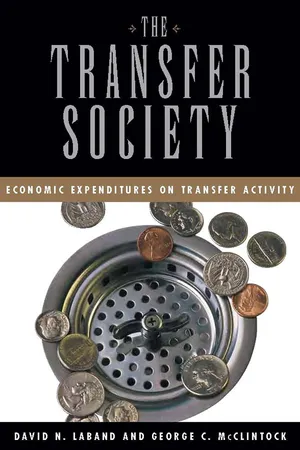
Transfer Society
eBook - ePub

Transfer Society

Economic Expenditures on Transfer Activity

  1. 84 pages
  2. English
  3. ePUB (mobile friendly)
  4. Available on iOS & Android
eBook - ePub

Transfer Society

Economic Expenditures on Transfer Activity

About this book

How much time, money, and other resources do Americans devote to influencing the distribution of wealth? According to David Laband and George McClintock, a conservative estimate of the total amount Americans spend on arranging or preventing forced transfers is more than $2,000 for every man, woman, and child in America. That's not a statement of the amount forcibly redistributed, but of the amount spent in effecting the forcible transfer of resources. And, as the authors show, this is a very conservative estimate of the dead-weight losses associated with the transfer society.

Through an ambitious cataloguing of different categories of expenditures on forced transfers and research into the amounts expended on each one, Laband and McClintock present a more complete picture of the effects of forced transfers than one would get from merely considering the aggregates of federal and state budgets or estimates of the amounts of wealth that change hands through the various forms of "freelance" redistribution, such as insurance fraud, theft, or extortion. After a careful examination of the measurable forms of dead-weight losses, the authors conclude by noting that the numbers they present understate the magnitude of resource expenditure on transfer activity in the United States. Moreover, the authors discuss the important question of why, relative to the huge amounts of wealth transferred by government at all levels, there is so little observable and measurable expenditure on effecting transfers.

This book both poses problems and offers solutions to important issues in economics and political science.

Frequently asked questions

Yes, you can cancel anytime from the Subscription tab in your account settings on the Perlego website. Your subscription will stay active until the end of your current billing period. Learn how to cancel your subscription.
At the moment all of our mobile-responsive ePub books are available to download via the app. Most of our PDFs are also available to download and we're working on making the final remaining ones downloadable now. Learn more here.
Perlego offers two plans: Essential and Complete
  • Essential is ideal for learners and professionals who enjoy exploring a wide range of subjects. Access the Essential Library with 800,000+ trusted titles and best-sellers across business, personal growth, and the humanities. Includes unlimited reading time and Standard Read Aloud voice.
  • Complete: Perfect for advanced learners and researchers needing full, unrestricted access. Unlock 1.4M+ books across hundreds of subjects, including academic and specialized titles. The Complete Plan also includes advanced features like Premium Read Aloud and Research Assistant.
Both plans are available with monthly, semester, or annual billing cycles.
We are an online textbook subscription service, where you can get access to an entire online library for less than the price of a single book per month. With over 1 million books across 1000+ topics, we’ve got you covered! Learn more here.
Look out for the read-aloud symbol on your next book to see if you can listen to it. The read-aloud tool reads text aloud for you, highlighting the text as it is being read. You can pause it, speed it up and slow it down. Learn more here.
Yes! You can use the Perlego app on both iOS or Android devices to read anytime, anywhere — even offline. Perfect for commutes or when you’re on the go.
Please note we cannot support devices running on iOS 13 and Android 7 or earlier. Learn more about using the app.
Yes, you can access Transfer Society by David N. Laband in PDF and/or ePUB format, as well as other popular books in Politics & International Relations & Conservatism & Liberalism. We have over one million books available in our catalogue for you to explore.

Table of contents

  1. 1. Introduction
  2. 2. Overview of the Problem
  3. 3. Resource Expenditures to Effect/ Prevent Direct Transfers
  4. 4. Resource Expenditures to Effect/ Prevent Indirect Transfers
  5. 5. Why So Little Observed Rent- Seeking?
  6. 6. Concluding Comments
  7. References