![]()
THE HISTORY OF
WESTBORO BAPTIST CHURCH
I
In the years after his move to Topeka, Fred Phelps told the story of how his family arrived in that community in May 1954, at the time when the Supreme Court had desegregated public schools in Brown v. Board of Education of Topeka, Kansas. The young pastor, who claims he left Bob Jones University (then located in Cleveland, Tennessee) over the school’s racist policies,1 had been working as an itinerant preacher among Mormons in Utah2 and on the campus of John Muir College, where he had been a student, preaching against public expressions of sexuality. His railings there against “sins committed on campus by students and teachers,” including especially “promiscuous petting” and other kinds of “pandering to the lusts of the flesh,” got him removed from campus by police, but the young preacher was able to continue to preach to students from the property of a sympathizer who lived across the street from the school.3 His confrontational style was well established by the time he and his wife, Margie, who had been a student at Arizona Bible College, were invited to Topeka by leaders of East Side Baptist Church, where Phelps would serve, planting Westboro Baptist Church in 1956 as a branch of East Side that would operate in conjunction with that church. Soon a rift between East Side and Westboro developed, and a legal battle for property ensued, resulting in a total split. At the same time, Fred Phelps grew to reject the Arminian theology of East Side in favor of Calvinism. This significant theological shift took place over a number of years, but by 1957 the church sign identified the congregation, “having been granted the grace to slough off that hellish pretense that it was by any human power that God redeems his elect people,”4 as Primitive Baptist. Phelps felt an additional calling, confirmed by his arrival at the time of Brown: to fight racism through the law.
Phelps had experienced the privilege of whiteness as a youth in Meriden, Mississippi, the midsized Southern town of his birth. His father, a railway detective, along with Fred Phelps’s aunt, reared Phelps and his sister after their mother died.5 The family was respected because of their affluence; because of their affiliation with the Methodist Church; and, according to Abigail Phelps, youngest child of Fred and Margie Phelps, because of her grandfather’s likely affiliation with the Ku Klux Klan (KKK), a relationship that, she claims, inspired her father’s antiracism.6
Despite the traumatic loss of his mother in childhood, Phelps excelled in school and as a community leader. After graduating from high school at sixteen, he was too young to attend West Point, to which he had received an appointment and which, up to that point, had been his lifelong goal. Thus, he had little to do during the summer after graduation except to attend the local junior college and wait for his next birthday. That summer Phelps attended a revival where he experienced a religious conversion. He promptly decided not to go to West Point but rather to attend Bob Jones University and switch his religious affiliation from Methodist to Baptist. At the end of the following summer, only one year after his conversion, within a year of his baptism,7 and after having completed only one year of study at Bob Jones University, Phelps was ordained and began to pursue a full-time preaching career. While honing his style on a Western preaching circuit, he came to the attention of East Side Baptist, a Topeka-based independent church, which called him to be its associate pastor.
Though, according to his daughter Shirley Phelps-Roper, a few members of East Side were unhappy about the new preacher’s admonitions against Masonry and other fraternal orders, most were pleased enough to select the pastor, described as a “commanding presence and . . . mesmerizing speaker” with a “spellbinding and chilling” speaking style,8 to establish a new church in the Westboro area of the city.9 Westboro Baptist Church was planted on November 27, 1955, and was formally organized in May 1956.10
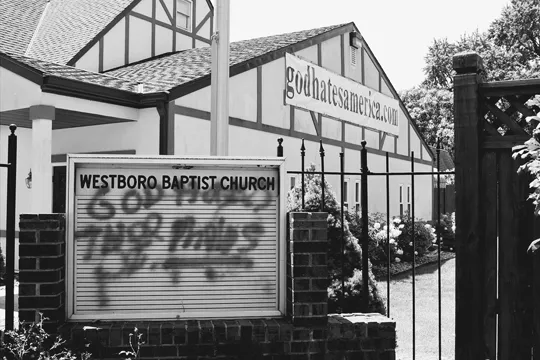
Westboro Baptist Church is attached to the modest home of Fred Phelps, Sr., now deceased, and his wife, Margie. The front of the building is covered with a massive banner promoting the church’s flagship web site. A privacy fence runs the perimeter of the block, which includes homes owned by church members. (Photograph courtesy of Ailecia Ruscin. All rights reserved.)
LAW CAREER, CIVIL RIGHTS ACTIVISM, AND DISBARMENT
The legal conflict between East Side and Westboro Baptist may have introduced Fred Phelps to the importance of legal skills. However, given his responsibilities as a new pastor, he did not graduate from Washburn University School of Law until 1964, just two years after he had completed an undergraduate degree in history from Washburn.11 Though he had been a star law student, heading both the school of law’s moot court and its law journal, Phelps struggled to gain admission to the bar because no judge would vouch for his character—a consequence, he contended, of the judges’ opposition to the theology he was preaching at Westboro Baptist Church and, at that point, on the radio.12 He eventually did gain admittance, having demonstrated, he claimed, his character with his Eagle Scout and American Legion awards as well as by a letter from former president Harry S Truman.
Phelps soon formed Fred W. Phelps Chartered (now Phelps-Chartered), a law firm dedicated to the enforcement of civil rights legislation through litigation. Phelps pursued discrimination cases, including Johnson v. Whittier, a 1973 class-action case on behalf of “all Black children who were then or had during the past ten years been students of elementary and junior high schools in East Topeka and North Topeka,”13 who, the suit contended, had been denied access to equitable facilities in the Topeka school district. The case failed to qualify as a class-action lawsuit, but it became a catalyst for the Department of Health, Education, and Welfare to examine racial discrimination in public schooling in the city, inspiring continued discussion of and litigation about Topeka’s failure to live up to the promise of Brown v. Board of Education. Further, Phelps filed suit on behalf of African American members of the Jordan-Patterson American Legion who alleged that their post had been illegally searched in an act of racial discrimination by police in 1979;14 he also represented racial minorities and women in employment discrimination cases.15 Phelps’s commitment to challenging racial discrimination was widely recognized. In 1986 he was the recipient of both the Omaha Mayor’s Special Recognition Award for his civil rights work and an award from the Greater Kansas City Chapter of Blacks in Government. In 1987 he was recognized by the Bonner Springs, Kansas, branch of the National Association for the Advancement of Colored People (NAACP) for his legal work on behalf of African Americans.16 Current Phelps-Chartered clients include many members of minority communities seeking assistance with immigration issues.
Some argue that Fred Phelps was and remained a racist and an opportunist who merely pursued a career in civil rights law because such cases were profitable. Nate Phelps, who left the church in the 1970s and is estranged from his family, credits his father with doing much good for African Americans in Kansas but cautions against misunderstanding his motives as altruistic. Instead, he says, his father saw an opportunity for an energetic lawyer to make money, often taking the bulk of a settlement in fees and leaving the plaintiff with very little.17 Indeed, according to Nate Phelps, his father preached a traditional conservative Protestant racist interpretation of the story of Noah’s sons, which says that Ham was punished by being made black and a servant to his brothers for laughing at his father’s drunken nakedness.
Whether or not individual church members are racist, social justice does not seem to be the only motive for pursuing civil rights litigation. A common accusation against Fred Phelps was that he encouraged clients to sue for huge sums, which pressured defendants to settle for smaller amounts regardless of their liability.18 A 1978 state investigation revealed that in many of the cases that Phelps settled outright, the settlement was one-tenth of 1 percent of the amount originally sought.19 The accusation of abuse of the legal process followed Phelps from the start of his legal career until the end, when the Wichita Eagle noted that “there have been more complaints filed against Phelps, and more formal hearings into his conduct, than any other Kansas attorney since records have been kept.”20
Phelps faced his first disciplinary case in 1969, just five years after he had passed the bar. He was suspended for two years on three of seven counts of professional misconduct alleged by the State Board of Law Examiners.21 In 1974 Phelps landed in further trouble with the state when he filed a case against a court reporter employed by the Shawnee County District Court, claiming that she had failed to provide a court transcript promptly. Phelps cross-examined the court reporter brutally, according to the Kansas Supreme Court’s assessment22—the kind of behavior that would, in a later case, earn him a ten-day jail sentence for contempt of court.23 When Phelps lost the case, he sought a new trial, promising to deliver witnesses who would testify against the court reporter to establish her reputation and character, with a focus on her sex life. When she provided affidavits from those same witnesses saying that they would not testify as Phelps promised, he was accused by the state of “clearly misrepresent[ing] the truth to the court.”24 In 1977 the state of Kansas began the process of disbarring Phelps. The lawyer for the state noted the harm that Phelps’s abnormally aggressive behavior and unwarranted personal attacks caused not only the defendant but also the legal system: “When attorneys engage in conduct such as Phelps has done, they do serious injury to the workings of our judicial system. Even the lay person could see how serious Phelps’ infractions are. To allow this type of conduct to go essentially unpunished is being disrespectful to our entire judicial system.”25 The justices of the Kansas Supreme Court agreed,26 concluding that Fred Phelps had “little regard for the ethics of his profession.”27 He was disbarred on July 20, 1979. Phelps was no longer able to practice law in the state courts of Kansas, and, at the same time, he was suspended from practicing law in Kansas’s US District Courts for two years. According to Phelps, though, “To be wrongfully disbarred by a corrupt court is a badge of honor.”28
Fred Phelps was able to continue practicing in federal court, and he continued to be known for his aggressive tactics, including sending “demand letters” to people whom he planned to sue.29 Though a panel of federal judges dismissed some charges related to the demand letters, they nevertheless delivered a public censure of Fred Phelps in 1987.30 During this time, though, Phelps and family members working for Phelps-Chartered were committing acts that would earn them more than a censure. In 1985 Fred Phelps, Sr.; Fred Phelps, Jr.; Betty Phelps, the wife of Fred Phelps, Jr.; daughter Margie Phelps; Shirley Phelps-Roper; Jonathan Phelps; and Elizabeth (Lizz) Phelps were accused of making false charges against nine US District Court judges in Kansas. The false accusations generally involved claims that the judges were racist, prejudiced against religion, and reluctant to hear civil rights cases.31 Given that, at one time, 25 percent of all the civil lawsuits in US District Court in Shawnee County and 6 percent of the civil docket in Shawnee County District Court were handled by Phelps-Chartered,32 both the charges and the potential consequences were serious. If Phelps’s accusations were found to be false and Phelps was disbarred, it would mean that African Americans would lose a valuable ally in civil rights litigation.
In 1989 investigators concluded that the Phelpses’ accusations against the judges were false and that the lawyers had violated their ethical code, echoing an earlier complaint by a local lawyer who had noted “a mean streak” in the pastor-lawyer: “Sometimes he is so filled with hate when he takes after somebody, it becomes an obsession with him.”33 Rather than fighting against the potential disbarment of all members of the family who were involved in the matter, Fred Phelps, Sr., agreed to surrender his license to practice in federal court if the other members of the family could retain their licenses. Fred Phelps, Sr., however, explained that he would retire from the practice of law “to expose judicial corruption.”34 Phelps’s legal career ended ignobly but not unsurprisingly, even to him. Phelps continued to believe that it was his civil rights work, antigay activism, and defense of free speech that made him a threat to his peer lawyers and the judges of the state of Kansas who pushed for his removal from the profession.
Given his professed commitment to racial equality, how can Phelps’s vitriolic antigay activity be explained? Phelps himself used theology to explain what some see as the contradiction between his commitment to civil rights for African Americans and his commitment to antigay activism. Like other anti–gay rights churches that deny a similarity between sexuality and race or homophobia and racism, Westboro Baptist Church clearly states that “the Scripture doesn’t support racism,” noting, “God never says ‘thou shalt not be black.’ However, He does say, ‘Thou shalt not lie with mankind, as with womankind: it is abomination.’ (Leviticus 18:22).”35 Explained Fred Phelps in a letter to the Topeka Capital-Journal,
Gays and lesbians are not legitimate minorities entitled to government’s protection by force of law. . . . Legitimate minorities are characterized by immutable attributes of being—not by immoral, criminal acts of conduction, voluntarily engaged in. Skin color is an immutable attribute, not an immoral, criminal act voluntarily performed. Homosexuals are self-defined by immoral, sinful, criminal sex acts, voluntarily engaged in.36
Such sentiments are shared by many anti–gay rights religious believers, including many African Americans.
Potentially, their shared history of civil rights struggle and their shared antigay theology may have contributed to Topeka’s black population’s long-lasting support of Fred Phelps’s law office. For example, in 1983 the president of the Wichita branch of the NAACP, Rev. D. D. Miller, noted, “Before Fred Phelps came on the scene, we couldn’t get an attorney in Wichita to touch a civil rights case.” An NAACP representative from Topeka called Phelps “a modern-day John Brown,” alluding to the famed Kansas abolitionist who led the raid on Harpers Ferry that began the Civil War.37
Though Fred Phelps was retired from law for more than twenty years before his death, the perception of him as a vicious litigator prepared to use the law as a weapon in personal ven...