![]()
CHAPTER 1
Was J. Edgar Hoover Gay? Does It Matter?
To address the questions posed in this chapter’s title simply and directly: we do not, and cannot, know; and no.
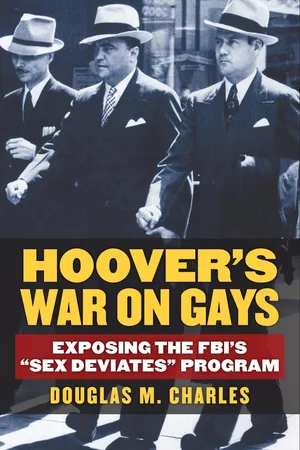
For decades, even during his own directorship, J. Edgar Hoover’s sexuality was the subject of rumors. These rumors were largely based on gay stereotypes and potent US sociocultural influences that dictated gender roles during Hoover’s lifetime. For much of US history—particularly in the post–Second World War period—a paternalistic, hypermasculinized, dominant, heterosexual culture defined expectations in US society. A man was presupposed one day to marry, have several children, and be the breadwinning king of his suburban castle. He further was expected to dominate his demure wife, whose only jobs were to raise the kids, buy the groceries, haul them home in a station wagon, cook the meals, and clean the home. Hoover defied all of this. He remained a lifelong bachelor and a man particularly close to his mother. He lived with her until she died in 1938, by which time Hoover was forty-three years old, and only then did he buy his own house. Hoover also maintained a long and close friendship with another bachelor, the number two man at the Federal Bureau of Investigation (FBI), Clyde Tolson, with whom he regularly dined and took vacations. All the while Hoover touted a strict, Victorian value system and castigated those forces in US society he believed were decaying it from within. He dispatched FBI agents to intimidate anyone who suggested he was gay.
A couple of examples illustrate this last point. During 1943, FBI agents learned that District of Columbia businessman John Monroe had claimed Hoover was a “fairy.” This was not all. Monroe also claimed to have proof, which, he bragged, protected him from the FBI. This information was developed by the New York Field Office of the FBI but not reported to headquarters until January 1944. When Hoover learned about it, he responded instantly in two ways. First, FBI officials officially admonished the special agent in charge (SAC) in New York for not forwarding the information promptly. Second, FBI Assistant Director Louis Nichols paid a visit to Monroe to make him, in Hoover’s oft-uttered refrain, “put up or shut up.” Monroe was sufficiently intimidated, which was the goal, and he signed a statement affirming he had never made the claim about Hoover.1
FBI harassment of those spreading homosexual allegations about Hoover was not restricted to prominent individuals. After FBI agents learned a woman had made disparaging comments about the FBI director’s sexuality at her bridge club in Cleveland, the SAC in that city paid her a visit. He admonished her about the claim and convinced her to tell her bridge partners at the next meeting that she was wrong and sorry for having made the comments. Similarly, after a beautician in Washington, DC, gossiped about Hoover’s sexuality, she was visited by two FBI officials who similarly intimidated her.2
It is not a surprise that many people—then as well as now—recognized something peculiar about Hoover and his unbending social orthodoxy and just assumed he was gay. Over the decades, moreover, there appeared a multitude of stories purporting to prove Hoover’s homosexuality or other seemingly related aspects or quirks about him, but it all came to a head at a precipitous moment. With the cold war and its attendant anxieties over by 1993—at the same time a fired gay FBI agent daringly sued the FBI to win back his job—these stories about Hoover received a significant boost after conspiracy-theory novelist Anthony Summers published his sensational biography of the FBI director. Summers resurrected the old rumors to claim not only that Hoover was gay but that he wore dresses and failed to target organized crime rings for prosecution because they had blackmailed him with a compromising sexual photo.3
In a world more driven by media than ever before, that boost accelerated to become a cultural phenomenon, the effects of which continue even today. The magazine Vanity Fair published excerpts from Summers’s book, the normally discriminating PBS series Frontline aired a documentary on Hoover using Summers as somehow an expert on the FBI director, and then the media frenzy multiplied exponentially. Various news outlets carried unverified stories about Hoover’s sexuality and related topics, including a 1993 New York Post piece that claimed Hoover had been caught up in a 1960s extortion investigation involving somebody using young men to target prominent gays by placing them in compromising positions and then extorting from them sums as large as $150,000. This particular rumor contained a kernel of truth, however. In fact, a 1960s FBI investigation captioned “Compromise and Extortion of Homosexuals,” code-named HOMEX, investigated famed pianist and performer Liberace among others (see Chapter 7), but it never involved Hoover as a subject. The media hype then extended to lowbrow jokes on Jay Leno’s Tonight Show about the FBI director’s presumed sexuality, and jokes were even offered by opposing prominent national politicians—notably President Bill Clinton and Republican Bob Dole—about Hoover’s alleged cross-dressing.4 The media hype then evolved to become a common and instantly recognizable cultural meme as reflected in the Hollywood spoof film Naked Gun 33 1/3: The Final Insult (1994), in which Detective Frank Drebin is retiring and shown his exalted spot on the retirees’ wall of fame. The wall included not portraits but Drebin’s carefully framed handcuffs and detective’s suit situated among others, including J. Edgar Hoover’s carefully framed handcuffs and pink, frilly, froufrou dress.5
The indomitable Hoover meme, and the seemingly uncritical public acceptance of the “fact” of Hoover’s homosexuality and cross-dressing, prompted Athan Theoharis—the dean of FBI historians and no defender of Hoover—to respond with a book examining the evidence Summers used in his biography. In short, Theoharis deflated that evidence by showing none of it was verifiable, convincing, or from credible sources—the bread and butter of academic historians. He also pointed out that many in the gay community, perhaps unsurprisingly, happily anointed Hoover homosexual because they had a vested political interest either in exposing “his hypocritical homophobia” or in holding him up as an example that gays, in fact, had long held sensitive and important government positions.6
There is no need to recount in detail here every single example of Summers’s so-called evidence, but the now culturally popular stories about Hoover and the most significant of Summers’s evidence should nevertheless briefly be surveyed. One of Summers’s sources, Susan Rosenstiel, claimed to have seen Hoover at two separate gay parties, one in 1958 and the other in 1959, at the Plaza Hotel in New York City. These were parties hosted by Roy Cohn (former aide to Senator Joseph McCarthy and himself reputedly a gay man), at which Hoover was alleged to have been wearing women’s clothing while having gay sex. A skeptical Theoharis asked the question: why would Rosenstiel be attending gay orgies? Why, moreover, would she be attending them with her wealthy, conservative-minded husband who was so worried about his public image that he hired former FBI official Nichols—Hoover’s skilled public relations man in charge of the FBI Crime Records Division—to protect that image? Rosenstiel, moreover, was divorced from her husband by the time she told these tales, and Summers had paid her for them.7
Theoharis argued convincingly the details of Rosenstiel’s claims were so outlandish that they defied credulity. In the midst of the Lavender Scare, when even an allusion to homosexuality would wreck someone’s career and forever ruin his or her life, the director of the FBI supposedly not only allowed himself to be seen at two gay orgies but wore a “fluffy black dress, very fluffy, with flounces, and lace stockings and high heels, and a black curly wig . . . makeup on and false eyelashes, . . . sitting there in the living room of the suite with his legs crossed.” Hoover was introduced to Rosenstiel, moreover, as “Mary”—a common gay euphemism—and openly had sex with two teenagers dressed in leather while one of them read from a Bible.8 “Nothing is missing” in this account, Theoharis perceptively noted, while concluding it best represented a stereotypical “homophobic account” from a motivated woman seeking to “defame her second husband, with whom she had been involved in a bitterly contested divorce which lasted ten years in the courts.”9
Theoharis also critically examined another source Summers used to suggest Hoover sought professional treatment for his homosexuality. Again this raises the issue of even the slightest allusion to homosexuality ruining one’s career, which should lead any discriminating historian to question the source’s authenticity. Theoharis pointed out, moreover, that the source was not the psychiatrist himself, who supposedly treated Hoover, but his widowed wife. Raising even more flags was her assertion that the medical records that would prove the contention had been destroyed, leaving nothing backing the claim but hearsay. More fantastical yet was Summers’s claim that Democratic Senator William Fulbright was the individual who had recommended this particular doctor to Hoover. In short, using hearsay evidence, Summers asks us to believe that Hoover, again, in the middle of the Lavender Scare, unhesitatingly sought a recommendation from a prominent politician—whose political views he did not share—so that he could place himself in the vulnerable position of seeking psychotherapeutic treatment to cure his homosexuality. Even worse, Hoover was willing to do this when he knew therapists’ confidentially was not inviolable. His own FBI agents, as this book demonstrates, used therapists as willing sources of information about gays.10
Summers’s third source on Hoover’s homosexuality involved the claim that a photo existed of Hoover having gay sex with Tolson, that members of the Mafia had it, and that they were blackmailing the FBI director to avoid investigation. Just as with the previous evidence, this allegation is loaded with red flags. As Theoharis pointed out, nobody has ever produced the photo; people have merely claimed to have seen it. Even more fantastical, the photo was supposedly taken by Office of Strategic Services (OSS) officers in 1946 to be used as bureaucratic leverage against Hoover’s FBI. At the time, federal agencies were entangled in a bureaucratic fight over who would be responsible for foreign intelligence after the Second World War. The photo then somehow supposedly found its way into the hands of organized crime rings. One glaring problem with this account, Theoharis observed, was that the OSS had dissolved a year prior to the photo having been taken. Theoharis also keenly pointed out that if the OSS, indeed, had a compromising photo of Hoover, the agency would not have used it as mere leverage but would have used it to purge Hoover from the FBI. Hoover would have been regarded as a security risk, and it would have been an unprecedented opportunity to forever remove a perennial, manipulative bureaucrat. It is true enough Hoover and other bureaucrats wrangled over who would control postwar foreign intelligence—I have written about it myself—but the photograph story simply defies credulity.11
There have been various responses to the renewed, post-1993 suggestions about Hoover’s sexuality and supposed cross-dressing in which authors have typically come down on one side or the other. Several former FBI officials have offered their views, including Ray Wannall, who long served as a top bureau official at headquarters—ultimately rising to be assistant director of the FBI Intelligence Division. Wannall dismissed Summers’s allegation in his memoir, arguing that the best journalists in the country had covered Hoover for almost fifty years and “developed nothing to confirm rumors of this nature, which cropped up occasionally during Hoover’s lifetime, usually tied to his status as an avowed bachelor.” He even cited the fact that journalist Jack Anderson, who famously and publicly questioned Hoover’s sexuality in the 1970s, decided by the 1990s he did not believe either the cross-dressing story or that Hoover was gay given the FBI director’s history of “venomous” comments about homosexuality.12
Cartha DeLoach, once head of the FBI Crime Records Division (where the Sex Deviates File was kept) before rising to the number three position in the FBI, similarly commented on the homosexual allegations in his memoir and elsewhere. DeLoach referred to Summers’s conclusions as nothing but a “string of opinions, rumors, and undocumented charges” that the biographer presented as fact. Revealing his own homophobia (and no doubt that institutionalized in Hoover’s FBI), DeLoach wrote that the allegations “so disgusted me that I simply put it out of my mind” until he was so commonly asked about it that he devoted a chapter of his memoir to the issue.13
To DeLoach, the idea that Hoover and Tolson could be gay was unbelievable. “You can’t work side by side with two men for the better part of twenty years,” he argued, and “fail to recognize signs of such affections.” He also refuted Summers’s claims that Hoover and Tolson had effeminate characteristics. DeLoach said, employing typically gendered language of his era, both “were tough and manly. Hoover was a bulldog.” As for Tolson, “there wasn’t the slightest sign of weakness or ‘prettiness’ in his face.” Then, taking a dig at Summers personally, DeLoach observed that Tolson “was certainly more of a man then Mr. Summers, and I’ve seen both at close quarters.”14
Besides relying on his own bigotry and stereotypes to refute Summers, DeLoach recognized that Summers’s evidence was flimsy at best. He characterized that evidence as the “testimony of corpses. They are convenient witnesses because they can’t be cross-examined.” DeLoach even castigate...