![]()
chapter one
Organic Destiny
Jerome Irving (J. I.) Rodale began making compost heaps in 1941, as he commenced farming on the sixty acres he had purchased near Emmaus, Pennsylvania. Compost piles included layers of vegetable material and grass clippings or animal manure as a nitrogen source. They had to be kept damp and rotated every few weeks with a pitchfork or shovel. Heat, worms, and fungi helped to break down the organic matter over the course of several months into rich black humus, the stable remains of decomposed plant tissue. This humus, or “mature” compost, would then help soil retain moisture, nutrients, and essential organisms. Rodale boldly believed that healthy soil—awash with organic matter—would produce healthy food and, in turn, healthy people. He used the term “organic” in reference to the crops he grew without artificial fertilizers or chemical sprays. He accentuated farming in “imitation of Nature.”1 His pesticide-free method, he discovered, could compete financially with the chemical bastion that governed agriculture at the time.2 Heartened by his bountiful crops and the physical vigor they spawned, Rodale was not content to be a reclusive gardener. With crusading zeal, he propagated the organic gospel and became the first major advocate for organic growing in the United States. For this, Rodale is frequently cited as the de facto founding father of the US organic movement.3 He was a pivotal—albeit colorful and controversial—figure who left his mark on much of the organic canon. This chapter examines Rodale’s goals, activities, and interactions with other prominent people connected to the birth of organics. It illuminates perspectives on the intertwined themes of “natural” farming and gardening, homesteading, environmentalism, health, and commercial growth that emerged in the 1930s, blossomed in the 1940s, and expanded in the 1950s, and would persist throughout the organic movement. It also argues that Rodale never wanted to brazenly sabotage chemical agriculture or to meekly till the soil. Heralding the good word, earning revenue, and cultivating middle-of-the-road appeal were among his earliest ambitions.
“TOUCHING OFF A POWDER KEG”: J. I. RODALE’S ORGANIC MISSION
An innovative, self-made man, Rodale was a quintessential Benjamin Franklin character: he was the architect of an organic printing empire, if not of organic farming itself. He had no background in agriculture or agronomy, but he was a novice who possessed ample enthusiasm. In the first year after procuring his land, Rodale received “such a wonderful crop that it was a joy to behold.” Seeing the promising results and convinced that “this compost system was nothing short of magic,” Rodale thought that “it would be a crime” not to teach others about it. Deciding to share his knowledge of “this simple method of farming,” he unearthed his calling.4 Rodale established Organic Farming and Gardening, touting it as a “New Kind of Agricultural Magazine.” It was a milestone. Upon later reflection, Rodale said, “I did not dream at that time that I was touching off a powder keg.”5 The initial spark igniting that powder keg was unassuming and unpretentious. The magazine’s inaugural issue in May 1942 included articles on composting, earthworms, soil fertility, and the superiority of mature (composted) animal manure over chemical fertilizers. From the beginning, it covered both gardening and farming. Doing things “Nature’s Way” was a recurring typology. Each issue played an instrumental role in ardently articulating organic philosophies for acolytes.
Rodale’s multifaceted magazine had far-reaching power with early organic growers; it carved out a niche partly due to the dearth of other data sources. It tackled topics like how to enliven the soil’s microbiological activity with organic matter. However, the publication was never just about farming and gardening. Rodale wished to connect with the general public and address its apprehensions about food. In his first editorial, he discussed how synthetic fertilizers altered the nutritive value of food. Touting the impressive quality of eggs, meat, and vegetables raised by organic methods, he wrote, “The better-earning class of the public will pay a high price if they can be shown its value, and that they will save on doctor bills.”6 Throughout his life, Rodale displayed keen gravitas in alerting people to health hazards and organic blessings. In an issue of Organic Farming and Gardening from 1944, Rodale wrote that if all the food-producing soil in the country were “intensively treated in the organic manner,” then “we could become a race of super-men and super-women.”7 He supported the commonplace allure of wholesome food for all and the bounteous profits it could reap for clever farmers. He wrote several seminal books, beginning with Pay Dirt: Farming and Gardening with Composts (1945). Pay Dirt proved to be an apt title for the book that launched Rodale on the path to being healthy, wealthy, and wise (in some circles, at least). He felt that organic gardening could remedy mineral deficiencies in crops, nutrient deficiencies in humans, and happiness deficiencies in society. Rodale was a passionate organic ambassador; he knew that savvy Americans were far more spellbound by optimum health and tasty tomatoes than by horticultural jargon about how lime in their compost would maintain good tilth and proper soil alkalinity. He started numerous other periodicals, and his compelling writing pioneered the vibrant organic movement in American culture.
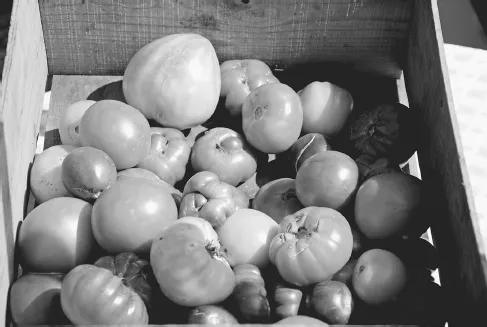
Organic heirloom tomatoes (Photo courtesy of Colleen Freda Burt)
Chemical agriculture reigned in the 1940s, when Rodale began his crusade. German chemist Justus von Liebig’s assertion that plants needed only a straightforward arrangement of nitrogen, phosphorus, and potassium (NPK) was the dominant paradigm. Endorsing an NPK ratio that could be manufactured and applied artificially, agronomists downplayed the merits of humus. The chemical industry eagerly produced synthetic nitrogen fertilizers, promising to feed the world. Rodale obdurately disagreed with this mechanistic approach. He felt that the soil was a living organism, and that chemicals wrecked beneficial bacteria. Rodale yearned to “saturate every segment of American life with the realization that there is something radically wrong with the foundations of our civilization.”8 An agrichemical substratum was a blunder; true organic farming, the art of cooperating with nature, was the only suitable bedrock. At first, skeptics vilified Rodale as an incendiary “crackpot” and “food faddist.”9 Though he couldn’t fully displace the disposition toward using chemicals, he was the vanguard actor in the cultural revision of attitudes toward organic farming. He eventually achieved a measure of legitimacy and renown as organic food came into vogue. When the number of organic gardening adherents ultimately boomed, Rodale would stand tall as the “leading apostle” of organically grown food.10 Though no one person “invented” organic farming, Rodale’s ability to capitalize on the organic explosion and parlay it into personal success would prompt some critics to impugn his motives. He may have been America’s first “eco-preneur,” with panache for both marketing and farming. In both capacities, when the stars aligned, Rodale thrived. He combined a genuine concern for educating Americans about organic farming and healthy living with an aptitude for making money by publishing that information. More than any other form of publicity, his magazines and books lifted public awareness of what “organic” meant.
SEEDS PLANTED
Rodale could be categorized as an archetypal rags-to-riches hero torn from the pages of a Horatio Alger novel. He was born in 1898 as Jerome Irving Cohen, one of eight children raised in what he called “the slums of New York City.”11 He grew up in a small flat at the rear of his father’s grocery store. In his youth, he suffered from nagging headaches and colds.12 Heart problems ran in the family; his father and five of his siblings died in their fifth or sixth decade due to heart attacks. He described himself as “mildly health-conscious since young adulthood.”13 To augment his fitness as a teenager, he followed self-improvement courses, such as the bodybuilding regimen of Bernarr Macfadden (1868–1959).14 He worked as an accountant and federal tax auditor after graduating from high school. Feeling that a Jewish name would hinder his aspirations to enter the writing and publishing business, he changed his last name from Cohen to Rodale in 1921.15 He married Anna Andrews in 1927 and had three children with her. After Rodale abandoned accounting, he initiated an electrical equipment manufacturing business with his brother and moved their plant to Pennsylvania in 1930. From this unlikely background, Rodale suddenly found himself “part of an agricultural scene.” Observing farmers at work in the fields, he began to covet his own piece of land.16 Farming was, at first, merely a hobby; his other diversion was publishing. With the revenue he earned from the factory, Rodale began a publishing company that issued magazines and pamphlets on humor, health, and etiquette.17 In these short-lived and mostly unprofitable publications was the birth of Rodale Press. The erstwhile urbanite soon sought to disclose what he was learning on his farm too.
Rodale’s fascination with organics began inadvertently when he stumbled upon the work of British agriculturist Sir Albert Howard (1873–1947), widely considered the “grandfather” of contemporary organic farming. Howard had served as a mycologist and agricultural lecturer in the Imperial Department of Agriculture for the West Indies, garnering knowledge of tropical agriculture. He then studied nutrient cycling in central India, at the Institute of Plant Industry in Indore, where he observed how the “methods of Nature” restored soil fertility. Howard developed the idea of emulating nature scientifically with an aerobic composting system. In the 1920s, he devised the “Indore Process,” a practical way of making compost in which high-quality humus determined soil quality. The Indore Process manufactured humus from vegetable and animal wastes, with a base to neutralize acidity, and managed the admixture so microorganisms could function effectively.18 Howard focused on building fertile soil according to “Nature’s dictates.” He came to believe that plant disease was “punishment meted out by Mother Earth for adopting methods of agriculture which are not in accordance with Nature’s law of return.”19 Howard was knighted in 1934 for his contributions to agriculture. Gardeners who adopted his Indore mode of making compost discarded customary commercial fertilizers formulated with inorganic chemical compounds. Howard’s Law of Return was his great principle underlying “Nature’s farming.” Animal and vegetable wastes had to be returned to the land. Nature provided the prototype for transforming wastes into humus, and this was the key to agricultural prosperity.20
The organic school often looked to Franklin King’s classic Farmers of Forty Centuries (1911), which extolled the agricultural practices of China, Korea, and Japan, as an authoritative text. King urged the United States to adopt the ways of these “old-world farmers” for maintaining soil fertility, including the use of organic material as plant food.21 Albert Howard also felt that the peasants of China, who returned all wastes to the land, came nearest to “the ideal set by Nature.”22 Howard believed that “Nature, the supreme farmer, manages her kingdom.”23 In An Agricultural Testament (1940), a founding text for organic farming, Howard predicted that at least half the illnesses of mankind would disappear once food supplies were raised from fertile soil and consumed fresh.24 Rodale appreciated this adulation of “Nature” and the critique of NPK scripture; he became Howard’s protégé. The link Rodale began to forge between organic farming and health would be a turning point in his voc...