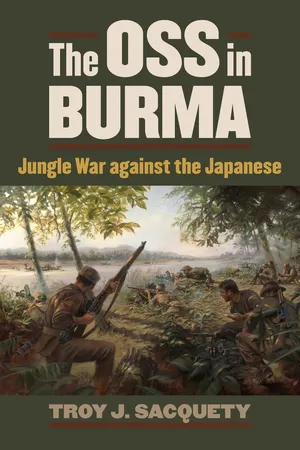
“One could not choose a worse place for fighting the Japanese,” said Winston Churchill of North Burma, deeming it “the most forbidding fighting country imaginable.” But it was here that the fledgling Office of Strategic Services conducted its most successful combat operations of World War II. Troy Sacquety takes readers into Burma’s steaming jungles in the first book to fully cover the exploits and contributions of the OSS’s Detachment 101 against the Japanese Imperial Army.
Functioning independently of both the U.S. Army and OSS headquarters—and with no operational or organizational model to follow—Detachment 101 was given enormous latitude in terms of developing its mission and methods. It grew from an inexperienced and poorly supported group of 21 agents training on the job in a lethal environment to a powerful force encompassing 10,000 guerrillas (spread across as many as 8 battalions), 60 long-range agents, and 400 short-range agents. By April 1945, it remained the only American ground force in North Burma while simultaneously conducting daring amphibious operations that contributed to the liberation of Rangoon.
With unrivaled access to OSS archives, Sacquety vividly recounts the 101’s story with a depth of detail that makes the disease-plagued and monsoon-drenched Burmese theater come unnervingly alive. He describes the organizational evolution of Detachment 101 and shows how the unit’s flexibility allowed it to evolve to meet the changing battlefield environment. He depicts the Detachment’s two sharply contrasting field commanders: headstrong Colonel Carl Eifler, who pushed the unit beyond its capabilities, and the more measured Colonel William Peers, who molded it into a model special operations force. He also highlights the heroic Kachin tribesmen, fierce fighters defending their tribal homeland and instrumental in acclimating the Americans to terrain, weather, and cultures in ways that were vital to the success of the Detachment’s operations.
While veterans’ memoirs have discussed OSS activities in Burma, this is the first book to describe in detail how it achieved its success—portraying an operational unit that can be seen as a prototype for today’s Special Forces. Featuring dozens of illustrations, The OSS in Burma rescues from oblivion the daring exploits of a key intelligence and military unit in Japan’s defeat in World War II and tells a gripping story that will satisfy scholars and buffs alike.