![]()
1
“ONE SHOULD SERVE HIS COUNTRY”
Prescott Bush, an imposing man who could trace his lineage to Henry III of England, was raised in Columbus, Ohio, took his degree at Yale, and served in World War I. His wife, the former Dorothy Walker, was born in Kennebunkport, Maine, and attended private schools in St. Louis and Connecticut. When she met Bush, he was working for the Simmons Hardware Company in St. Louis. They were married in 1921 and moved to New York in 1924, where Bush soon became a partner in the investment firm of Brown Brothers, Harriman. They would have five children. Their second child, George Herbert Walker Bush, was born in Milton, Massachusetts, on 12 June 1924. He was named after his maternal grandfather and also inherited his nickname, “Poppy.” Of his father, his second child would later say, “Everything he did was star quality.”1
When he stepped into the national spotlight, much was made of George Bush’s upbringing and background, as he was charged by his political opponents with being out of touch with the masses (Texas governor Ann Richards quipped at the 1988 Democratic Convention: “George can’t help it—he was born with a silver foot in his mouth”). But those who dismissed Bush as a coddled member of the upper class did not take into account his rather disciplined upbringing. Both his mother and father were, to be sure, members of the genteel class—well educated, well pedigreed, well mannered, and well connected. They were also wealthy, but not so much so that they could claim membership in the leisure class who lived off their investment income. Prescott Bush did not have the money to engage in conspicuous consumption; even if he had, it would have been quite out of character for this staid New Englander to flaunt his wealth. The world in which the Bush children were raised, then, was one in which comfort was never an issue, but neither were the constant reminders that that comfort could not be taken for granted. Prescott refused to allow his children to loiter their way to adulthood. Rather, he inculcated in them the same values of self-reliance and a mind-set of active service. George Bush’s most favorable biographer, Fitzhugh Green, wryly noted that though the Bush family was comfortably insulated from the Great Depression of the 1930s, Prescott “had to work hard to do so. Therefore, it was wrong to leave one’s bicycle out in the rain.”2 Prescott Bush used his wealth as a safety net for his children. They were expected to go out, earn their own wealth, and do the same.
Akin to the value of hard work was that of public humility about their accomplishments. Boasting about good fortune, or flaunting their wealth or station, was expressly forbidden in the Bush household. One of his children later remembered with pride that Prescott Bush commuted to New York City from his Greenwich, Connecticut, home by train each day: “He’d die now with limos picking them up. He was a straphanger.”3 Doro Bush Koch, George Bush’s daughter and one of his future biographers, noted that her father “always heard [his mother’s] voice in his head,” telling him to keep his ego in check and not to brag about his accomplishments (“How did the team do, George?”).4 This did not, however, translate to the preaching of passivity. Both Prescott and Dorothy were athletes of professional caliber, both were intensely competitive, and they expected their children to be likewise. Prescott played on the 1915 Yale baseball team (a first baseman like his son) and was an outstanding golfer (he would serve as a president of the U.S. Golf Association and was often partnered with another outstanding golfer, Dwight Eisenhower).5 Both Bushes were outstanding tennis players, especially Dorothy (who once reached the finals of the National Girl’s Tennis Championship; the Walker’s Cup was named after her father), who encouraged her children to excel in the game. Their children were just as competitive, joining and excelling in a variety of sports. Indeed, all games offered an opportunity to smack a sibling: a friend watching a particularly brutal family game of Ping-Pong dryly noted: “I was surprised there was still a ball.”6 Above all, both parents preached the sanctity of family ties. The nickname “Poppy” may have sounded both juvenile and preppy, but it emphasized Bush’s direct link to his familial heritage.
Of course, with privilege came privileges. Bush enrolled his sons in the Greenwich Country Day School. They lived at home until they completed the ninth grade, when they went away to prep school at Phillips Academy in Andover, Massachusetts—“Andover.” The school’s seal, which was designed by Paul Revere, proclaimed the values that Dorothy Bush had already inculcated in her children—“Non Sibi” (not for self) and “Finis Origine Pendet” (the end depends upon the beginning).7 George was so attached to his elder brother, Prescott Jr., that his parents allowed him to enter Andover one year early, so that the two boys might be together.8 His time there was far from uneventful. In spring of his junior year, he contracted a serious infection in his right arm. He took the summer off and repeated a year. When he returned to Andover, his classmates were his own age. He became senior class president, president of the Greeks, captain of the baseball and soccer teams, a member of the basketball team, and a participant in many other clubs and groups.9
It was also during his senior year, while attending a Christmas dance at the Greenwich Country Club, that George met Barbara Pierce. She was attending Ashley Hall, a girls’ finishing school. Her father was the vice president of McCall’s Publishing Company, and she could trace her family tree to President Franklin Pierce.10 Barbara’s chief biographer pays tribute to her “caustic tongue”—a trait she shared with her outspoken father.11 She was sixteen; he was seventeen—Barbara later wrote that George Bush was the first man that she ever kissed.12 George Bush was smitten. They became “secretly” engaged—a secret that virtually everyone in both families knew.
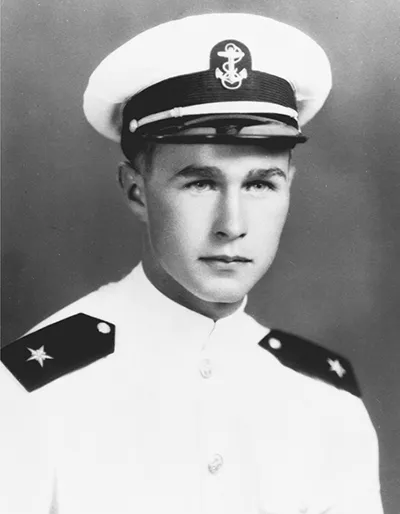
George Bush learned about the Japanese attack on Pearl Harbor while he was at Andover, walking near the chapel.13 He later remembered that his reaction “was the same as every other American—’We gotta do something about this one.’”14 Despite the advice of secretary of war Henry Stimson, who told Bush’s graduating class that they should go to college before enlisting, and despite his father’s wish for him to go to Yale University, where he had already been accepted, Bush enlisted in the navy on 12 June 1942, his eighteenth birthday.15 He would later write that at the train station, “that was the first time I saw my father cry.”16 He was assigned to Chapel Hill, North Carolina, to undergo his preflight training. He then went to Minnesota to learn how to fly, and to Corpus Christi, Texas, to learn instrument flying and navigation. On 9 July 1943, he received his aviator’s wings and was promoted to ensign.17 Just nineteen, Bush was the youngest pilot in the U.S. Navy. For close to a year he traveled across the United States from base to base, practicing his carrier landings and learning to fly Grumman’s three-man TBF torpedo bomber, nicknamed the “Avenger.” Late in 1943, a rather nonchalant Bush wrote his parents: “True, there is a danger to TB’s which you know about, but I don’t think we should consider that. Someone has to fly them.”18
Naval Ensign George H. W. Bush. (Courtesy of the George Bush Presidential Library and Museum)
On 15 December 1943, Bush was assigned to the aircraft carrier San Jacinto, a “baby flattop” that was part of the navy’s Fifth Fleet. He saw plenty of action. During the June 1944 campaign in the Marianas (the greatest aircraft carrier battle in history, it was nicknamed “The Great Marianas Turkey Shoot”), Bush was airborne for more than thirty-two hours; more than half of that time was spent in strikes against Japanese who were dug in on the island of Saipan, where the marines were in the process of landing. During that battle—one week after his twentieth birthday—Bush and his crew were forced to ditch their plane in the ocean immediately after takeoff.19 Later that summer, Bush flew air cover for the marine landings on the islands of Guam, Iwo Jima, and Chichi Jima.
On 2 September 1944, Bush took off on his fiftieth mission. He and his crew were sent to bomb an enemy radio site at Chichi Jima. Bush remembered that “the minute we pushed over to dive, you could just feel the danger . . . some way about halfway down the run I was hit.”20 He later described the incident in a letter to his parents: “We got hit. . . . I told the boys in the back to get their parachutes on. . . . The cockpit was full of smoke and I was choking from it. . . . I felt certain that [the crew] had bailed out.”21 Bush made it out of the cockpit, but both his crewmen were killed. When Bush landed in the ocean, he realized that he had not hooked his life raft to his parachute; fortunately, the raft landed only a few yards from him. A half hour later, a submarine patrolling the area, the USS Finback, picked him up. Had the Finback not been there, the tides would have taken Bush to Chichi Jima, where Americans were well aware of the corroborated stories of the barbaric treatment of American prisoners, which included cannibalism.22 After his ordeal, Bush returned to his squadron in the Philippines for three further months of combat missions.23
Bush was by then eligible for leave. He used it to get married on 6 June 1945 (he reportedly mumbled to his new bride, “Enjoy it. It’s the last time I’ll ever dance in public”).24 Bush had also earned enough points for a discharge, but instead he opted to return to the Pacific (as he later remembered, “It was different then; ’we gotta go back and do our duty’”).25 However, the atomic bomb was dropped on Japan before he could be shipped back. Bush was discharged on 18 September 1945. He had flown fifty-eight missions, accrued 1,228 hours of flying time, made 126 carrier landings, and earned the Distinguished Flying Cross.26 Bush later said, “I had faced death, and God had spared me.”27
After facing death, Bush accepted the invitation to earn the higher education that he had deferred in 1941. When Bush enrolled at Yale in fall 1945, he was part of the blitz on America’s college and universities that became known as the “GI Bulge.” Many schools had been badly hurt by the drop in enrollment caused when young men left to fight in World War II, so they welcomed returning veterans, the vast majority of whom had their way paid by the GI Bill, with open arms: Bush’s class of some 8,000 freshmen was the largest entering class in Yale’s history.28 Colleges also made the effort to help veterans catch up for lost time with innovative—and abbreviated—programs. Bush enrolled in an accelerated program that allowed him to earn his BA in economics in only two years. He was also an outstanding baseball player, an excellent fielding first baseman whom major league scouts were observing.29 Bush also made Phi Beta Kappa and advanced his contacts by being tapped for the Skull and Bones Club, a supersecret society whose members (one of whom had been his father) remained close for the rest of their lives.
In June 1948, just before his graduation from Yale, Bush wrote a friend:
I have thought of teaching. . . . I could work for [uncle] Herby Walker in St. Louis. . . . [But] I am not sure I want to capitalize completely on the benefits I received at birth. . . . I have this chance to go with Neil Mallon’s Dresser Industries—perhaps to Texas. . . . at the moment [the job] has great appeal. I would be seeing new people, learning something of basic importance.30
Given his background, as well as his experience in World War II, one should not be surprised, as are many of Bush’s biographers and political contemporaries, that he gravitated toward an adventurous rather than a “safe” career choice. Having been weaned on self-sufficiency since his youth, Bush went his own way after his June 1948 graduation from Yale, entering an occupation that was loaded with the possibility of failure. He chose the oil business and moved his young family to Texas. However, the Bushes did not go into these volatile hinterlands without a safety net; their way was made much easier by his father’s contacts. Prescott had been a member of the board of Dresser Industries and was a friend of the company’s president, Neil Mallon, who agreed to take George on as the company’s only trainee in 1948.
That summer Bush moved to Odessa, on the Permian Basin in western Texas (Bush: “I had no idea where it was. Had to look it up on a road map”).31 A Saharan backwater, Odessa was a stagnant town of 25,000 that had not yet been transformed by the oil boom. Bush started at Ideco (International Derrick and Equipment Company), a subsidy of Dresser, in a job that paid $375 a month and where he became a member of the United Steelworkers Union.32 It was hardly the lap of luxury. Living in a town dominated by warehouses and hard-fighting and hard-drinking roustabouts and pipelayers, the Bushes lived in a tiny apartment where they shared a bathroom with their neighbors—several prostitutes. Bush’s job included such menial tasks as sweeping warehouses and hand painting pump jacks. He took the first opportunity to escape. In April 1949, Dresser moved Bush to Pacific Pumps, one of its subsidiaries based in Huntington Park, Ca...