Debating or making speeches, American politicians invariably cite tenets of Christian faith—even as they unfailingly defend the liberal principles of tolerance and religious neutrality that underpin a pluralistic democracy. How these seemingly contradictory impulses can coexist—and whether this undermines the religious tradition that makes a liberal democracy possible—are the pressing questions that Giorgi Areshidze grapples with in this exploration of the civic role of religion in American political life.The early modern Enlightenment political philosophy of John Locke has been deeply influential—if often misunderstood and sometimes contested—in shaping both the theoretical and practical contours of contemporary debates and anxieties about religion in a liberal society. Areshidze demonstrates that Locke anticipated a great theological transformation of Christianity in light of modern rationalism, one that would make Christianity into a tolerant religion compatible with liberal political principles. Locke's experiment, as this book shows, has succeeded in important respects, but at a tremendous cost—by demanding a certain theological skepticism about revealed religion that could ultimately undermine the public concern for religious or theological truth altogether. Democratic Religion from Locke to Obama evaluates these results in light of the role of religion in American political development, particularly as this role has been further defined in the work of political philosopher John Rawls. In the political theologies of Martin Luther King, Jr., Abraham Lincoln, and Barack Obama, Areshidze shows how, while working under Locke’s influence, all of these thinkers draw upon religion, including traditional revealed Christian ideas, in their efforts to reshape America’s moral consciousness—especially on the question of racial equality—in ways that might have surprised Locke. Finally, drawing on Alexis de Tocqueville’s encounter with the Lockean experiment in America, this book suggests that the dissonance between how tolerant we want religion to be and what we expect it to accomplish in our civic life is a consequence of the liberal transformation of religion. By reminding us of this religious transformation, Tocqueville’s “political science” may explain some of the deepest spiritual and civic anxieties that continue to beset American democracy.
eBook - ePub
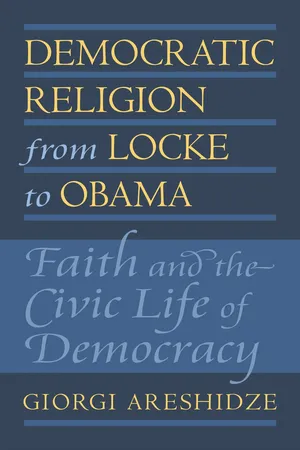
Democratic Religion from Locke to Obama
Faith and the Civic Life of Democracy
- 224 pages
- English
- ePUB (mobile friendly)
- Available on iOS & Android
eBook - ePub
About this book
Information
CHAPTER ONE
RELIGION AND THE POST-ENLIGHTENMENT LIBERALISM OF JOHN RAWLS
Liberalism and Religious Transformation
In Bad Religion, his popular but highly controversial treatment of the fate of American religiosity, New York Times columnist Ross Douthat argues that in the last five decades America has become a nation of heretics” because of its increasing propensity to transform Christianity into newer and newer (and less orthodox) versions of itself.1 Writing from the perspective of a Catholic conservative, Douthat laments the watering-down of American theology in the second half of the twentieth century and finds the evangelical accommodation with capitalism and the rise of therapeutic spiritualism” among mainline Protestants deeply troubling from the perspective of traditional religion. In its place, he seeks to remind his readers of the heyday of American religiosity, when religion was both more orthodox and more institutionally robust, and when its cultural role in public life was more universally respected: A chart of the American religious past would look like a vast delta, with tributaries, streams, and channels winding in and out, diverging and reconverging—but all of them fed, ultimately, by a central stream, an original current, a place where the waters start. This river is Christian orthodoxy.”2 The erstwhile dominance of Christian orthodoxy, according to Douthat, fulfilled important civic purposes in our national life: Both doubters and believers have benefited from the role that institutional Christianity has traditionally played in our national life,” Douthat writes. He cites traditional Christianity’s communal role, as a driver of assimilation and a guarantor of social peace, and its prophetic role, as a curb against our national excesses and a constant reminder of our national ideals.”3 Like others, Douthat traces the transformation of American Christianity to the cultural revolutions that began in the 1960s, which he presents as a kind of historical aberration in an otherwise harmonious theological-political tradition that has animated American history.4 While he chooses to settle for a call for a Christian renewal that can re-evangelize America, Douthat’s study leaves it an open question whether such a revival is at all foreseeable in our day and age.
The leading school of contemporary liberal theory is singularly illequipped to assess the civic costs of the transformation of religion that Douthat pinpoints. John Rawls’s influential work, which takes its bearings from the fact of moral and religious pluralism, emphasizes the need for a liberalism that secures a limited consensus by maintaining impartiality” between controversial comprehensive doctrines, including especially religious ones.5 Rawlsian neutrality has both metaphysical and political consequences: it is not only often thought to imply that liberalism can be theoretically justified independently from metaphysical foundations, but also that it requires a culture of public reasoning that eschews divisive religious appeals in support of coercive laws a concept popularized by Rawls as the public reason” requirement of liberalism.6 Thus, in large part because of the influence of Rawls’s approach, debates in political theory in America have often focused more on the narrow question of the rules that should govern the interjection of religious views in public deliberation, and less on the question of whether liberalism presupposes a theological transformation. To be sure, Rawls’s paradigm has had its detractors, with critics often asserting that it risks excluding the contribution of religious arguments to democracy’s civic life,7 and in recent years an inclusivist”8 alternative that allows for religious argumentation in deliberation has gained prominence.9 But while these inclusivists” are friendlier to the contribution of religion than the exclusivist” Rawlsians, they still retain the original spirit of Rawls’s consensus-oriented approach: they claim that liberal neutrality helps bring about a convergence” between competing viewpoints and traditions of reasoning (both religious and nonreligious) in support of shared political conclusions, even if they do not expect the justificatory foundations of those political conclusions to be mutually acceptable across the various traditions under consideration.10 Thus, according to this view, religious and nonreligious citizens may come to share liberal political principles without agreeing on the reasons why those principles are fundamentally sound or desirable.
What both the defenders and (to a lesser extent) the critics of public reason may fail to bring into sharper focus, however, is that the contemporary debates about the requirements that should govern public speech take place within the context of a broader transformation of religion in modern democracy. Accordingly, a different group of scholars has emphasized that democratic pluralism itself alters the essential experience of religious faith.11 These commentators have shown that the cultural pressures that modern democracy generates liberate individual rationality and nurture an attitude that questions the inerrancy (and the authority) of revelation as a source of moral and political guidance. This is a development with consequences for theology that we are still trying to comprehend, although most scholars agree that overall its results include increasing interreligious tolerance and decreasing salience of theological controversy between faith groups.12 In American Grace, their celebrated study of American religiosity, Robert Putnam and David Campbell show that theological flexibility and religious fluidity” allows Americans to combine exceptional religious devotion with religious diversity while maintaining relatively high levels of toleration.13 While they claim that religious identities are still distinct and meaningfully intact in spite of this fluidity, their findings simultaneously point to a theological ambiguity underlying America’s religious pluralism: Americans appear to have become indifferent to theology—so much so that they believe in an equal opportunity heaven.”14 Although they neglect to highlight this underlying homogeneity of America’s religious landscape, their findings confirm Alan Wolfe’s famous conclusion that Americans impose their individualism on their religious beliefs rather than the other way around.”15 This book advances the debate by bringing these disparate scholarly foci into critical dialogue with each other. I attempt to evaluate and trace the intellectual sources of this theological development and to assess its implications for the civic life of American democracy. I grapple with the following foundational questions: Can liberalism maintain a posture of neutrality toward religion, as John Rawls famously argued it should in his Political Liberalism, or does a liberal regime presuppose (and even bring about) a certain transformation of religious beliefs? Furthermore, has the apparent democratization of religion transpired the way early Enlightenment thinkers, such as Locke, or recent liberal thinkers, such as Rawls, expected it would, and how has this transformation affected religion’s capacity to contribute to the moral and civic life of a liberal society? Finally, is there something crucial in religion that is lost in translation,” and should that be a concern for those who care about the health of democracy today? I explore these questions through an investigation of the political and religious thought of John Locke, Alexis de Tocqueville, Abraham Lincoln, Martin Luther King, Jr., Barack Obama, and Jürgen Habermas. In chapters that focus on their political and theological legacies, I place these figures in dialogue with each other as well as with contemporary debates, illustrating in each case how they struggle to navigate the foundational tensions between religion and liberalism.
By stressing the ambiguous effects of the liberal transformation of religion on the civic health of democracy, I offer a new framework for thinking about the role of religion in contemporary democratic life that goes beyond both the Rawlsian and Lockean paradigms of liberalism. Unlike Douthat, most scholars have at least implicitly followed Lockean liberalism in celebrating democracy’s relative success at transforming religion and at rendering it in important respects more tolerant and more liberal. Putnam and Campbell are again instructive in this regard, since they are troubled by the deeply moralistic” and less tolerant” denominations of American Christianity, and they favor what they call a faith without fanaticism” insofar as it contributes to America’s interreligious tolerance.16 Not surprisingly, they find the decline in religious chauvinism,” or the percentage of true believers” that identify their faith as the only path to heaven, to be beneficial for American politics, although it is less than clear that this redounds to the benefit of religion.17 America would be better off, according to their account, if religious groups emulated the ecumenism of mainline Protestantism. But studies of America’s civic culture, among them Putnam’s own Bowling Alone (published a decade before his American Grace), have simultaneously pointed to alarming trends that should leave us less than sanguine about the civic effects of this transformation: democratic culture is increasingly individualized and atomistic, resulting in the erosion of traditional institutions (including especially religious ones) that historically sustained what Putnam refers to as democracy’s social capital,” the network of communal and social ties that are necessary for a vibrant civic life.18
Following Alexis de Tocqueville, who I show anticipated these troubling developments in democracy, this study highlights a foundational ambiguity in liberalism’s posture toward religion: I point to an abiding tension between the civic benefits that religion can provide and the tendency of democracy to make religion increasingly liberal, tolerant, and accordingly theologically easygoing, suggesting that paradoxically a faith that maintains some form of rootedness in tradition and revelation may be more effective at counteracting democratic pathologies than are the liberalized faiths that we frequently encounter today. I ask whether this tension can ever truly be surmounted by liberalism and whether an essentially liberal civic faith is either theoretically coherent or practically feasible. The book suggests that this dissonance between how tolerant we want religion to be and what we expect it to accomplish in our civic life is a consequence of the liberal transformation of religion and may explain some of the deepest spiritual and civic anxieties that continue to beset American democracy.
Rawls’s Public Reason” Liberalism and the Muddle of Contemporary Neutrality
Post-Enlightenment Liberalism and John Rawls’s Anti-Foundationalism
Contemporary liberal theory often operates under a blind spot with respect to these theological trade-offs and thus misses the tension between the requirements of liberal tolerance and the fate of religion in democracy. By aspiring to move beyond both rationalism and religion to a liberalism of neutrality,” present-day political theory neglects the ambiguous civic and theological effects of the liberal transformation of religion. A prominent illustration of this approach is John Rawls’s Political Liberalism, a work that continues to define not just the methodological parameters but also the foundational questions that inform liberal theory today.19 Taking his bearings from the enduring fact of reasonable pluralism”20 of comprehensive doctrines in modern societies, Rawls proposes a teaching of liberalism that would be political not metaphysical.”21 For Rawls, the political not metaphysical” formula means that liberalism can achieve political neutrality between competing worldviews by embracing a theoretical abstinence with regard to metaphysical, theological, and moral foundations: political liberalism refrains from passing judgment on the truth of any comprehensive doctrine, even including its own, and thus it need not take an official stand on foundational questions. This strategy, according to Rawls, will enable liberalism to secure an overlapping consensus,” allowing individuals to embrace liberal political principles without at the same time abandoning or altering their privately held comprehensive outlooks. Is this approach theoretically and practically coherent? Can liberalism as a way of life remain neutral with respect to religion and with respect to its own theological (or anti-theological) foundations?
It is important to note that Rawls distinguishes his version of political liberalism from its Enlightenment predecessor, on which his political teaching aims to improve in crucial respects. In Rawls’s telling, the Enlightenment project” was developed in response to the historical problem created by the Reformation, which, he writes, introduce[d] into people’s conceptions of the good a transcendent element not admitting of compromise,” thereby transforming politics into an arena of mortal conflict” and precipitating the European Wars of Religion.22 The liberal thinkers of the Enlightenment responded to their historical predicament by proposing to replace the reigning religious claims with a morality derived exclusively from secular philosophy, from which derive the principles of separation of church and state and limited constitutional government rooted in individual natural rights (xvii). But Rawls emphasizes that political liberalism has no such aims”: emphatically, it does not aim to replace comprehensive doctrines, religious or nonreligious, but intends to be equally distinct from both and, it hopes, acceptable to both” (xxxviii). Accordingly, the intention is not to replace those comprehensive views, nor to give them a true foundation.”23 Indeed, doing so would be delusional,” since Rawls believes no such true foundations can ever be expected to be found.24 Political liberalism will therefore present a conception of justice that will be essentially freestanding,” i.e., not dependent on any exclusive (and therefore controversial) conception of the good life (10). A great deal hinges on Rawls’s ambitious promise that political liberalism can achieve neutrality, since it is such neutrality that will ensure its greater tolerance and inclusiveness, even (apparently) of illiberal theological views: the strategy of neutrality means that both religious and nonreligious, liberal and nonliberal” comprehensive views may freely endorse, and so freely live by and come to understand [the] virtues” of political liberalism (xxxviii).
While Rawls presents political liberalism as a practical improvement on Enlightenment liberalism, he also indicates that it does not entail a mere rejection, but rather a revision or an extension, of the Enlightenment’s foundational theoretical posture. Indeed, he presents political liberalism’s break with the Enlightenment as the ultimate consequence of the Enlightenment’s own principle of toleration: political liberalism applies the principle of toleration to philosophy itself,” thus setting aside the whole question of moral and philosophical truth as such from political consideration (10). Political liberalism thus aims to generalize and universalize the Enlightenment’s apparent religious strategy: just as Enlightenment thinkers, in Rawls’s reading, took the truths of religion off the political agenda” when they constructed the liberal secular state, by avoiding comprehensive doctrines” altogether Rawlsian liberalism will in turn seek to bypass religion and philosophy’s profoundest controversies” (152). As Rawls elaborates this point further, we see more fully the far-reaching import that he imputes to his attempt to construct a freestanding liberalism:
Were justice as fairness to make an overlapping consensus possible it would complete and extend the movement of thought that began three centuries ago with the gradual acceptance of the principle of toleration and led to the nonconfessional state and equal liberty of conscience. The extension is required for an agreement on a political conception of justice given the political and social circumstances of a democratic society. To apply the principle of toleration to philosophy itself is to leave citizens themselves to settle the questions of religion, philosophy, and morals in accordance with views they freely affirm (154).
In an essay responding to an earlier iteration of Rawls’s project, Richard Rorty brings out the anti-foundationalist implications of Rawls’s approach. Rorty argues that Rawls . . . shows us how liberal democracy can get along without philosophical presuppositions,” and that this is the ultimate implication of Rawls’s effort to, in his own words, ‘stay on the su...
Table of contents
- Front Cover
- Series Page
- Title Page
- Copyright Page
- Dedication
- Contents
- Acknowledgements
- 1 Religion and the Post-Enlightenment Liberalism of John Rawls
- 2 Barack Obama’s Civic Faith: A Post-Christian Civil Religion or Rawls’s Public Reason?
- 3 Does Toleration Require Religious Skepticism? An Examination of Locke’s Teaching on Toleration
- 4 Lincoln’s Religious Statesmanship and Rawls’s “Public Reason”: Slavery and Biblical Theology in the Civil War
- 5 The Theological Foundations of Martin Luther King, Jr.’s Legacy of Racial Equality and Civil Disobedience
- 6 Can Liberalism Appropriate the Moral Contents of Religion? Habermas and Tocqueville on Religious Transformation and Democracy’s Civic Life
- Conclusion
- Notes
- Bibliography
- Index
- Back Cover
Trusted by 375,005 students
Access to over 1.5 million titles for a fair monthly price.
Study more efficiently using our study tools.
Frequently asked questions
Yes, you can cancel anytime from the Subscription tab in your account settings on the Perlego website. Your subscription will stay active until the end of your current billing period. Learn how to cancel your subscription
No, books cannot be downloaded as external files, such as PDFs, for use outside of Perlego. However, you can download books within the Perlego app for offline reading on mobile or tablet. Learn how to download books offline
Perlego offers two plans: Essential and Complete
- Essential is ideal for learners and professionals who enjoy exploring a wide range of subjects. Access the Essential Library with 800,000+ trusted titles and best-sellers across business, personal growth, and the humanities. Includes unlimited reading time and Standard Read Aloud voice.
- Complete: Perfect for advanced learners and researchers needing full, unrestricted access. Unlock 1.5M+ books across hundreds of subjects, including academic and specialized titles. The Complete Plan also includes advanced features like Premium Read Aloud and Research Assistant.
We are an online textbook subscription service, where you can get access to an entire online library for less than the price of a single book per month. With over 1.5 million books across 990+ topics, we’ve got you covered! Learn about our mission
Look out for the read-aloud symbol on your next book to see if you can listen to it. The read-aloud tool reads text aloud for you, highlighting the text as it is being read. You can pause it, speed it up and slow it down. Learn more about Read Aloud
Yes! You can use the Perlego app on both iOS and Android devices to read anytime, anywhere — even offline. Perfect for commutes or when you’re on the go.
Please note we cannot support devices running on iOS 13 and Android 7 or earlier. Learn more about using the app
Please note we cannot support devices running on iOS 13 and Android 7 or earlier. Learn more about using the app
Yes, you can access Democratic Religion from Locke to Obama by Giorgi Areshidze in PDF and/or ePUB format, as well as other popular books in Politics & International Relations & Political History & Theory. We have over 1.5 million books available in our catalogue for you to explore.