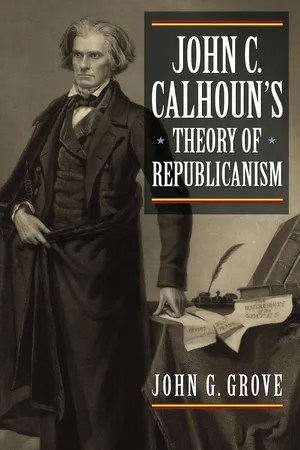
John C. Calhoun (1782–1850), the South Carolinian who served as a congressman, a senator, and the seventh vice president of the United States, is best known for his role in southern resistance to abolition and his doctrine of state nullification. But he was also an accomplished political thinker, articulating the theory of the “concurrent majority.” This theory, John G. Grove contends, is a rare example of American political thought resting on classical assumptions about human nature and political life. By tracing Calhoun’s ideas over the course of his political career, Grove unravels the relationship between the theory of the concurrent majority and civic harmony, constitutional reform, and American slavery. In doing so, Grove distinguishes Calhoun’s political philosophy from his practical, political commitment to states’ rights and slavery, and identifies his ideas as a genuinely classical form of republicanism that focuses on the political nature of mankind, public virtue, and civic harmony.
Man was a social creature, Calhoun argued, and the role of government was to maximize society’s ability to thrive. The requirements of social harmony, not abstract individual rights, were therefore the foundation of political order. Hence the concurrent majority permitted the unique elements in any given society to pursue their interests as long as these did not damage the whole society; it forced rulers to act in the interest of the whole. John C. Calhoun’s Theory of Republicanism offers a close analysis of the historical development of this idea from a basic, inherited republican ideology into a well-defined political theory. In the process, this book demonstrates that Calhoun’s infamous defense of American slavery, while unwavering, was intellectually shallow and, in some ways, contradicted his highly developed political theory.