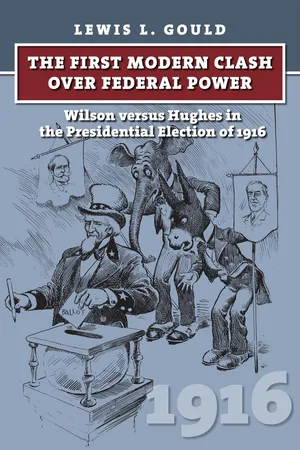
Fully examined for the first time in this engrossing book by one of America’s preeminent presidential scholars, the election that pitted Woodrow Wilson against Charles Evan Hughes emerges as a clear template for the partisan differences of the modern era. The 1916 election dramatically enacted the two parties’ fast-evolving philosophies about the role and reach of federal power. Lewis Gould reveals how, even more than in the celebrated election of 1912, the parties divided along class-based lines in 1916, with the Wilson campaign in many respects anticipating the New Deal while the Republicans adopted the small government, anti-union, and anti-regulation positions they have embraced ever since. The Republicans dismissed Wilson’s 1912 win as a fluke, the result of Theodore Roosevelt’s “Progressive” apostasy splitting the party. But in US Supreme Court Justice Hughes, whose electoral prowess had been proven in two successful runs for governor of New York, the Republicans had anointed a flawed campaigner whose missteps in California sealed his fate very late in the election. Wilson’s strong performance as the head of a united Democratic government (for the first time since 1894), along with Americans’ uncertainty about the outbreak of war in Europe, led to victory.
Along with the ins and outs of the race itself, Gould’s book explores the election’s broader meaning—as, for the first time, the popular election of the Senate coincided with a presidential election, and the women’s suffrage movement gathered steam. The year 1916 also marked the restoration of a two-party competition for president and, as we see in this enlightening book, the beginning of the two-party battle for the hearts and minds of Americans that continues to this day.