The Asian Development Bank has actively supported the Government of the Republic of the Philippines' Department of Budget and Management in institutionalizing results-based management across the country's bureaucracy. This guide to the Results-Based Management Framework (RBMF) provides a common reference point from which further refinement can occur. It aims to give insights on performance management with discussions on living within one's means (aggregate fiscal discipline), spending on the right things (allocative efficiency), and obtaining value for money (operational efficiency). It also aims to help readers understand how RBMF principles emphasize the importance of the government's goal of establishing a more transparent, accountable, and participatory culture.
- 64 pages
- English
- ePUB (mobile friendly)
- Available on iOS & Android
eBook - ePub
About this book
Information
| 1 | Introduction |
This guidebook will provide useful insights to new graduates joining the Philippine civil service for the first time, and a useful “refresher” to those in the civil service who find that they need a reminder of a concept or relationship. The move toward the results-based management framework (RBMF) has had three key objectives, namely:
• aggregate fiscal discipline,
• allocative efficiency, and
• operational or technical efficiency.
Government’s Financial Management Objectives
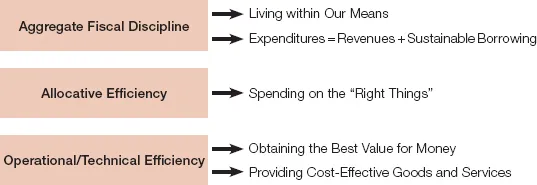
The manner in which the Philippine RBMF is being developed will support all three objectives. But continuous improvement is what we strive for; so, in a real sense, the RBMF is always going to be a work in progress.
A. Layout of the Guide
This guidebook focuses on the RBMF that is currently being institutionalized in the Philippines. It begins with an outline of the RBMF business model characterizing the RBMF concepts that have been implemented in the Philippines and then focuses on the performance management aspects of the model, including the importance of the statistical framework, the collection of data at monitoring points, the importance of rigorous and consistent specification of performance indicators (PIs), and the definition of major final outputs (MFOs) and performance attribution and evaluation.
The topics discussed in the subsequent chapters are as follows:
Results-Based Management Business Model—Chapter 2
Performance Management Hierarchy—Chapter 3
Performance Indicators—Chapter 4
Results-Based Planning—Chapter 5
Monitoring and Evaluation—Chapter 6
Strategic Performance Management System—Chapter 7
B. A Brief History
For many years, department/agency budgets increased incrementally with little consideration of program duplication or overlaps, changes in agency mandates, or the effectiveness of agency activities in attaining sector and societal goals. The incremental and overlapping nature of public financial management processes made it difficult to measure the performance of departments/agencies and their contributions to achieving development outcomes and goals. Projects and programs tended to continue without review of their efficiency or their effectiveness and assumed a life of their own. Reviews were rarely conducted, and individuals had little incentive to show initiative toward reform. If vested interests might be adversely affected, suggestions for a program or project to be reviewed, downsized, or even abandoned were unlikely to find much support. The system had a built-in bias toward expansion of programs and projects, even where the evidence, if it was available, might show those programs to be ineffective. As interest in public policy grew and more information became available, pressure grew for more decisions to be based on supporting evidence, which is now known as “evidence-based policy development.” In the Philippines, a number of developments supported the change to an evidence-based approach to policy needs analysis, which have led to the gradual evolution of the RBMF. Some of the significant events and developments over the last 40 years include the following:
1973 |
The Bureau of the Census and Statistics introduced statistical series of Indicators of Social Development.
The Development Academy of the Philippines Social Indicators Project commenced with the aim of measuring the impact of government policy on high-level economic and social statistics. |
1975 |
National government interagency discussions held to review the general sector objectives and the policy instruments being implemented, and development of a set of performance indicators (PIs) that would measure the degree of attainment of national sectoral and regional targets. |
1978 |
The National Economic and Development Authority (NEDA) developed macro indicators for measuring and monitoring the degree of achievement of goals identified in the Government of the Philippines’ development plans, identifying 100 key indicators and 197 supportive indicators. (However, only 80 economic and 38 social indicators were available, and none on the rate of poverty.) |
1988 |
The Department of Agrarian Reform introduced PIs; emancipation patents documented or distributed; settlers resettled, rehabilitated, and assisted; land titles and order of awards distributed; Community Land Trusts issued, adjusted, and corrected; leasehold contracts registered and perfected.
The Department of Health (DOH) introduced PIs; inpatient days, bassinet days; outpatient visits provided; persons serviced and protected; doses and units produced; laboratory examinations and analyses performed; hospital licenses issued; inspections conducted. |
2005 |
Budget Call prescribed use of the Organizational Performance Indicator Framework (OPIF) forms in budget preparation. |
2007 |
Publication of the first OPIF Book of Outputs |
2012 |
Issuance of the OPIF Reference Guide
Introduction of the Performance-Based Incentive System |
| 2 | The Philippine Results-Based Management Framework Business Model |
A. Budget Documents
The suite of budgetary information released annually includes the following:1
• The General Appropriations Act (GAA)—sets out new appropriations for programs, activities, and projects. From 2014 onward, the appropriation of operational activities is based on MFOs.
• The National Expenditure Program (NEP)—sets out new appropriations, automatic appropriations, and continuing appropriations for the year in which it is published and for the previous year, and shows estimated new appropriations for the next financial year. From 2014 onward, the NEP includes PI data and targets for each MFO.
• The Budget of Expenditures and Sources of Financing—sets out macroeconomic assumptions; consolidated financial position; sector distribution; regional allocations; spending on infrastructure; spending on capital outlays; spending on maintenance and other operating expenses; overviews of local government units and government-owned and -controlled corporations’ (GOCCs) financial positions; breakdown of the expenditures and funding sources for the budget year, the current year, and the previous years into summaries of financial data by location.
• Staffing Summary—sets out a summary of the staffing complement of each department and agency, including the number of positions and funding amounts allocated.
• Details of Selected Programs/Projects—set out more detailed disaggregation of key programs, activities, and projects (PAPs) in the NEP to flesh out lump-sum allocations in terms of project listing and their locations.
In addition, longer-term planning documents include:
• The Philippine Development Plan (PDP)—presents discrete initiatives to be implemented over a 6-year period and enumerates specific targets for a range of indicators.
• The Public Investment Plan (PIP)—presents information on PAPs (derived from the PDP consultative process) that are to be scheduled for implementation over the life of the PDP.
The Medium-Term Expenditure Framework (MTEF) and the forward estimates are revised annually by the Department of Budget and Management (DBM) and the results are issued in the Annual Budget Call as indicative budget ceilings but, as at the date of printing of this guidebook, have not been published.
B. Outline of the Results-Based Management Framework Business Model
The Philippines’ RBMF has four main elements (excluding the techni...
Table of contents
- Front Cover
- Title Page
- Copyright Page
- Contents
- Figures and Tables
- Preface
- Acknowledgments
- Abbreviations
- 1 Introduction
- 2 The Philippine Results-Based Management Framework Business Model
- 3 Performance Management Hierarchy
- 4 Major Final Output Specification, Performance Indicators, and Targets
- 5 Results-Based Planning
- 6 Monitoring and Evaluation
- 7 The Strategic Performance Management System
- 8 Future Directions
- Glossary
- References
- Back Cover
Trusted by 375,005 students
Access to over 1.5 million titles for a fair monthly price.
Study more efficiently using our study tools.
Frequently asked questions
Yes, you can cancel anytime from the Subscription tab in your account settings on the Perlego website. Your subscription will stay active until the end of your current billing period. Learn how to cancel your subscription
No, books cannot be downloaded as external files, such as PDFs, for use outside of Perlego. However, you can download books within the Perlego app for offline reading on mobile or tablet. Learn how to download books offline
Perlego offers two plans: Essential and Complete
- Essential is ideal for learners and professionals who enjoy exploring a wide range of subjects. Access the Essential Library with 800,000+ trusted titles and best-sellers across business, personal growth, and the humanities. Includes unlimited reading time and Standard Read Aloud voice.
- Complete: Perfect for advanced learners and researchers needing full, unrestricted access. Unlock 1.5M+ books across hundreds of subjects, including academic and specialized titles. The Complete Plan also includes advanced features like Premium Read Aloud and Research Assistant.
We are an online textbook subscription service, where you can get access to an entire online library for less than the price of a single book per month. With over 1.5 million books across 990+ topics, we’ve got you covered! Learn about our mission
Look out for the read-aloud symbol on your next book to see if you can listen to it. The read-aloud tool reads text aloud for you, highlighting the text as it is being read. You can pause it, speed it up and slow it down. Learn more about Read Aloud
Yes! You can use the Perlego app on both iOS and Android devices to read anytime, anywhere — even offline. Perfect for commutes or when you’re on the go.
Please note we cannot support devices running on iOS 13 and Android 7 or earlier. Learn more about using the app
Please note we cannot support devices running on iOS 13 and Android 7 or earlier. Learn more about using the app
Yes, you can access Results-Based Management Framework in the Philippines by in PDF and/or ePUB format, as well as other popular books in Economics & Development Economics. We have over 1.5 million books available in our catalogue for you to explore.