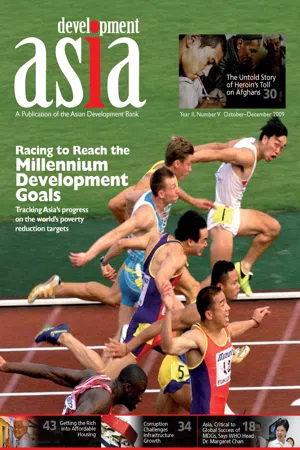
Development Asia—Racing to Reach the Millennium Development Goals
October–December 2009
,
48 pages
English
ePUB (mobile friendly)
Available on iOS & Android
eBook - ePub
Development Asia—Racing to Reach the Millennium Development Goals
October–December 2009
,
About this book
The adoption of the Millennium Development Goals (MDGs) in 2000 by the United Nations (UN) General Assembly was a major breakthrough in the fight against poverty. Not only did it draw out firm commitments from nations but it also promoted greater transparency and urgency by putting the spotlight on national and international efforts to improve the living conditions of the poorest by 2015. With nearly two-thirds of deadline time elapsed, this edition of Development Asia takes a hard look at progress made toward the MDGs in Asia and the Pacific. Much success has been achieved in key areas, such as in lowering the child mortality rate and improving the quality of life of those on the fringes of society. Yet, despite the advances made, most of Asia and the developing world will fall short of the targets as they struggle to cope with the global economic crisis, rising food prices, and climate change. In an exclusive interview with Development Asia, Director-General Dr. Margaret Chan of the World Health Organization stresses the importance of building on successes in achieving the goals and urges donor nations to continue aid programs. These ambitious global goals have presented challenges to development professionals—and leaders—on how best to measure development progress. Critics tell Development Asia that MDG indicators tend to draw a skewed picture since these show progress at the national level that may be vastly different from conditions at the provincial level. Still, development workers agree that these indicators, though not perfect, provide the most comprehensive framework for reducing poverty worldwide. In other stories, this issue tells the little known tale of Afghanistan's heroin addicts. Much has been written about the country feeding the world's addiction, but few have examined heroin's painful toll on Afghanistan's people. This edition also looks at the problem of endemic corruption in infrastructure projects, while it weighs both the positive and negative effects of road building, one of the largest types of infrastructure projects, and most common. Patralekha Chatterjee argues that road projects need HIV/AIDS officers as much as they need engineers. In our From the Field section, we talk to Tony Meloto, the energetic founder of the highly successful Philippine housing organization, Gawad Kalinga. The program is promoted as getting the wealthy and middle class into low-cost housing… as volunteers. A former marketing executive, Mr. Meloto is as comfortable in the slums as he is in the polo club.
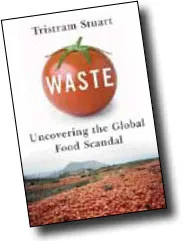
In Waste, author Tristram Stuart asks why North America and Europe throw away 30% to 50% of their food. He claims that the fresh produce discarded by farmers, manufacturers, supermarkets, and consumers could feed the millions of starving people in the world at least three times over. He argues that avoiding waste is the easiest remedy to a global food crisis.
Mr. Stuart has been a freelance writer for Indian newspapers, a project manager in Kosovo, and a critic of the food industry. He has made regular contributions to television documentaries, and radio and newspaper debates on the social and environmental aspects of food. His first book, The Bloodless Revolution: Radical Vegetarians and the Discovery of India, was published in 2006.
“Stuart, a freegan and environmental campaigner, has based his book on painstaking research carried out over several years of firsthand experience of foraging in supermarket bins, as well as interviews with company executives and trawls through the meagre data provided by governments and businesses… Waste is certainly one of the most important environmental books to come out in years. But it is more than that. It is an indictment of our consumer culture that should make us all feel deeply ashamed. The scale of our food waste problem—and its effect on the developing world—revealed in this book will leave you shocked. And, the author hopes, demanding change.”—Fiona Harvey, Financial Times
“Stuart is surely right that ‘reducing food waste should become one of the highest priorities on the environmental agenda.’ It’s a no-brainer: good for the hungry (North America and Europe combined chuck out enough to feed the world’s hungry three times over), good for the environment (excess food production is directly linked to the destruction of the rainforest) and even good for business (‘where waste has been cut, profit margins soar’).”—Bee Wilson, The Sunday Times
“In Waste, Tristram Stuart shows how we could have much more food overnight simply by not tossing away so much of it. This simple concept ingeniously unites many food scandals that often do not get the attention they deserve: the mould that destroys a third or more of Third World harvests; the fish caught by accident that must be thrown back, dead, under rules intended to conserve stocks; the millions of tons of edible food wasted by modern food processing and ‘sell-by’ dates; even western squeamishness about eating ‘every part of the pig but the squeal.’”—Debora MacKenzie, New Scientist
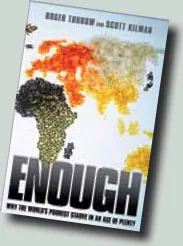
ENOUGH
Why the World’s Poorest Starve in an Age of Plenty
By Roger Thurow and Scott Kilman PublicAffairs/The Wall Street Journal
$27.95
Investigative reporters from The Wall Street Journal look into the economic, political, and social dynamics that perpetuate famine. Roger Thurow and Scott Kilman seek to answer why more than 9 million people die of hunger, malnutrition, and related diseases every year when the technology and know-how to grow enough food to end chronic hunger have been available for years. They focus on Africa, where more die of hunger than from AIDS and malaria combined.
Mr. Thurow has been a foreign correspondent for The Wall Street Journal for 20 years. Mr. Kilman has been the Journal’s leading agriculture reporter. They have teamed up to produce ground-breaking stories on famine and food aid. Their stories on three 2003 famines were a finalist for the 2004 Pulitzer Prize in international reporting.
“Thurow and Kilman are journalists who have covered famines in Africa, agricultural policy in the corridors of Washington and Brussels, and food commodities markets in Chicago. Yet their book is more than just a rough first draft of history. While grounded in colorful, entertaining reportage, Enough also displays a depth of thought and research more commonly found in academic studies. Well-chosen anecdotes bring the issues to life.”—Javier Blas, Financial Times
“This very readable book argues that the agricultural science and technology of the green revolution, which ended famine in much of the world last century, was on the whole a good thing, and that we need more of it.”—Debora MacKenzie, New Scientist
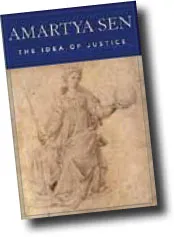
THE IDEA OF JUSTICE
By Amartya Sen Belknap Press
$29.95
Nobel laureate Amartya Sen writes a critique on the theory of social justice that takes into consideration practical realities and differences in the understanding of a just society. He argues that society inevitably faces a choice between what is “more” or “less” just.
Mr. Sen is winner of the 1998 Nobel Prize in Economics. He is Lamont University Professor at Harvard University.
“Two themes predominate: economic rationality and social injustice. Mr. Sen approaches them alike. He can, when he wants, theorize without oxygen at any height. But he believes that theory, to be of use, must keep its feet on the ground. Modern theorists in his view have drifted too far from the actual world.”—The Economist
“The most important new intellectual notion here is a working through of the fundamental distinction between two competing approaches to justice. Most modern political philosophers are concerned with finding the right rules, institutions and social contracts for a just society. This school of thought—dubbed ‘transcendental institutionalism’ by Sen—found its greatest 20th-century exponent in John Rawls, who built on foundations laid by Kant and Rousseau… The competing vision of justice Sen prefers is a ‘comparative’ one, which examines ‘what kind of lives people can actually lead.’ The heroes of the comparative pantheon are Condorcet, Wollstonecraft and Mill. For them, as for Sen, abolishing slavery or giving women the vote would free people to lead lives of their own choosing, even without creating a perfectly just society.”—The Sunday Times
“In showing why those who pursue justice do not need an ideal of a perfectly just society, only a view about what would make the world a more just place, The Idea of Justice deserves to be acclaimed as a major advance in contemporary thinking.”—John Gray, Literary Review
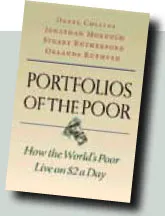
PORTFOLIOS OF THE POOR
How the World’s Poor Live on $2 a Day
By Daryl Collins, Jonathan Morduch, Stuart Rutherford and Orlanda Ruthven
Princeton University Press $29.95
The book explains how more than two billion people around the world survive on just two dollars a day or less. The authors of Portfolios of the Poor asked villagers and slum dwellers in Bangladesh, India, and South Africa to keep track of how they manage their money over a period of one year. Their “financial diaries” show that they cope by using financial tools that tap informal networks and family ties. Some have run saving clubs and used microfinancing.
The authors believe that the experiences of these poor households reveal new methods to fight poverty and ideas to develop financial products for the poor.
Daryl Collins, who conceived and directed the most recent version of the financial diaries in South Africa, is a senior associate at Bankable Frontier Associates in Boston. Jonathan Morduch is professor of public policy and economics at New York University and coauthor of The Economics of Microfinance. Stuart Rutherford is the author of The Poor and Their Money, and founder of SafeSave, a microfinance institution in Bangladesh. Orlanda Ruthven recently completed a doctoral degree in international development at the University of Oxford and lives in New Delhi.
“In Portfolios of the Poor, authors Daryl Collins, Jonathan Morduch, Stuart Rutherford and Orlanda Ruthven tackle the question of how some 2.5 billion people, roughly 40% of humanity, survive on $2 a day. The answer? Creatively. Turns out that the poorest people on earth engage in the sort of sophisticated money management that would make Chuck Schwab proud… One key finding is that the poor do not live hand to mouth, exhausting every last cent on food and shelter. Earnings shift by season, job and health, so the poor spread them out… The diaries reveal a ‘real, ongoing, and substantial demand’ for better financial services, which poor families need to provide better health care and schooling for their children.”—Carlos Lozada, The Washington Post
“The research provides Evidence of the sophistication Ivith which poor people think about their finances. They are acutely aware, for example, of the Importance of some psychological phenomena whose effects behavioral economists have only recently begun to explore.”—The Economist
“Ten years ago, the authors of this unusual study began collecting detailed year-long ‘financial diaries’ from households in Bangladesh, India, and South Africa… The diarists did things that might seem irrational—borrowing in order to save; paying interest on savings—but that made sense given their unpredictable incomes and limited options. While the authors do offer prescriptions for how to expand those options, it’s their scrupulous attention to actual behavior that makes this book invaluable.” —The New Yorker
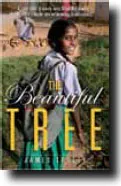
THE BEAUTIFUL TREE
A Personal Journey Into How the World’s Poorest People Are Educating Themselves
By James Tooley Cato Institute
$19.95
Award-winning scholar James Tooley shares lessons learned on a journey that took him from the largest shanty town in Africa to the mountains of Gansu in the People’s Republic of China (PRC). He tells the story of how parents, teachers, and education entrepreneurs in poor communities in Africa, India and the PRC have built and funded their own small private schools.
The Beautiful Tree is named after Mahatma Gandhi’s phrase for the schools of pre-colonial India.
Mr. Tooley was a professor in leading universities in Canada, England, and South Africa for many years. He has conducted research and consultancy work for the International Finance Corporation (IFC), World Bank, United Nations, UNESCO, and Asian Development Bank Institute on private education in developing countries. He received recognition for his r...
Table of contents
Front Cover
Title Page
Copyright Page
Contents
Tracking Progress Against Poverty with the MDGs
Letters to the Editor
Contributors
Tough Goals
Rating Asia’s Pro Gress
Asia is Critical to Global Success of the MDGs
What does it Mean to be Poor?
A Skewed Picture
A Surprise MDG Success Story
Afghanistan’s Forgotten Heroin Addicts
Coruption Challenges Infrastructure Growth
What a Difference a Road Makes
Opinion: Road Pro Jects Need an HIV Officer as Much as an Engineer
Departments •
Asia by Numbers
From the Field
On the Record
Must-Read Books
Back Cover
Trusted by 375,005 students
Access to over 1.5 million titles for a fair monthly price.
Study more efficiently using our study tools.
Frequently asked questions
Yes, you can cancel anytime from the Subscription tab in your account settings on the Perlego website. Your subscription will stay active until the end of your current billing period. Learn how to cancel your subscription
No, books cannot be downloaded as external files, such as PDFs, for use outside of Perlego. However, you can download books within the Perlego app for offline reading on mobile or tablet. Learn how to download books offline
We are an online textbook subscription service, where you can get access to an entire online library for less than the price of a single book per month. With over 1.5 million books across 990+ topics, we’ve got you covered! Learn about our mission
Look out for the read-aloud symbol on your next book to see if you can listen to it. The read-aloud tool reads text aloud for you, highlighting the text as it is being read. You can pause it, speed it up and slow it down. Learn more about Read Aloud
Yes! You can use the Perlego app on both iOS and Android devices to read anytime, anywhere — even offline. Perfect for commutes or when you’re on the go. Please note we cannot support devices running on iOS 13 and Android 7 or earlier. Learn more about using the app
Yes, you can access Development Asia—Racing to Reach the Millennium Development Goals by in PDF and/or ePUB format, as well as other popular books in Social Sciences & Global Development Studies. We have over 1.5 million books available in our catalogue for you to explore.