This report assesses the KALAHI-CIDSS community-driven development project in the Philippines to determine its contribution toward improved service delivery and governance in the beneficiary communities. KALAHI-CIDSS was found to be especially effective in facilitating broad-based participation of community residents, addressing local priorities and delivering basic services to the intended beneficiaries, providing community residents with valuable experience, and creating space for local government officials to collaborate with community residents in subproject management. The project created positive effects on the income and non-income dimensions of poverty. It is valued highly by recipient communities, participating local governments, and development partners.
- 60 pages
- English
- ePUB (mobile friendly)
- Available on iOS & Android
eBook - ePub
About this book
Information
Context of the KALAHI-CIDSS: KKB Project
1. This report presents the findings of an assessment of the 8-year KALAHI-CIDSS Project in the Philippines. The assessment of this community-driven development (CDD) initiative is part of an ongoing regional technical assistance project of the Asian Development Bank (ADB) that seeks to build the capacity of ADB developing member countries to introduce or scale up community development operations. The outputs of the ADB initiative are 4 country studies on CDD, knowledge-sharing through publications and workshops, and a CDD learning network.
The KALAHI-CIDSS Approach
2. Kapit-Bisig Laban sa Kahirapan-Comprehensive and Integrated Delivery of Social Services: Kapangyarihan at Kaunlaran sa Barangay (KALAHI-CIDSS, for short) is a CDD initiative of the Government of the Philippines’ Department of Social Welfare and Development (DSWD).1 KALAHI-CIDSS seeks to reduce poverty and vulnerabilities to poverty by addressing a lack of capacity and resources at the local level and limited responsiveness of local governments to community priorities.
3. KALAHI-CIDSS reflects recognition by the Government of the Philippines of the endemic and widespread nature of poverty. Its design drew inspiration from two major antipoverty programs—the DSWD’s Comprehensive Integrated Delivery of Social Services Program and Indonesia’s Kecamatan Development Program, a CDD initiative started in the 1990s.
4. KALAHI-CIDSS seeks to “empower communities in targeted poor municipalities to achieve improved access to sustainable basic public services and to participate in more inclusive Local Government Unit planning and budgeting”. The acronym, LET-CIDSS, summarizes the basic principles that guide its implementation: localized decision making, empowerment, transparency, community priority setting, inclusiveness, demand-driven, simple, sustainable (Table 1).
Table 1: The Main Principles of KALAHI-CIDSS
Localized Decision Making | This principle emphasizes the importance of community discussions and decision making, including the formulation and implementation of projects and other interventions to address problems that community residents have identified. |
Empowerment | The project invests heavily in capacity-building activities that progressively develop the capabilities of the people, including analysis of local conditions, design of appropriate development interventions, and implementation of development projects. Capacity building takes place throughout the community empowerment activity cycle in which communities realize their individual and collective strengths, acquire and develop community and project management skills, and increase their confidence to engage local governments in periodic dialogues to improve resource allocation and delivery of basic services. |
Transparency | Peoples’ participation is the project’s core requirement and the prerequisite to the success of all activities and interventions. Village assemblies provide opportunities for people to participate and be informed about the physical and financial status of subprojects. Consultation on community issues or problems promotes responsibility and accountability. The KALAHI-CIDSS multilevel monitoring system, including the use of nongovernment organizations and media as independent monitors and the grievance monitoring and resolution mechanism, supports transparency. |
Community Priority Setting | Selection of subprojects and capacity-building activities is the product of a collective decision-making process. Projects are prioritized for funding by a municipal inter-barangay (intervillage) forum whose members are elected by the participating villages. |
Inclusiveness | The entire community, including formal and traditional leaders, representatives of different sectors, individuals, groups, and local organizations, are encouraged to participate in KALAHI-CIDSS. Special efforts ensure the participation of women and indigenous people. Broadening the base of participation prevents elite capture of project activities and benefits. |
Demand Driven | KALAHI-CIDSS supports communities with prioritizing their own needs and problems, designing their own subprojects, and making decisions on how resources are used. Residents develop ownership of the subprojects they have identified, developed, and implemented, so the subprojects have better outcomes and are more sustainable than would otherwise be the case. |
Simple | KALAHI-CIDSS procedures and other requirements are simple and are designed to facilitate understanding, appreciation, and involvement of all stakeholders. |
Sustainable | Communities are required to develop and implement viable plans for sustainability for each subproject to ensure that they deliver intended benefits over the long term. |
Note: To avoid confusion, KALAHI-CIDSS is referred to as a “project;” the activities supported by KC at the village level are referred to as “subprojects.”
5. Capacity-building and implementation support, community grants, and monitoring and evaluation are the three main components of KALAHI-CIDSS. Grants for community subprojects are provided to participating municipalities with each municipality’s allocation equal to the number of villages within its jurisdiction multiplied by approximately $14,000 per year for 3 years. Since the grant to a municipality is not enough to meet the funding needs of proposed subprojects from all villages within the municipality, funds for subprojects are allocated through a competitive community priority-setting process. This competitive element is possibly the defining characteristic of KALAHI-CIDSS and the single most important feature that differentiates it from other community development programs in the Philippines with CDD characteristics, such as the Mindanao Rural Development Program, the Agrarian Reform Communities Development Program, and the Autonomous Region in Muslim Mindanao Social Fund.
6. The initial period of engagement between KALAHI-CIDSS and a participating community extends for 3 years.2 A DSWD-recruited area coordinating team, consisting of an area coordinator, engineer, financial analyst, and community facilitators (at a ratio of one facilitator for every three to five villages, depending on accessibility), is deployed in each target municipality to lead local implementation and assist participating villages. All villages in a target municipality are eligible to participate in KALAHI-CIDSS.
7. The cornerstone of the KALAHI-CIDSS approach is the community empowerment and activity cycle (CEAC). Each village that entered KALAHI-CIDSS since the project started in 2003 went through the CEAC three times (approximately once each year) during its engagement with the project. There are four stages in the CEAC: social preparation, subproject identification and development, subproject selection and approval, and subproject implementation (Figure 1).
8. Social preparation involves training to identify communities’ problems and propose solutions. The key activity during social preparation is the participatory situation analysis (PSA), which is a collective assessment of conditions by community volunteers chosen by their peers. The analysis involves visual tools, such as resource and social maps, time division of labor, Venn diagrams, and the like. Village residents subsequently validate the results of the PSA at a barangay (village) assembly or meeting.
Figure 1: The Community Empowerment Activity Cycle
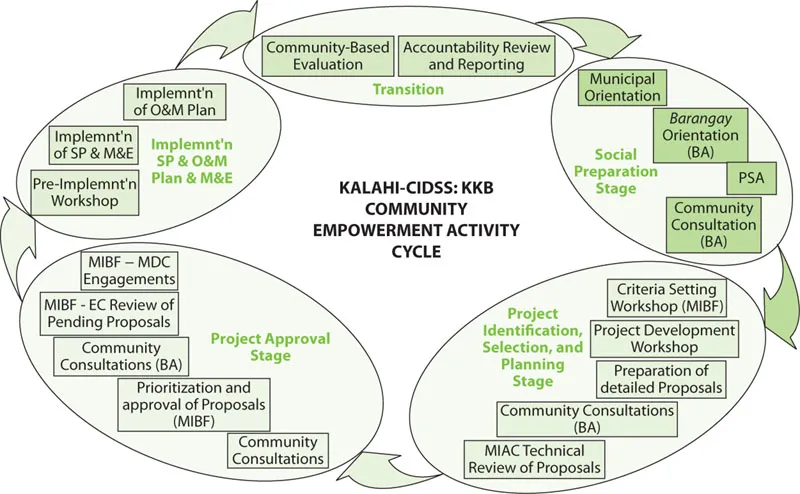
BA = barangay (village) assembly, EC = executive committee, MDC = municipal development council, M&E = monitoring and evaluation, MIAC = municipal interagency committee, MIBF = municipal inter-barangay forum, O&M = operation and maintenance, PSA = participatory situation analysis, SP = subproject
Note: Although this figure uses the term “project” to describe the community empowerment activity cycle at the local level, such projects are considered to be subprojects at the village level here and elsewhere in the report.
Source: KALAHI-CIDSS National Project Management Office. Field Guide for KALAHI-CIDSS: KKB Area Coordinating Teams—CEAC Operations Manual. Unpublished. 5 February 2007.
9. The major activity during subproject identification and development is the criteria-setting workshop, where village representatives determine the quantitative and qualitative criteria for the selection and ranking of village proposals. Sample criteria for subproject selection can include responsiveness to a priority problem, beneficiary reach, quality of benefits, and cultural acceptability. The criteria guide villages in the selection and preparation of their subproject proposals.
10. A community can propose any subproject it considers important for its development except for activities that have adverse social or environmental impacts or microcredit activities that involve the lending of funds. Based on KALAHI-CIDSS-1 (KC-1) experience, subprojects likely to be proposed and supported include water systems, access roads, schools, health stations, and day care centers. Together, such subprojects accounted for 80% of all KALAHI-CIDSS community grants during the first phase of KALAHI-CIDSS.
11. In the subproject approval phase, democratically elected village representatives convene in an intervillage meeting (known as the municipal inter-barangay forum) for the competitive ranking of subproject proposals using the criteria selected earlier. When all proposals have been ranked, the municipal grant is allocated first to the amount needed for the highest-ranked subproject, and then to the second highest-ranked, and so on, until the municipality’s grant has been fully committed.
12. Communities with approved proposals then move to the fourth stage, subproject implementation, monitoring, evaluation, and operation and maintenance (O&M). During subproject implementation, community residents find new ways of working with each other, engage local gove...
Table of contents
- Front Cover
- Title Page
- Copyright Page
- Contents
- List of Tables and Figures
- Abbreviations
- Acknowledgments
- Executive Summary
- Context of the KALAHI-CIDSS: KKB Project
- The ADB Assessment of KALAHI-CIDSS: KKB
- Findings and Assessment: Community Participation
- Findings and Assessment: Utility and Sustainability of Subprojects
- Findings and Assessment: Accountability and Transparency
- Findings and Assessment: Institutional Impacts
- Lessons Learned and Implications for Policy and Practice
- References
- Back Cover
Trusted by 375,005 students
Access to over 1.5 million titles for a fair monthly price.
Study more efficiently using our study tools.
Frequently asked questions
Yes, you can cancel anytime from the Subscription tab in your account settings on the Perlego website. Your subscription will stay active until the end of your current billing period. Learn how to cancel your subscription
No, books cannot be downloaded as external files, such as PDFs, for use outside of Perlego. However, you can download books within the Perlego app for offline reading on mobile or tablet. Learn how to download books offline
Perlego offers two plans: Essential and Complete
- Essential is ideal for learners and professionals who enjoy exploring a wide range of subjects. Access the Essential Library with 800,000+ trusted titles and best-sellers across business, personal growth, and the humanities. Includes unlimited reading time and Standard Read Aloud voice.
- Complete: Perfect for advanced learners and researchers needing full, unrestricted access. Unlock 1.5M+ books across hundreds of subjects, including academic and specialized titles. The Complete Plan also includes advanced features like Premium Read Aloud and Research Assistant.
We are an online textbook subscription service, where you can get access to an entire online library for less than the price of a single book per month. With over 1.5 million books across 990+ topics, we’ve got you covered! Learn about our mission
Look out for the read-aloud symbol on your next book to see if you can listen to it. The read-aloud tool reads text aloud for you, highlighting the text as it is being read. You can pause it, speed it up and slow it down. Learn more about Read Aloud
Yes! You can use the Perlego app on both iOS and Android devices to read anytime, anywhere — even offline. Perfect for commutes or when you’re on the go.
Please note we cannot support devices running on iOS 13 and Android 7 or earlier. Learn more about using the app
Please note we cannot support devices running on iOS 13 and Android 7 or earlier. Learn more about using the app
Yes, you can access The KALAHI-CIDSS Project in the Philippines by in PDF and/or ePUB format, as well as other popular books in Economics & Development Economics. We have over 1.5 million books available in our catalogue for you to explore.