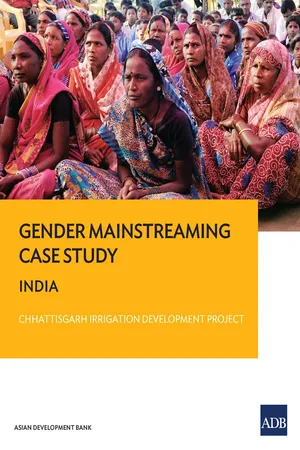
In 2006, the State of Chhattisgarh adopted the new Participatory Irrigation Management (PIM) Act, which set out important changes for irrigation management and had significant implications for women's participation in irrigation system. Chhattisgarh has abundant agricultural land and rainfall. However, agricultural productivity was low because only wet season rice (or paddy) was grown in most areas. The Chhattisgarh Irrigation Development Project (CIDP) improved irrigation, making it possible for dry season (rabi) cropping and giving many farmers the opportunity to improve their livelihood. With the PIM Act, the CIDP improved farm productivity and increased the participation of women in farm decision-making. The CIDP was the first irrigation project in Chhattisgarh that worked within a participatory irrigation management framework and strengthened water users' associations.
- 18 pages
- English
- ePUB (mobile friendly)
- Available on iOS & Android
eBook - ePub
About this book
Information
India: Chhattisgarh Irrigation Development Project
Project Overview
Chhattisgarh has abundant agricultural land and rainfall. However, agricultural productivity was low because only wet season rice (or paddy) was grown in most areas. The Chhattisgarh Irrigation Development Project (CIDP) improved irrigation. Dry season (rabi) cropping became possible and gave many farmers the opportunity to improve their livelihood.
Water users’ associations (WUAs) were established in Chhattisgarh in 1999 to manage local irrigation initiatives. Their first year, however, was relatively unsuccessful. Members lacked skills in managing water systems, and WUAs had insufficient funds.
In 2006, through the CIDP, the State of Chhattisgarh adopted the new Participatory Irrigation Management (PIM) Act, which set out important changes for irrigation management and had significant implications for women’s participation in irrigation systems. These included
• Extending WUA membership to spouses, thus opening up avenues for women’s participation. Both men and women—not just women with land titles—are now full WUA members with the right to attend meetings, stand for election, and vote.
• Establishing reserved seats for women and underrepresented groups, including scheduled castes and tribes. WUA subcommittees are to be composed of at least 33% women.
• Expanding jurisdictions for WUAs to include minor irrigation systems and lower parts of medium and major irrigation systems.
• Allowing government to share a quarter of the water fees collected from users with WUAs, which is used for small repairs and system maintenance.
With the PIM Act, the CIDP improved farm productivity and increased the participation of women in farm decision making. The CIDP was the first irrigation project in Chhattisgarh that worked within a participatory irrigation management framework and strengthened WUAs. See Box 1 for basic information on the CIDP.
Box 1: The Chhattisgarh Irrigation Development Project: Basic Facts
Loan Number: | 2159 |
Loan Approval: | March 2006 |
Closing Date: | March 2013 |
Executing Agency: | Water Resources Department, Government of Chhattisgarh |
Overall Project Cost: | $66.60 million |
Financing: | ADB loan: $46.10 million |
Project Beneficiaries: $0.60 million | |
Government: $19.90 million | |
Gender Classification: | Effective gender mainstreaming |
Note: In this report, “$” refers to US dollars.
Source: Project records, Project Management Unit.
Main Aims and Approaches
The overall goal of the Chhattisgarh Irrigation Development Project (CIDP) was to improve agricultural productivity and rural livelihoods, and reduce poverty through improved irrigation delivery, enhanced agricultural practices, and strengthened water resource management. The project was designed to help the State of Chhattisgarh rehabilitate and upgrade irrigation systems, strengthen the Water Resources Department (WRD), empower WUAs, and promote the adoption of improved water management and agricultural practices among farmers.
The main project components were as follows:
Component 1: Institutional strengthening and capacity development for the WRD, which aimed to strengthen the department and improve its ability to develop and manage irrigation systems.
Component 2: Improved institutional framework and capacity development for WUAs, which used a PIM framework to develop the capacity of WUAs to play a meaningful role in the rehabilitation, management, operations, and maintenance of irrigation systems.
Component 3: Rehabilitation and upgrading of existing irrigation schemes leading to improved performance, which sought to rehabilitate and upgrade minor and medium irrigation systems through a participatory process directed by WUAs.
Component 4: Improved capacity and willingness of farmers to engage in rabi (dry season) cropping and diversified farming, which provided support to enhance WUAs’ and farmers’ capacities for improved agricultural practices.1
The project employed a range of activities including civil engineering works, support for institutional and policy changes, capacity development (including organizing farmer field school extension), farmers’ mobilization, public education campaigns, and the development of a monitoring and evaluation program. Nongovernment organizations (NGOs) were contracted with technical assistance from ADB to develop the capacities of WUAs, provide agricultural support services (especially for the newer rabi crops), and increase awareness and education among WUA members. CIDP also linked WUAs with the Department of Agriculture and other service providers from the private sector, and helped the WUAs establish marketing partnerships. The project also eased access to seeds, farm equipment, and fertilizer.
Relevant Gender Equality Issues
During project implementation, there was a growing recognition of the importance of taking into account gender issues in water resources management in general, and irrigation initiatives in particular. Gender differences and inequalities, as well as cultural stereotypes and norms, were assessed to determine the extent of women’s participation in irrigation management. Specific gender issues identified include2
• Access to resources, assets, and labor, and responsibility in decision making are dominated by men. Thus, women have little or no access to land other than through their relationship with male family members. As landownership was a condition for membership in many water management bodies before the enactment of the PIM Act, many landless women farmers and agricultural workers were excluded from participating in decision making and management of water resources. Participation is important to women because of their various uses of water, such as for crops, livestock, economic activities, and household use. A holistic view of women’s need for water and their important role in its management is thus important.
• The division of labor, which is prescribed by social norms and tradition, limits women to the immediate household area. Hence, irrigation infrastructure design needs to adopt technologies that match with the preferences and capacities of users, and enable rural women to benefit fully from them.
• The social norms limit women’s participation in political and other forms of decision making that affect their lives. The restrictions are particularly hard to overcome for women who head households, whether as widows or through divorce or abandonment. Women workers earn considerably less than male workers. Women also have lower average calorie consumption, indicated by higher malnutrition, mortality, and morbidity rates for girls and women than for males.
• Women’s needs as farmers are not always addressed by agricultural extension services. Sociocultural restrictions also limit their capacity to control the proceeds from their labor or to access extension services, especially when male officers deliver these services. Given these factors, their contributions to agricultural production, such as caring for livestock and crop production, are not always supported by new technologies and training opportunities.
• Women’s membership in WUAs or committees does not always translate into effective participation. Even with reserved seats and/or mandatory membership, women may not be full partners with men. They may be uncomfortable speaking; when they do speak up, they are not listened to. Gender stereotypes, power imbalances, and lack of confidence affect women’s ability to take full advantage of legal openings. Women may also be held back by lower literacy levels, lack of information on agricultural techniques, leadership gaps, and lack of experience in conflict resolution. To be effective, legal instruments often require supporting measures such as capacity building for women, awareness raising for men, and learning new ways of working together.
Involving Women and Addressing Gender Disparities
The project acknowledged institutional, social, and cultural barriers to women’s empowerment and provided measures to promote the interests of women. One measure was pushing for the passage of the new PIM Act 2006 through which women became eligible both for WUA membership and for election to WUA governing bodies and committees. In accordance with this law, in 2007, for the first time in WUA elections, seats in the WUA management committee were reserved for women and less represented and socially excluded communities (Scheduled Tribes, Schedule Castes, and “Other Backward Classes”).
CIDP’s Summary Poverty Reduction and Social Strategy (SPRSS) included various measures to support women’s participation and gender equality outcomes as listed below.
• The revised participatory irrigation management policies included several key changes such as (i) membership in the WUA is on a household basis so that both women and men can become members with the right to attend meetings and vote; and (ii) all women (not just women property owners with a title) who are part of a WUA member household can stand for election and be elected into the WUA management committee and any subcommittee.
• The WUA ma...
Table of contents
- Front Cover
- Title Page
- Copyright Page
- Contents
- India: Chhattisgarh Irrigation Development Project
- Back Cover
Trusted by 375,005 students
Access to over 1.5 million titles for a fair monthly price.
Study more efficiently using our study tools.
Frequently asked questions
Yes, you can cancel anytime from the Subscription tab in your account settings on the Perlego website. Your subscription will stay active until the end of your current billing period. Learn how to cancel your subscription
No, books cannot be downloaded as external files, such as PDFs, for use outside of Perlego. However, you can download books within the Perlego app for offline reading on mobile or tablet. Learn how to download books offline
Perlego offers two plans: Essential and Complete
- Essential is ideal for learners and professionals who enjoy exploring a wide range of subjects. Access the Essential Library with 800,000+ trusted titles and best-sellers across business, personal growth, and the humanities. Includes unlimited reading time and Standard Read Aloud voice.
- Complete: Perfect for advanced learners and researchers needing full, unrestricted access. Unlock 1.5M+ books across hundreds of subjects, including academic and specialized titles. The Complete Plan also includes advanced features like Premium Read Aloud and Research Assistant.
We are an online textbook subscription service, where you can get access to an entire online library for less than the price of a single book per month. With over 1.5 million books across 990+ topics, we’ve got you covered! Learn about our mission
Look out for the read-aloud symbol on your next book to see if you can listen to it. The read-aloud tool reads text aloud for you, highlighting the text as it is being read. You can pause it, speed it up and slow it down. Learn more about Read Aloud
Yes! You can use the Perlego app on both iOS and Android devices to read anytime, anywhere — even offline. Perfect for commutes or when you’re on the go.
Please note we cannot support devices running on iOS 13 and Android 7 or earlier. Learn more about using the app
Please note we cannot support devices running on iOS 13 and Android 7 or earlier. Learn more about using the app
Yes, you can access Gender Mainstreaming Case Study by in PDF and/or ePUB format, as well as other popular books in Social Sciences & Gender Studies. We have over 1.5 million books available in our catalogue for you to explore.