Impoverished children living in the remote rural areas and urban slums of Pakistan are not well served by the country's struggling public school system. To provide an alternative, the provincial government of Punjab revitalized the Punjab Education Foundation (PEF), which works with private schools located in poor communities throughout the province. Through these public–private partnerships (PPPs), the PEF provides school funding, teacher training, and vouchers allowing needy children to attend participating private schools for free. As a result, students at these private schools have shown strong gains in academic assessment tests, and the foundation's programs have already been replicated elsewhere in the country. This report examines a number of aspects of the PEF experience with the design and implementation of PPPs in the education sector. It begins by providing an overview of the governance structure of the PEF, and then outlines the design of, and trends in, its various programs, including the flagship Foundation Assisted Schools Program. The report concludes with a brief discussion of the lessons that can be drawn from the PEF's experience with education PPPs.
eBook - ePub
Public-Private Partnerships in Education
Lessons Learned from the Punjab Education Foundation
- 38 pages
- English
- ePUB (mobile friendly)
- Available on iOS & Android
eBook - ePub
Public-Private Partnerships in Education
Lessons Learned from the Punjab Education Foundation
About this book
Information
FOUNDATION-ASSISTED SCHOOLS
The Foundation-Assisted Schools Program
The FAS program is the PEF’s flagship program, providing financial assistance to private schools for each child enrolled under its auspices. The PEF has demonstrated that, through PPPs, quality education at the primary, middle, and secondary levels of private schools can be made available to poor children at a much lower cost than at the public school system. FAS’s success has been primarily due to the financial, academic, and managerial support provided by the FAS partner schools, and to the continuous monitoring and evaluation of student learning outcomes, which is done in a transparent and accountable manner. Continued financial assistance from the PEF to an FAS partner school hinges on that school’s performance on the Quality Assurance Test (QAT), administered in March and October of every year. The results of this collaboration between the PEF and its FAS partner schools have been better student achievement, reduction of the dropout rate to zero, and better attendance among teachers.
Foundation-Assisted Schools Selection Criteria
Through its FAS program, the PEF has demonstrated that:
•While it is the responsibility of the state to ensure free education for all children, it does not necessarily have to provide the service, i.e., funding of a service can be separated from its actual provision.
•Through PPPs, better-quality education can be provided to a child at significantly less cost than that in the public school system.
•Financial assistance on a per-enrolled-child basis through FAS is driven by considerations of equity, quality, and access to all.
The process for selecting schools is transparent. Advertisements inviting schools to apply for FAS partnerships are placed in leading national and local daily newspapers. The following criteria have been formulated for the selection of schools to participate in FAS:
| (i) | Target schools cannot charge tuition of more than PRs350 per month (increased from PRs300 in 2008). Schools charging higher fees were subsequently allowed to join the FAS program by the Board of Directors in 2006. |
| (ii) | The schools must have an enrollment of at least 100 students at the time of application. |
| (iii) | Schools may be at the primary, middle, or secondary level. |
| (iv) | Preference is given to female educational institutions, so that the overall proportion of girls in FAS will be at least 50%. |
| (v) | Schools must be located in districts with the lowest literacy rates and the highest number of children not attending school. |
| (vi) | Apart from such criteria as school location (rural areas, urban slums) and adequate physical infrastructure, the schools’ delivery of quality education is one of the most important requirements for qualifying for the FAS program. |
| (vii) | It is mandatory that secondary schools have science laboratories and a library. |
Foundation-Assisted Schools Operating Rules
The PEF’s Academic Development Unit administers QAT to two classes in every primary school and to three classes in every middle and secondary schools seeking acceptance into the FAS program. It is mandatory that two-thirds of the students pass the test with a grade of at least 40%. After a school joins the program, continued QAT testing serves as the chief factor to determine whether the school may continue its FAS partnership. For a partner school to qualify for a continuation of its FAS partnership, two-thirds of its students must score at least 40% on the QAT.
School fees paid by the FAS program are subject to change on an annual basis and are linked to the country’s official inflation rate. Participating schools cannot charge their students any additional fees after entering into a partnership with FAS.
The PEF provides all parents with information about FAS through brochures, newspapers, radio, and television.
The number of students enrolled in partner schools is verified through surprise visits by the PEF’s M&E teams.
Foundation-Assisted Schools Program Statistics
The FAS pilot program was launched in 2005 in 54 schools in five districts of Punjab, i.e., Bahawalpur, Chakwal, Khushab, Lahore, and Sialkot. The districts were representative of all 36 districts of the Punjab province in terms of literacy and the human development index as categorized in the Multiple Indicators Cluster Survey (2004). The schools were selected according to the criteria listed in Section 2.2. In 2006, the pilot program was increased to include 184 schools in 10 districts. In 2007, it was evaluated by the Punjab’s Planning and Development Department and was rated as a successful intervention in terms of enrollment, retention, and learning outcomes. During a presentation to the chief minister of Punjab, it was decided that FAS should concentrate on the southern districts of Punjab, which have the lowest literacy rates and the highest concentrations of out-of-school children in the province. These districts are Bahawalnagar, Bahawalpur, Dera Ghazi Khan, Lodhran, Multan, Muzaffargarh, and Rajanpur. The FAS program, henceforth, focused on these seven districts, which now account for more than 90% of all students in the program. Table 3 shows the number of schools and students (male and female) participating in the FAS program from 2005 to 2009.
Table 3: Number of Students and Schools in Foundation-Assisted Schools, 2005–2009

Source: Foundation-Assisted Schools Department, Punjab Education Foundation. 2009.
There was a sharp rise in the number of schools and a meteoric rise in the number of students between 2005 and 2008. For starters, there was an increase of 720.5% in the number of students in 2006 compared to 2005. The increases continued every year: 264.6% in 2007, 75.4% in 2008, and 17.7% in 2009. By 2008 the PEF, through the FAS program, supported 1,337 schools with 529,210 students.
The PEF is considering raising the bar for the QAT score that the two-thirds of students must earn so that a school can continue its partnership, and thus continue to receive funds beyond the initial 3-year period in the program. The PEF has also introduced incentives to enhance competition among schools and improve their performance. The best-performing school in each district receives a cash reward of PRs50,000, while five teachers in every school in which 90% or more of the students score at least 40% in the QAT receive PRs10,000 each.
As a result of the PPPs, which combine the financial and administrative support provided by the PEF with the academic leadership provided by the schools, the FAS has had the following salutary effects on schools, families, and students:
| (i) | Because parents do not have to worry about paying school tuition, they have more disposable income. Schools have also been spared financial hardship. They no longer have to waste time and resources collecting tuitions, which were often delayed for months. They no longer suffer the loss of fees when students drop out because there are no dropouts (see item IV). Therefore, the schools are free to concentrate exclusively on providing the best education possible. |
| (ii) | Participating schools invest heavily in physical infrastructure to accommodate more students. This further enhances their revenue because, in the FAS model, the money follows the child and not the school. To further enhance their standards, and therefore attract more students, these schools have hired better-qualified teachers to complement existing faculty, thus improving not only the learning outcomes of the students but also the overall level of competence of the faculty. |
Salaries of teachers were raised from approximately PRs2,500 per month before the introduction of the FAS model to PRs6,500 in 2008, and they are being raised again to PRs8,500.
In Pakistan, more than 40% of students drop out of school by the time they reach Grade 4, but in FAS partner schools the dropout rate is zero. Whenever a student is absent, someone from the school administration visits the child’s home to verify that the absence is not due to truancy. This follow-up is in the school’s financial interest because the foundation’s M&E team makes surprise visits to verify how many students are actually in the classroom and its reports will determine the size of payments from the FAS program.
Of the 529,210 students benefiting from the FAS program in 2009, 267,107 (50.5%) were males and 262,103 (49.5%) were females. The near-parity of these figures reflects the high priority that the FAS program has given to female education.
Impact of the Foundation-Assisted Schools Program on the Quality of Instruction
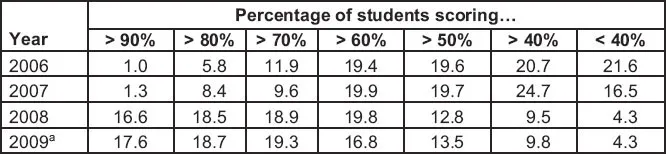
The PEF administers the QAT in March and October of every year in all the FAS partner schools. Two classes are tested in each elementary school and three classes in each middle and high school. The figures for each year in Table 4 are aggregates of the two QATs given in 2006, 2007, and 2008, as well as the one test given in March 2009.
Table 4: Results of the Quality Assurance Tests, 2006–2009
a Figures for 2009 do not include October tests.
Source: Academic Development Unit, Punjab Education Foundation, 2009.
As Table 4 shows, there have been
| (i) | a continuous improvement in the percentage of students scoring more than 90% in the QATs—from about 1% in 2006 to over 17% in 2009, and |
| (ii) | a continuous decrease in the percentage of students scoring under 40%—from over 21% in 2006 to just over 4% in 2009. |
Overall, the mean QAT score at FAS partner schools rose from 63% to 79% over the 4-year period. In general, girls outperformed boys on QATs. An analysis of QAT scores has shown that the 200 schools with mean scores in the 80%–90% range all have qualified math and science teachers. In fact, the high-performing schools have very high concentration (more than 95%) of university-trained teachers. In contrast, the schools with mean scores below the 40% threshold also shared a common trait: none of their teachers had any pre-employment training.
The FAS program also underwent a third-party evaluation (TPE) conducted by Innovative Development Strategies (IDS), an international firm based in Islamabad (Section 3.6). IDS tested 5,790 students from the seven selected districts, which comprised 2,617 G...
Table of contents
- Front Cover
- Title Page
- Copyright Page
- Contents
- About the Author
- Foreword
- Acknowledgment
- Executive Summary
- Introduction
- Punjab Education Foundation
- Foundation-Assisted Schools
- Continuous Professional Development
- Teaching in Clusters
- Education Voucher Scheme
- Public–Private Partnerships in Education: Lessons Learned
- Back Cover
Trusted by 375,005 students
Access to over 1.5 million titles for a fair monthly price.
Study more efficiently using our study tools.
Frequently asked questions
Yes, you can cancel anytime from the Subscription tab in your account settings on the Perlego website. Your subscription will stay active until the end of your current billing period. Learn how to cancel your subscription
No, books cannot be downloaded as external files, such as PDFs, for use outside of Perlego. However, you can download books within the Perlego app for offline reading on mobile or tablet. Learn how to download books offline
Perlego offers two plans: Essential and Complete
- Essential is ideal for learners and professionals who enjoy exploring a wide range of subjects. Access the Essential Library with 800,000+ trusted titles and best-sellers across business, personal growth, and the humanities. Includes unlimited reading time and Standard Read Aloud voice.
- Complete: Perfect for advanced learners and researchers needing full, unrestricted access. Unlock 1.5M+ books across hundreds of subjects, including academic and specialized titles. The Complete Plan also includes advanced features like Premium Read Aloud and Research Assistant.
We are an online textbook subscription service, where you can get access to an entire online library for less than the price of a single book per month. With over 1.5 million books across 990+ topics, we’ve got you covered! Learn about our mission
Look out for the read-aloud symbol on your next book to see if you can listen to it. The read-aloud tool reads text aloud for you, highlighting the text as it is being read. You can pause it, speed it up and slow it down. Learn more about Read Aloud
Yes! You can use the Perlego app on both iOS and Android devices to read anytime, anywhere — even offline. Perfect for commutes or when you’re on the go.
Please note we cannot support devices running on iOS 13 and Android 7 or earlier. Learn more about using the app
Please note we cannot support devices running on iOS 13 and Android 7 or earlier. Learn more about using the app
Yes, you can access Public-Private Partnerships in Education by Allah Bakhsh Malik in PDF and/or ePUB format, as well as other popular books in Education & Educational Policy. We have over 1.5 million books available in our catalogue for you to explore.