Electronic procurement has become one of the main e-government initiatives for many countries as they look to improve procurement through a more open, competitive, and transparent environment. E-procurement continues to prove itself as a viable alternative to manual processes, bringing cost savings and efficiencies. The Asian Development Bank has been a promoter of electronic government procurement (e-GP) as a key component for procurement reforms through active involvement in the Multilateral Development Bank Working Group on e-GP. This handbook aims to inform readers about e-GP, provide a reference for related concepts, and examine how e-GP implementations have taken shape in different jurisdictions worldwide.
- 135 pages
- English
- ePUB (mobile friendly)
- Available on iOS & Android
eBook - ePub
About this book
Information
1 | The Case for e-Government Procurement |
1.1 Definition of e-Government Procurement
What is e-government procurement (e-GP)? In its broadest sense, the term e-GP refers to the use of electronic systems to handle any or all steps of public procurement process, but several formal definitions also exist.
According to the World Bank (2003b), e-GP is defined as: “the use of information technology (especially the internet) by governments in conducting their procurement relationships with suppliers for the procurement of works, goods, and consultancy services required by the public sector.” The World Bank further defines e-GP under the headings e-tendering and e-purchasing. An e-tendering solution is used for procurement of specialized works, goods and services, characterized by high-value and low-volume transactions. Procurement of standard goods and services is addressed using an e-purchasing solution, characterized by low-value and high-volume transactions.
The European Union (EU) offers a similar definition, specifically distinguishing procurement by “government institutions and other public sector organizations” (European Commission 2004a). Other e-GP definitions have a greater focus on process and refer to the introduction of information and communications technology (ICT) and transaction processing throughout the procurement chain, including the following phases of procurement: “publication of tender notices, provision of tender documents, submission of tenders, evaluation, award, ordering, invoicing and payment” (European Commission 2010a). The handling of all procurement processes—fully electronic and integrated—is referred to as end–to-end e-procurement or straight-through e-procurement. Implementation of straight-through e-procurement is difficult to achieve (Vaidya et al. 2006) and is often referred to as the “ultimate prize” (European Commission 2010a) that various jurisdictions strive to achieve.
Box 1 Definition of e-Government Procurement
The term e-government procurement (e-GP) broadly refers to the use of electronic systems to handle any or all steps of the public procurement process. Many governments across all regions of the world have embarked on implementation of e-GP and worldwide adoption is increasing. Government procurement accounts for a significant percentage of the economy, meaning dollar value savings from implementation of e-GP can be considerably high. Common misconceptions about e-GP are also dispelled, such as e-GP does not necessarily lead to job losses, nor does it take away discretionary powers assigned to officials. Key challenges related to e-GP implementation are identified and explained. It should be noted, however, that the full potential of e-GP will only be realized when implementation is accompanied by procurement reforms.
The Republic of Korea, Singapore, and a handful of other countries have had success in implementing straight-through e-procurement. Elsewhere, only one or more stages of public procurement are handled using electronic systems, such as
(i) | publication of tender documents through a web portal (e-publication), |
(ii) | electronic submission of bid documents by suppliers (e-tendering), and |
(iii) | vendor selection and transaction processing based on electronic catalogs (e-catalogs). |
Government agencies tend to use ICT to handle one or more procurement steps initially, and then roll out the application of ICT to include additional steps in a phased manner over time. With time, the functional coverage of e-GP tends to expand toward end-to-end coverage.
An end-to-end e-GP system typically has an enterprise web portal that primarily addresses the requirements of the supplier community. This portal is tightly integrated with an enterprise application system, designed to handle procurement-related workflows within the government (Vaidya et al. 2006). A fully implemented e-GP system has both government-to-business (G2B) and government-to-government (G2G) system components knitted together.
1.2 e-Government Procurement Systems Plotted on Timescale
Plotting e-GP systems on a timescale provides a high-level view as to where, when, and in what sequence e-GP is being implemented across the world (Figure 1). The information required for the plotting was obtained from secondary sources, including KONEPS (2011), the World Bank (2009), Chia (2009), the Auditor General of Victoria (2003), Sebelebele (2002), Brian (2011), the OECD (2009), UNDP (2005), a survey of international e-GP systems funded by the MDBs (MDBs 2007), and an e-GP survey recently conducted by ADB (2011). The systems plotted on the timescale are by no means exhaustive; instead, they provide a glimpse into the uptake of e-GP systems across multiple world regions.
Figure 1 e-Government Procurement Systems Plotted on a Timescale
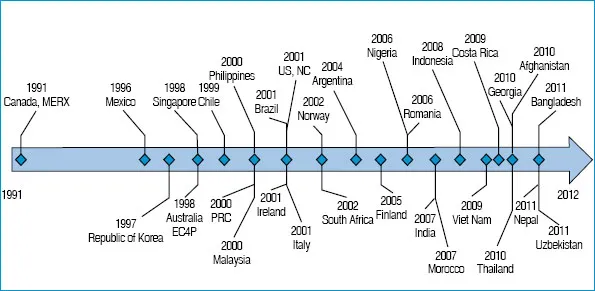
EC4P = E-Commerce for Procurement, NC = North Carolina, PRC = People’s Republic of China, US = United States.
This plotting of e-GP systems does not make reference to their uptake and usage, such as functionality covered and number of procurement entities using the system. Instead, it makes a basic reference to e-GP adoption and attempts to highlight the initiatives taken by countries that have embarked on e-GP implementation. When there is more than one e-GP system in a country, the earliest and the most prominent is plotted on the timescale.
As the internet became more prevalent, the application of ICT in public procurement increased. Canada’s MERX system—considered a pioneering initiative—went live in 1991 (World Bank 2009).5 Mexico embarked on implementation of its Compranet e-GP system in 1996 and a few years later, the Republic of Korea and Singapore joined the e-GP bandwagon with their KONEPS and GEBIZ systems respectively. Chile embarked on implementation of e-GP in 1999 (Orrego et al. 2000). In Australia, the State of Victoria launched the e-Commerce for Procurement (EC4P) initiative in 1998 and has since added the following systems:
(i) | Government Electronic Marketplace, established by the Western Australian Government; |
(ii) | Austender, a web-based e-tendering system of the Government of Australia; and |
(iii) | Smartbuy, implemented by New South Wales. |
Between 2000 and 2005, a number of additional countries across five continents launched e-GP systems:
(i) | Africa: South Africa in 2002; |
(ii) | Asia: the People’s Republic of China (PRC), Indonesia, and the Philippines, all in 2000; |
(iii) | Europe: Ireland and Italy in 2001, Norway in 2002, and Finland in 2005; |
(iv) | North America: United States (US) (the state of North Carolina) in 2001; and |
(v) | South America: Brazil in 2001 and Argentina in 2004. |
A similar trend continued from 2005 onward, with many more countries initiating e-GP implementation, including India.
The adoption of e-GP is now widespread; meanwhile, existing systems are getting increasingly sophisticated. According to a recent survey conducted by ADB (2011), 16 out of 27 countries surveyed (approximately 60%) either had a comprehensive plan and road map for implementation of e-GP already in place or were in the initial stages of preparing an e-GP development plan and road map.
1.3 Importance of Public Procurement and Government Procurement
Public procurement expenditure as a percentage of gross domestic product (GDP) is estimated to be in the range of 10% to 25%. In the EU, for instance, the size of the public procurement market varies significantly, from 11.9% of GDP in Italy to 21.5% of GDP in the Netherlands (European Commission 2004b). Public procurement as a percentage of GDP is estimated at 16% and 20% for Morocco and India respectively (OECD 2009; World Bank 2003c). The dollar value of public procurement is significantly high and estimated as $2,083 billion in 1998 (Audet 2002).6
Savings achieved from better utilization of funds allocated for public procurement can have a significant impact on the economy as a whole. A study by the EU shows that a 10% savings in public procurement would turn the budget deficits of three member countries into surplus values and that no eurozone member would run a budget deficit in excess of 3% (European Commission 2004b). Enhancing efficiency in government procurement is also regarded as a viable mechanism to address deficit concerns in the US (Obama 2008).
The money spent on public procurement belongs to taxpayers and it is therefore the responsibility of government to minimize economic losses while obtaining the best value for money (VFM). To do so, government needs to encourage competition among supplier communities. Public procurement transactions are typically governed by well-defined procedures and adherence to these preset procedures by procurement entities is transaction intensive. Optimization of government procurement procedures can reduce transaction costs significantly, particularly when one considers that the cost of transaction amounts to a substantial share of GDP in a modern economy (MDBs 2004d).
That said, public procurement is much more than a mere transaction-focused activity. The policies, procedures, and practices of government also have tremendous impact on the economy and the business community. Government uses public procurement as a policy tool for economic development; for example, to catalyze the economy, promote the development of small and medium-sized enterprises (SMEs), and develop expertise among economic operators in an area of specialization. The public’s perception of a government’s performance is influenced by the extent to which procurement transactions are conducted in a transparent and efficient manner (World Bank 2003c).
The Organisation for Economic Co-operation and Development (OECD 2007) terms public procurement as “the government activity most vulnerable to waste, fraud and corruption due to its complexity, the size of the financial flows it generates and the close interaction between the public and the private sectors.”
It is widely recognized that the introduction of ICT has the potential to significantly improve transparency, efficiency, and effectiveness in public procurement.
1.4 e-Government Procurement Objectives
Defining the objectives and their corresponding perfor...
Table of contents
- Front Cover
- Title Page
- Copyright Page
- Contents
- List of Tables, Figures, and Boxes
- Preface
- Acknowledgments
- Abbreviations
- Introduction
- 1 The Case for e-Government Procurement
- 2 Policy, Legal, and Regulatory Framework
- 3 Strategic Considerations for Government Implementers
- 4 Change Management and Capacity Development
- 5 Readiness Assessment
- 6 Implementation in Government
- 7 e-Government Procurement Functionalities
- 8 e-Government Procurement Technical Requirements and Specifications
- 9 e-Government Procurement from a Supplier Point of View
- 10 References
- Back Cover
Trusted by 375,005 students
Access to over 1.5 million titles for a fair monthly price.
Study more efficiently using our study tools.
Frequently asked questions
Yes, you can cancel anytime from the Subscription tab in your account settings on the Perlego website. Your subscription will stay active until the end of your current billing period. Learn how to cancel your subscription
No, books cannot be downloaded as external files, such as PDFs, for use outside of Perlego. However, you can download books within the Perlego app for offline reading on mobile or tablet. Learn how to download books offline
Perlego offers two plans: Essential and Complete
- Essential is ideal for learners and professionals who enjoy exploring a wide range of subjects. Access the Essential Library with 800,000+ trusted titles and best-sellers across business, personal growth, and the humanities. Includes unlimited reading time and Standard Read Aloud voice.
- Complete: Perfect for advanced learners and researchers needing full, unrestricted access. Unlock 1.5M+ books across hundreds of subjects, including academic and specialized titles. The Complete Plan also includes advanced features like Premium Read Aloud and Research Assistant.
We are an online textbook subscription service, where you can get access to an entire online library for less than the price of a single book per month. With over 1.5 million books across 990+ topics, we’ve got you covered! Learn about our mission
Look out for the read-aloud symbol on your next book to see if you can listen to it. The read-aloud tool reads text aloud for you, highlighting the text as it is being read. You can pause it, speed it up and slow it down. Learn more about Read Aloud
Yes! You can use the Perlego app on both iOS and Android devices to read anytime, anywhere — even offline. Perfect for commutes or when you’re on the go.
Please note we cannot support devices running on iOS 13 and Android 7 or earlier. Learn more about using the app
Please note we cannot support devices running on iOS 13 and Android 7 or earlier. Learn more about using the app
Yes, you can access e-Government Procurement Handbook by in PDF and/or ePUB format, as well as other popular books in Economics & Development Economics. We have over 1.5 million books available in our catalogue for you to explore.