This paper was originally produced for the "International Conference on Payments for Environmental Services," held in Ningxia Hui Autonomous Region in China on 6-7 September 2009, and jointly hosted by the People's Republic of China's National Development and Reform Commission, the Ministry of Environmental Protection, the government of Ningxia Hui Autonomous Region, and the Asian Development Bank (ADB). It is part of the full volume of conference proceedings published by ADB in December 2010, entitled "Payments for Ecological Services and Eco-Compensation: Practices and Innovations in the People's Republic of China".
eBook - ePub
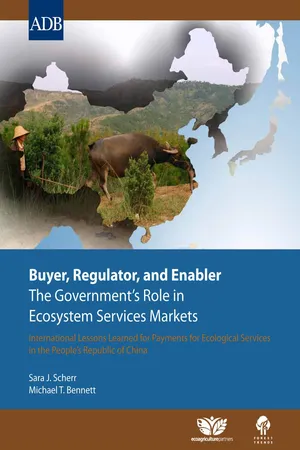
Buyer, Regulator, and Enabler: The Government's Role in Ecosystem Services Markets
International Lessons Learned for Payments for Ecological Services in the People's Republic of China
- 23 pages
- English
- ePUB (mobile friendly)
- Available on iOS & Android
eBook - ePub
Buyer, Regulator, and Enabler: The Government's Role in Ecosystem Services Markets
International Lessons Learned for Payments for Ecological Services in the People's Republic of China
About this book
Information
1 | Introduction |
The People’s Republic of China (PRC) is at an exciting stage in the development of its national environmental policy framework. The fast-paced economic growth of the past 3 decades, while having lifted hundreds of millions of rural denizens out of poverty, has unfortunately also greatly multiplied the environmental challenges faced by policy makers at all levels of government, increasing pressures on fragile ecosystems, creating a range of new pollution and environmental safety issues, and further straining the country’s already limited per capita natural resource base. At the same time, economic growth has also created opportunities, since the PRC’s “economic miracle” is giving the government the financial wherewithal to improve its capacity to monitor and enforce existing environmental laws, and to fund new environmental initiatives and policies. At the nexus of these countervailing trends, policy makers have been experimenting with new approaches to environmental management, resulting in a wide range of policy and program innovations, many under the broad heading of “eco-compensation.” Many of these incorporate, or provide a framework for, market-based approaches to environmental policy, and in particular for payments for ecological services (PES) (Bennett 2009).
PES is gaining traction internationally as a valuable new approach to conservation that uses direct payments, either in cash or other forms of compensation, from ecosystem services beneficiaries (e.g., private businesses, communities and society as a whole) to land stewards (i.e., those who can influence the provision of ecosystem services) to encourage ecosystem conservation and restoration (Wunder 2005). In general, four types of ‘market’ or ‘market-like’ instruments exist for ecosystem services provision:
• Private payments for private benefits (that may or may not have public benefits);
• Public payments (on behalf of the public interest) for public benefits;
• Private payments motivated by cap-and-trade or floor-and-trade regulatory systems; and
• Eco-certification where ecosystem services provision is included as a characteristic of a standard market good (e.g., “green” and organic agricultural products in the PRC).
In the backdrop of PES is the broader vision of creating the institutional foundations necessary to engender ecosystem service markets. According to economic theory, under the right conditions (e.g., appropriate institutional and legal frameworks, and sufficiently low transactions costs) markets can function more effectively than government “command-and-control” regimes to identify and align the social costs and benefits of ecosystem services provision. International interest in PES has been growing in recent years due to a number of factors, including the increasing value of ecosystem services due to their growing economic demand, the need to tap into new sources of finance for conservation, growing corporate interest in making environmentally responsible investments, and supportive changes in the governance of natural resources (Scherr et al. 2006). As a result, these direct payment schemes have been flourishing, expanding beyond government-funded initiatives to real market transactions between beneficiaries and providers of services. In 2007, it is estimated that annual payments under all payment schemes and markets for ecosystem services totaled around $77 billion worldwide, and these total payments are expected to increase to approximately $300 billion by 2020 (Carroll and Jenkins 2008). Currently, the biodiversity and certified agriculture (i.e., eco-labeling) markets are the most active in terms of volumes of monetary transactions.1 In the foreseeable future, markets for carbon and certified agricultural products are expected to account for a significant proportion of the growth in payments and markets for ecosystem services.
In comparison to PES, the Chinese term “eco-compensation” is broader, encompassing PES-like policies as well as a range of other policies and programs types, both with and without market-based elements (Bennett 2009). The PRC’s national government has been playing a central role in promoting ecosystem service market development through its various eco-compensation programs and policies; it has made extraordinary efforts in driving some of the largest public payment schemes for ecosystem services in the world, having spent over CNY130 billion on the Conversion of Cropland to Forest and Grassland (CCFG) program to date, under which over 9 million hectares (ha) of cropland has been afforested, and more than CNY13 billion since 2001 on the Forest Ecosystem Compensation Fund (FECF), which currently covers 105.2 million ha of forest area across 30 provinces in the PRC (State Forestry Administration [SFA] 2007; Economic Daily 2007; SFA 2008a).2 On-going interest in improving the effectiveness, efficiency, and financial sustainability of these efforts has meant that policy circles have been abuzz with debate on how to improve these programs as well as how to explore and develop other market-based tools and regulatory innovations to better address the country’s environmental and development challenges.
At this critical stage, the PRC has the opportunity to both benefit from and provide innovative examples for international developments in PES. In particular, the PRC’s experience highlights an important point often implicitly overlooked in the international discourse on ecosystem service markets and PES: the central role of the public sector. Current international literature on PES tends to emphasize its private-sector and voluntary aspects, since one of the exciting promises of PES is to broaden and deepen sources of conservation finance by directly engaging a wider array of economic actors as buyers of ecosystem services. In contrast, much discussed amongst policy circles in the PRC is the concept of “combining market mechanisms with government guidance,” indicating a predominantly public-sector driven approach.3 At first glance, the PRC’s situation thus appears to be unique. It is not. The public sector is still very much the dominant player in ecosystem service markets worldwide. Excluding eco-certified products markets, the public sector contributes roughly 70% of annual ecosystem services payments internationally by value (Milder et al. 2009).4
To provide insights for the PRC’s policy makers in the development of a national eco-compensation policy framework, this paper discusses the public sector’s role in PES internationally. In general, the public sector’s role in these markets is both critical, and evolv...
Table of contents
- Front Cover
- Title Page
- Copyright Page
- Contents
- 1 Introduction
- 2 Government as Buyer
- 3 Regulation-driven markets
- 4 Government as Enabler of Ecosystem Services Markets
- 5 Looking to the Future: The Evolving Role of Government
- Reference
- Back Cover
Trusted by 375,005 students
Access to over 1.5 million titles for a fair monthly price.
Study more efficiently using our study tools.
Frequently asked questions
Yes, you can cancel anytime from the Subscription tab in your account settings on the Perlego website. Your subscription will stay active until the end of your current billing period. Learn how to cancel your subscription
No, books cannot be downloaded as external files, such as PDFs, for use outside of Perlego. However, you can download books within the Perlego app for offline reading on mobile or tablet. Learn how to download books offline
Perlego offers two plans: Essential and Complete
- Essential is ideal for learners and professionals who enjoy exploring a wide range of subjects. Access the Essential Library with 800,000+ trusted titles and best-sellers across business, personal growth, and the humanities. Includes unlimited reading time and Standard Read Aloud voice.
- Complete: Perfect for advanced learners and researchers needing full, unrestricted access. Unlock 1.5M+ books across hundreds of subjects, including academic and specialized titles. The Complete Plan also includes advanced features like Premium Read Aloud and Research Assistant.
We are an online textbook subscription service, where you can get access to an entire online library for less than the price of a single book per month. With over 1.5 million books across 990+ topics, we’ve got you covered! Learn about our mission
Look out for the read-aloud symbol on your next book to see if you can listen to it. The read-aloud tool reads text aloud for you, highlighting the text as it is being read. You can pause it, speed it up and slow it down. Learn more about Read Aloud
Yes! You can use the Perlego app on both iOS and Android devices to read anytime, anywhere — even offline. Perfect for commutes or when you’re on the go.
Please note we cannot support devices running on iOS 13 and Android 7 or earlier. Learn more about using the app
Please note we cannot support devices running on iOS 13 and Android 7 or earlier. Learn more about using the app
Yes, you can access Buyer, Regulator, and Enabler: The Government's Role in Ecosystem Services Markets by Sara J. Scherr, Michael T. Bennett in PDF and/or ePUB format, as well as other popular books in Biological Sciences & Ecology. We have over 1.5 million books available in our catalogue for you to explore.