Experiences of the Asian Development Bank (ADB) in the water supply sector show the consequences of inadequate asset management, such as lack of customer coverage and high nonrevenue water ratios. One response is lending to allow for new infrastructure. Some immediate benefits may be evident, but sustainability is at risk unless better asset management is part of the solution. This guide provides ADB's perspective on asset management, as well as an overview of the concept, processes, and systems of asset management, followed by a presentation of case studies about what utilities have done to manage their assets, including the results achieved.
- 45 pages
- English
- ePUB (mobile friendly)
- Available on iOS & Android
eBook - ePub
About this book
Information
CHAPTER I
A Brief Overview of Asset Management
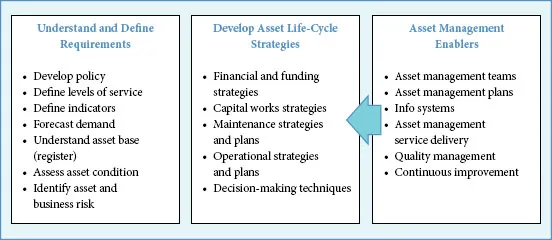
This guide uses the International Infrastructure Management Manual structure to explain the essentials of asset management (Figure 1).
Figure 1: Asset Management Explanation Structure
Source: The New Zealand Asset Management Support Group. 2011. International Infrastructure Management Manual.
New Zealand. (www.nams.org.nz/pages/273/international-infrastructure-management-manual-2011-edition.htm
New Zealand. (www.nams.org.nz/pages/273/international-infrastructure-management-manual-2011-edition.htm
A. Understand and Define Requirements
As a basis for effective asset management, utility managers need to (i) put in place an asset management policy, (ii) develop implementation and monitoring plans to achieve the targeted service levels and demand forecast, and (iii) obtain a good understanding of the condition of all their assets and identify the potential risks and consequences if they fail. This section presents an outline of these requirements.
1. Asset Policy
Utilities need to raise their organizations’ awareness so everyone understands that asset management is important in achieving their service, financial, and sustainability goals. It should be high priority and considered by all while they go about everyday tasks. Crafting an asset management policy, later supported by plans and strategies, can raise this awareness (Box 1).
Box 1: Asset Policy Example
The organization will at all times practice the highest level of asset management including
- asset planning based on demand forecasts and targeted service levels;
- maintenance of reliable integrated asset records that facilitate good governance;
- maintenance, renewal, and replacement of assets based on life-cycle costing, condition monitoring, and risk assessment; and
- clear accountability for asset acquisition, security, operation, inspection, maintenance, and disposal.
Source: Asian Development Bank.
2. Service Levels
Establishing targets and monitoring achievements at various service levels: (i) informs the public, politicians, and the regulator of the utility’s targeted and actual performance; (ii) enables managers decide on asset acquisition and management; (iii) allows the utility to compare its performance with that of others; and (iv) educates the staff on the links between top service-level indicators, strengthened asset performance indicators, and their own jobs.
For water the customer service level may be described in terms of availability (24/7) which may be judged by the number of interruptions or cumulative period of interruptions, quality (appearance and smell), pressure, number of supply interruptions and response times to supply interruptions.
Wastewater service levels are determined through (i) health and environmental conditions (such as final effluent discharges compliance with certain levels—Biochemical Oxygen Demand, suspended solids, and nitrogen); and (ii) system performance levels, such as the annual number of sewer overflows in the case of combined systems.
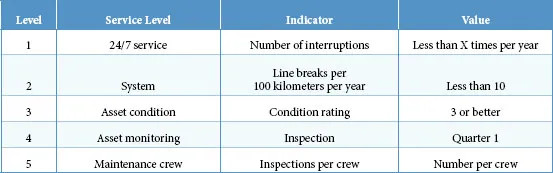
Customer service-level targets are set through consultation. The targets are reviewed occasionally or imposed through regulation. Cascading service levels throughout the organization requires indicators based on the SMART (specific, measurable, achievable, relevant, and time bound) criteria. This ensures that results are linked through all levels of the organization. The number of indicators increases as the organization level goes up (Table 1).
Table 1: Cascading of Service-Level Targets
Source: Asian Development Bank.
3. Demand Forecast
Predicting demand is of key importance for asset management. It enables managers to plan what assets may be needed for system expansion or upgrades to sustain agreed levels of service.
Utility managers should have one or more demand forecasts based on different assumptions or scenarios. The challenge is to obtain reliable information on time and in sufficient detail for planning. Information to consider includes government records of building approvals, land releases that flag population growth, or repurposed buildings within an area that can lead to more demand for water and/or sewerage services.
Without accurate forecasts, new assets to replace current assets under stress will not be acquired and commissioned on time or insufficient revenues will be generated to recoup the cost of the assets acquired.
4. Understanding Asset Base
Asset management is impossible without the support of good asset records (usually known as an asset register or asset database). This requires (i) investing in robust processes for consistently collating and recording information; (ii) gathering past data; (iii) establishing an asset classification method; and (iv) investing in a computer system that contains a number of key modules to allow, for example, planning and acquisition of assets, maintenance of records, and scheduling of asset replacement (Figure 2).
Figure 2: Illustration of Asset Management System Modules
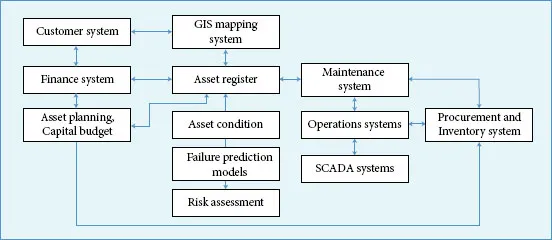
GIS = geographic information system, SCADA = supervisory control and data acquisition.
Source: Asian Development Bank.
Asset record systems include card indexes, spreadsheets, customized software from major vendors, or computer applications developed in-house. Customized vendor systems may be the most cost-and time-efficient option. Vendors have invested considerable funds to develop their asset systems, which are integrated with other systems such as financial, customer services, maintenance, and GIS. Furthermore, vendor systems feature data security methods to maintain data quality. They also provide a range of standard reports to help managers monitor assets and make decisions. System processes include acquisition, operation, inspection, maintenance, renewal, and disposal. Asset systems in the more advanced utilities allow for inquiry and updating from portable computers or handheld devices. An extract from an IBM system is in Appendix 1.
Many utilities may not know what assets they have or where they are located. Utilities can remedy this by introducing a program to progressively develop the quality and coverage of their asset records. Typical information needed to do this includes the date of asset acquisition, description, maintenance history, original cost, current valuation, type, expected life, inspection frequency, risk rating, location (possibly tied to GIS), performance information, and unique identifier.
Asset records should be structured so they can be managed effectively. In Figure 3, the assets are classified in the following order: major function or process, sub-function, type, and component.
Figure 3: Asset Hierarchy for Classifying Assets
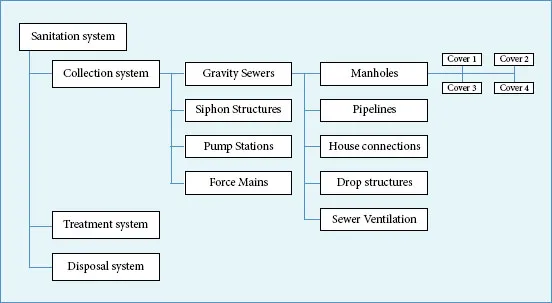
Source: Adapted by consultant from GHD on Asset Management.
Classification may also be done by asset type (pipes, pumps, etc.) or by area. Classification facilitates data collection, reporting, and comparative analyses. The structure of the classification and the level of detail should be agreed on by utility management. A utility’s needs—whether for energy consumption management or asset maintenance, for example—will dictate the type of information that should be captured. This, in turn, will influence the structure and level of detail that utility management will agree on for classification.
5. Asset Condition
Asset condition ranges from brand new, to worn out and failing (Figure 4). Timely maintenance can improve the condition of assets and prolong their useful life. If the condition is known or reasonably predictable, then maintenance, renewal, or replacement can be timed to minimize service delivery interruption and costs.
Figure 4: Illustration of Asset Condition
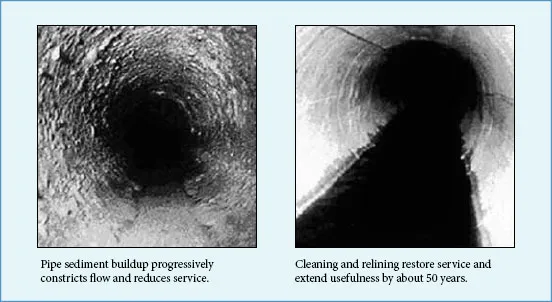
Source: GHD Course on Asset Management.
Condition monitoring allows utilities to predict when an asset needs repair and replacement. It can also gauge how much longer the asset can be used. One way to approach this is to establish condition classes (Table 2).
Table 2: Simple Condition Ranking
| Condition Class | Action Required |
|---|---|
| 1 | Repair immediately |
| 2 | Repair within 1 year |
| 3 | Repair within 3 years |
| 4 | Repair within 7 years |
| 5 | Repair when convenient |
| 6 | No damage, repair unnecessary |
Source: Adapted by consultant from GHD Course on Asset Management.
The defining and setting of class rules is specific to each utility. The final set of conditions and action rules is best decided by the utility’s engineers based on information from s...
Table of contents
- Front Cover
- Title Page
- Copyright Page
- Contents
- Tables, Figures, and Boxes
- Abbreviations
- Background
- Introduction to Asset Management
- Chapter I A Brief Overview of Asset Management
- Chapter II Asset Management Case Histories
- Chapter III ADB Perspectives
- Appendix 1 Computer-Based Asset Management Systems
- Appendix 2 Asset Management Self-Diagnostic Guide
- Appendix 3 Benchmarking
- Back Cover
Trusted by 375,005 students
Access to over 1.5 million titles for a fair monthly price.
Study more efficiently using our study tools.
Frequently asked questions
Yes, you can cancel anytime from the Subscription tab in your account settings on the Perlego website. Your subscription will stay active until the end of your current billing period. Learn how to cancel your subscription
No, books cannot be downloaded as external files, such as PDFs, for use outside of Perlego. However, you can download books within the Perlego app for offline reading on mobile or tablet. Learn how to download books offline
Perlego offers two plans: Essential and Complete
- Essential is ideal for learners and professionals who enjoy exploring a wide range of subjects. Access the Essential Library with 800,000+ trusted titles and best-sellers across business, personal growth, and the humanities. Includes unlimited reading time and Standard Read Aloud voice.
- Complete: Perfect for advanced learners and researchers needing full, unrestricted access. Unlock 1.5M+ books across hundreds of subjects, including academic and specialized titles. The Complete Plan also includes advanced features like Premium Read Aloud and Research Assistant.
We are an online textbook subscription service, where you can get access to an entire online library for less than the price of a single book per month. With over 1.5 million books across 990+ topics, we’ve got you covered! Learn about our mission
Look out for the read-aloud symbol on your next book to see if you can listen to it. The read-aloud tool reads text aloud for you, highlighting the text as it is being read. You can pause it, speed it up and slow it down. Learn more about Read Aloud
Yes! You can use the Perlego app on both iOS and Android devices to read anytime, anywhere — even offline. Perfect for commutes or when you’re on the go.
Please note we cannot support devices running on iOS 13 and Android 7 or earlier. Learn more about using the app
Please note we cannot support devices running on iOS 13 and Android 7 or earlier. Learn more about using the app
Yes, you can access Water Utility Asset Management by in PDF and/or ePUB format, as well as other popular books in Politics & International Relations & Public Affairs & Administration. We have over 1.5 million books available in our catalogue for you to explore.