The term "Green City" has many different meanings to different people. There is no universal solution that can be applied to every city. Adaptable, responsive, and innovative solutions that differ from one place to another enable Green Cities to emerge in various forms and enable us to recognize the variation and dynamism of cities. Green Development considers how to improve and manage the overall quality and health of water, air, and land in urban spaces; its correlation with hinterlands and wider systems; and the resultant benefits derived by both the environment and residents. This tool kit is a reference for Asian Development Bank staff, consultants, and city leaders that introduces key concepts of Green City development and identifies crosscutting issues that help in designing urban programs to support city development in a green and sustainable manner. It outlines a three-step city assessment framework and provides a summary of existing tools and resources for green and sustainable development.
- 134 pages
- English
- ePUB (mobile friendly)
- Available on iOS & Android
eBook - ePub
About this book
Information
Topic
EconomíaSubtopic
Desarrollo sostenible1. Introduction
1.1 What is the Green City Development Tool Kit?
This is a reference guide (herein called the tool kit) for Asian Development Bank (ADB) staff and consultants as well as city leaders. This tool kit introduces the key concepts of Green City development and includes a summary of each sector, highlighting crosscutting themes and benefits of actions. Following the introduction of key concepts and issues, the tool kit sets out a framework for undertaking assessments of urban areas and determining green and sustainable development responses. It also provides an inventory of current and existing resources that complement and support the design and preparation of green and sustainable development actions.
1.2 Why is the Tool Kit Needed?
Asia is urbanizing rapidly. It is predicted that from 2015, population growth in Asia will predominantly occur in urban centers.2 Pressure on resources and increased demand on local and global environments, coupled with the need and expectation to improve the overall quality of life of residents, means that the decisions taken by governments (across all levels) and its populace have never been more important. The concept of “Green City” or “Green Development” is not new. Previously couched within the term “sustainable development,” it seeks to integrate environmental, social, and economic considerations within development processes. A Green City or Green Development is an extension of this concept but is understood within the frame of a city’s actions and how these actions contribute to a city or urban area advancing as green and sustainable. Green Development considers how to improve and manage the overall quality and health of water, air, and land in urban spaces; its correlation with hinterlands and wider systems; and the resultant benefits derived by both the environment and residents.
In Asia, Green Cities or Green Development is essential. Most urban cities in Asia are struggling to meet their infrastructure needs; maintain or provide adequate service delivery; and upgrade city systems to keep pace with the rate of change, urbanization, and population gain. In addition, limitations in human and financial capital, technical expertise, and low community awareness all contribute to the challenge for city leaders and government to implement urban upgrading and development initiatives. Compounding these challenges, scarce natural resources and depleted or degraded natural environments within and around urban areas often means that the required improvement and investments are starting at a low baseline, increasing the potential up-front costs and often requiring significant justification to gain the necessary support to proceed. Similarly, increased vulnerability—as a result of climate change and exposure to disaster events—shapes the development needs of urban areas and places pressure on scarce resources. Further, inappropriate land use location, poor governance, and weak legislation and enforcement capacity exacerbate urban and city centers’ inability to “go green.”
ADB’s Urban Operational Plan 2012–2020 encapsulates the sustainable development concept within three initiatives, known as the 3E approach. The 3E approach frames city development within the context of economy (the competitive city), equity (the inclusive city), and environment (the Green City). Each initiative sets out the key components for achieving such a city and supports the other, providing the basis for sustainable urban development.
The Green City and promotion of green development recognize that cities are dynamic, have limited resources, need resilient infrastructure (hard and soft), and are able to deliver the quality of life benefits expected by its residents. Cities can also provide greater opportunity for the private sector to engage and deliver green development outcomes. This tool kit is therefore situated within this context and has been prepared as a means of sign posting ADB staff and consultants, and partners; decision makers; and civil society groups to a range of resources that can assist in developing, progressing, and enhancing the green city agenda. Importantly, the tool kit recognizes that the development of a city is iterative, that cities are dynamic, and that no two cities are the same. Accordingly, this variation and dynamism provides the potential for innovative responses to be developed and incremental change to occur.
The transition of cities through the development curve can correspond, but not always, with that of the transition to different stages of a “green city.” As resources and capacity permit, the investments taken in cities influence how quickly and effectively this transition takes place. However, this correlation is not always neat. The economic status of a city does not always translate into higher investment or achievement of green development.
Central to the success of green development and city development is increased knowledge and participation of residents and the community. Early engagement with the community to identify needs, to promote understanding and awareness of key issues, and to obtain inputs into design processes provides invaluable local context and knowledge, and supports the development of community-led responses. Community engagement supports knowledge transfer and education initiatives—an important element and basis for long-term sustainability.
Situating green development within the context of livability and improved urban environments enables a more practical understanding of the importance of green development initiatives and its relationship to individuals. Developing indicators that can assist city leaders and community track progress that relates to the livability of cities is a useful tool to improve knowledge and encourage accountability as well as celebrating success. Tracking progress and transition through the development and green city cycle is therefore important, and the tool kit also provides an introduction and/or framework for establishing indicators leading, ultimately, to the establishment of an index.
1.3 How is the Tool Kit Structured?
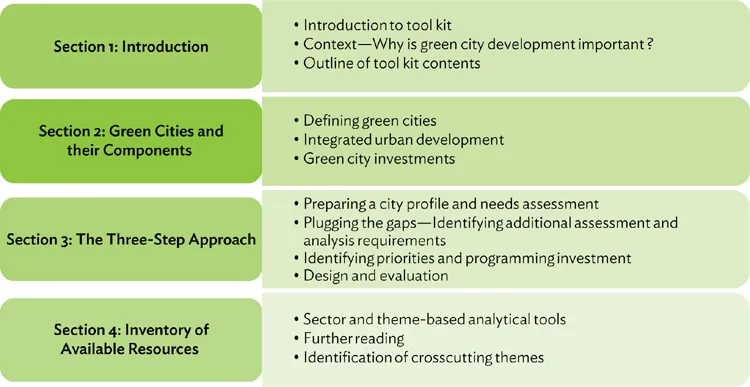
The guide is structured in four main sections (Figure 1.1).
Figure 1.1: Tool Kit Structure
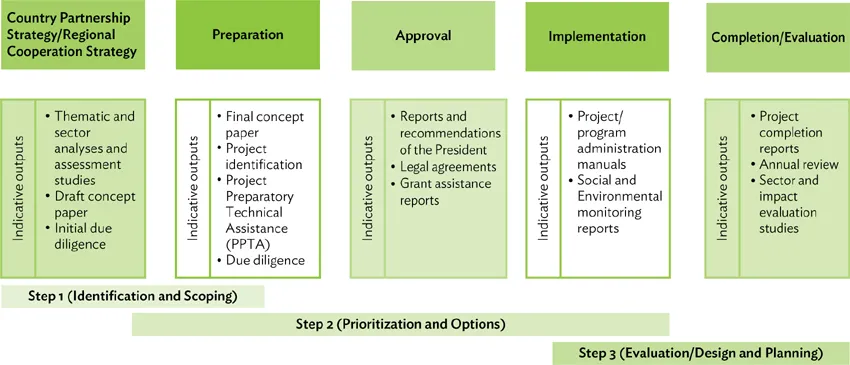
This tool kit complements the five stages of the ADB project cycle and can be applied in various forms at each stage. For ease of use, this tool kit has streamlined the project or program cycle into three steps:
Implementation has not been captured specifically as the emphasis of this tool kit is on introducing key concepts to enable the development and design of appropriate interventions vis-à-vis guidance on how to implement such projects. Thus, the tool kit introduces key concepts to users and explains interrelationships across urban sectors and themes while highlighting currently available resources that will help identify key issues, design appropriate green city interventions, and identify the tools available to evaluate progress.
Figure 1.2: Three-Step Approach

Source: Emma Lewis adapted from ADB guidance http://www.adb.org/projects/cycle
Figure 1.3: The ADB Project Cycle and the Tool Kit
Source: Emma Lewis adapted from ADB guidance http://www.adb.org/projects/cycle
2. Green Cities and Their Components
Green Cities minimize environmental impact and maximize opportunities to improve and support the natural environment. Green Cities are energy efficient and reduce reliance on nonrenewable energy sources; actively encourage waste reduction and management; include green and resilient infrastructure, low-carbon transport, and water cycle management; and deliver improved quality of life outcomes for residents.
Cities are dynamic, and complex. Asia is urbanizing rapidly, increasing pressure on resources and infrastructure, and simultaneously influencing the living conditions and quality of life conditions for inhabitants. How Asian cities respond to these challenges has local, regional, and international reach. Green City does not have a universal definition and therefore will mean many different things to different people. Along the same lines, there is no universal solution that can be applied to every city in any country. Adaptable, responsive, and innovative solutions that differ from one place to another enable Green Cities to emerge in various guises and recognize the variation and dynamism of cities.
Providing a definition of Green Cities needs to be situated within this dynamic context and provide a framework for how key themes can be implemented, adapted, and developed at the city level. The United Nations’ Agenda 21 initiative of the early 1990s began to mainstream sustainable development principles within planning and development processes. Since then, knowledge and practice have continued to develop. Green Cities can be considered the contemporary name for which areas develop in a manner that is socially responsible, and environmentally and economically sustainable, as captured by ADB in its 3E approach.
Although there is no uniform definition of “Green City,” several central themes help shape and define what a Green City is. Such themes include energy efficiency (including built form) and reducing reliance on nonrenewable energy sources, sustainable and low-carbon transportation systems, green and resilient infrastructure, waste reduction and management, increased green areas, water cycle management, and integrated planning. How a city develops as green varies across geography, sector, and pace at which it occurs. Decisions taken by city leaders on where, what, and how investment will be directed to support green development need to be considered when adopting a system-based approach. A system-based approach recognizes the interconnectedness of sectors and the importance of sequencing.3 It also recognizes that cities will evolve to different levels of “green” at different rates and that this development is not uniform.
Figure 2.1 provides a conceptual framework of how cities transition to various levels of “green,” commencing at basic and progressing to eco and then carbon positive.4 This framework provides a basis for cities to operate and track progress within. The framework is not rigid, and some cities may find their experience and development spread across multiple categories, that is, one sector may be eco, another basic, and another carbon...
Table of contents
- Front Cover
- Title Page
- Copyright Page
- Contents
- Tables, Figures, and Boxes
- Abbreviations
- Acknowledgments
- Preface
- 1. Introduction
- 2. Green Cities and Their Components
- 3. Green City Development: The Tool Kit
- 4. Inventory of Existing Resources
- References
- Back Cover
Trusted by 375,005 students
Access to over 1.5 million titles for a fair monthly price.
Study more efficiently using our study tools.
Frequently asked questions
Yes, you can cancel anytime from the Subscription tab in your account settings on the Perlego website. Your subscription will stay active until the end of your current billing period. Learn how to cancel your subscription
No, books cannot be downloaded as external files, such as PDFs, for use outside of Perlego. However, you can download books within the Perlego app for offline reading on mobile or tablet. Learn how to download books offline
Perlego offers two plans: Essential and Complete
- Essential is ideal for learners and professionals who enjoy exploring a wide range of subjects. Access the Essential Library with 800,000+ trusted titles and best-sellers across business, personal growth, and the humanities. Includes unlimited reading time and Standard Read Aloud voice.
- Complete: Perfect for advanced learners and researchers needing full, unrestricted access. Unlock 1.5M+ books across hundreds of subjects, including academic and specialized titles. The Complete Plan also includes advanced features like Premium Read Aloud and Research Assistant.
We are an online textbook subscription service, where you can get access to an entire online library for less than the price of a single book per month. With over 1.5 million books across 990+ topics, we’ve got you covered! Learn about our mission
Look out for the read-aloud symbol on your next book to see if you can listen to it. The read-aloud tool reads text aloud for you, highlighting the text as it is being read. You can pause it, speed it up and slow it down. Learn more about Read Aloud
Yes! You can use the Perlego app on both iOS and Android devices to read anytime, anywhere — even offline. Perfect for commutes or when you’re on the go.
Please note we cannot support devices running on iOS 13 and Android 7 or earlier. Learn more about using the app
Please note we cannot support devices running on iOS 13 and Android 7 or earlier. Learn more about using the app
Yes, you can access Green City Development Tool Kit by in PDF and/or ePUB format, as well as other popular books in Economía & Desarrollo sostenible. We have over 1.5 million books available in our catalogue for you to explore.